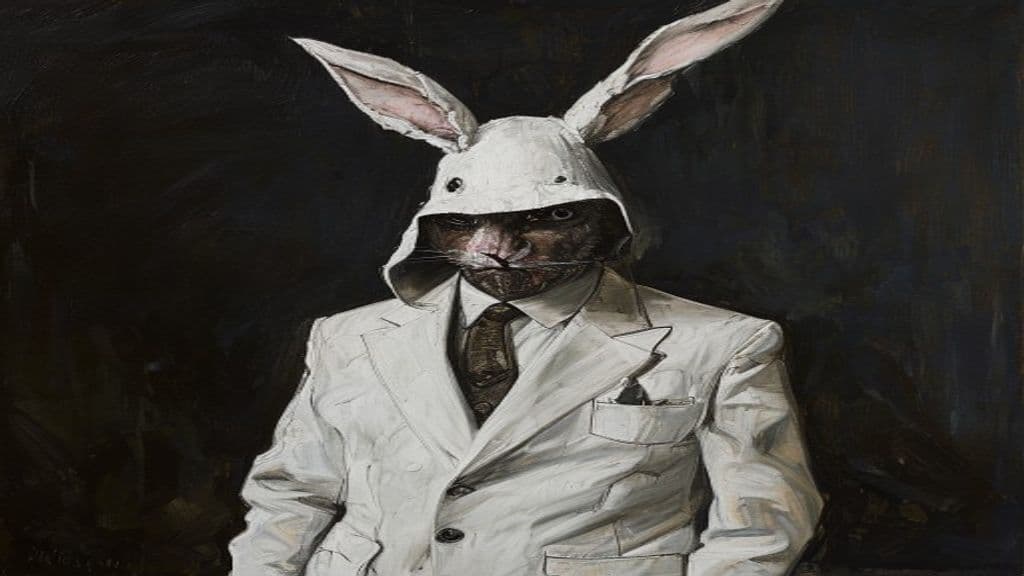
The Bunny Man legend originates in two contemporaneous 1970 incidents in Fairfax County, Virginia. On October 19, 1970, investigators recorded an incident in which a man allegedly threw a hatchet through a vehicle passenger window; on October 31, 1970, a separate report described a man chopping at a porch post with a long-handled axe while issuing threats to trespassers on Guinea Road in the Kings Park West area. Folklorists and local researchers (including Patricia Johnson and Brian A. Conley) have documented how those reports were retold, multiplied, and sensationalized—producing at least dozens of narrative variations that relocated or expanded details (notably to the Colchester Overpass, often called "Bunny Man Bridge") and added invented historic backstories in later internet postings.
Contemporaneous witness reports conflict but consistently note a human in unusual white/gray/black clothing evoking a rabbit. One October 19, 1970 account described "a man dressed in a white suit with long bunny ears," while other reports (October 31, 1970) described "a gray, black, and white bunny costume" and an approximate human stature and weight. A related eyewitness contested that the assailant wore a white capirote rather than bunny ears. Subsequent retellings introduce many contradictory details—variations in costume, omission of costume, or spectral/aged appearances—but the core imagery used in most versions is of a man associated with rabbit-like headgear or suit.
The documented behaviors from the 1970 incidents are secular criminal actions: throwing a hatchet through a car window, chopping at a porch post with an axe (leaving multiple gashes), issuing threats about trespassing, and fleeing when confronted. Later folkloric accretions convert these acts into more sensational crimes (murder, mutilation) or claim a supernatural recurrence (annual ghostly returns on Halloween); such elements are explicitly identified in sources as later embellishments rather than part of the original police reports.
The Hook (the Hookman)
An American urban-legend figure, the Hook (or Hookman) is narrated as a violent outsider—commonly an escaped convict or patient—distinguished by a hook in place of a hand who attacks couples parked at lovers' lanes. The legend functions as a mid-20th-century cautionary tale warning against risky teenage behavior rather than as a documented supernatural being.
Bulleteer
Bulleteer is a fictional human-based superheroine from DC Comics (debut: Seven Soldiers: The Bulleteer #1, 2005). Alix (civilian name Alix Harrower; also appears as Rose Mendes in the Injustice continuity) is transformed when an experimental 'smartskin' bonds to her, rendering her tissues indestructibly hard and granting superhuman strength; she subsequently adopts the costumed identity Bulleteer and operates as a mid-tier hero within shared-universe team narratives.
Bulletman and Bulletgirl
Golden Age American comic-book heroes created for Fawcett Comics: Jim Barr (Bulletman), a ballistics expert/inventor who developed a chemical "crime cure" and a bullet-shaped Gravity Regulator Helmet, and Susan Kent (Bulletgirl), who received a second helmet and the same enhancements. Human inventors/experimenters rather than supernatural beings, they act as engineered, helmet-enabled crimefighters in wartime-era and later shared-universe stories.
Bunbuku Chagama
A Japanese folktale figure—typically a tanuki (raccoon dog)—that uses shapeshifting to become an ordinary tea-kettle (chagama) or a hybrid half-animal/half-kettle; in the tale it performs acrobatics for a human owner and brings them good fortune. The story exists both as a mukashi-banashi fairy tale and as a local engi tied to Morin-ji temple in Gunma.
Bune
Bune is a ducal spirit in European grimoire tradition, listed in works such as the Lesser Key of Solomon, Pseudomonarchia Daemonum, Dictionnaire Infernal, and the Livre des Esperitz. Described as commanding many legions and able to move the dead, confer wealth, and grant eloquence and wisdom, Bune functions as a summonable operant office within early modern ceremonial magic.
Bunene
Bunene is an attendant deity (sukkal) of the Mesopotamian sun-god Šamaš (Utu), described as the charioteer who conveyed the sun from the eastern horizon to the western doorway of heaven and as a cultic intercessor included in offerings and temple inventories, especially at Sippar.
Bungisngis
The Bungisngis is a one-eyed giant from Philippine folklore, described as humanoid, always laughing, and possessing great strength but easily outwitted. Tales place it in specific Philippine localities and often portray it as a comic yet dangerous antagonist defeated by clever protagonists.
Bunyip
A class of Aboriginal Australian water-being from southeastern Australia associated with swamps, billabongs, creeks, riverbeds and waterholes. Bunyip stories warn people away from dangerous waters and in some traditions enforce resource-use norms and child safety.
Bura-bura
A fragmentary modern-media term rather than a coherent traditional spirit in the supplied sources; the clearest folkloric-like depiction within the provided materials is the fictional burabura chochin — a benign 'wandering lantern' spirit from the video game Final Fantasy XIV. Other occurrences of 'bura'/'burabura' in the sources are mainly Japanese-language titles and modern media that use the lexical sense of 'wandering' rather than describing a single supernatural being.
Burabura Chochin
Attested chiefly in Final Fantasy XIV game materials, the Burabura Chochin is presented as a benign 'lantern ghost' or wandering lantern spirit associated with Mount Rokkon; the label 'burabura' evokes wandering or dangling in contemporary Japanese usage. It functions in-game as a summonable minion/mount and as a narrative creature that befriends other wanderers rather than haunting them.
Burha dangoria
Burha dangoria is sparsely attested in available sources and is catalogued in Wikidata as a type of ghost or spirit associated with the Nagaon district region of Assam, India. Beyond a name and a tentative classification, no substantive descriptions, stories, or practices are provided in the supplied materials.
Burkan / Burkhan
No folkloric information about a Mongolian mountain or forest spirit called 'Burkan' / 'Burkhan' is present in the supplied sources. The available materials only show unrelated modern or toponymic occurrences of the string 'Burkan' and do not provide ethnographic, mythological, or ritual details.
Community Record
- [1]Bunny Man. Wikipedia: "Bunny Man" article (summarizes 1970 incidents, witness descriptions, later variants, and internet-era fabrications)wiki
- [2]Wikidata entry for Bunny Man. Wikidata: Bunny Man (cataloging the urban-legend entry)other
- [3]Archival materials referenced in research notes. Archive item cited in provided research notes (contextual archival material)other
- [4]Archival materials referenced in research notes. Archive item cited in provided research notes (contextual archival material)other
- [5]Archival materials referenced in research notes. Archive item cited in provided research notes (contextual archival material)other