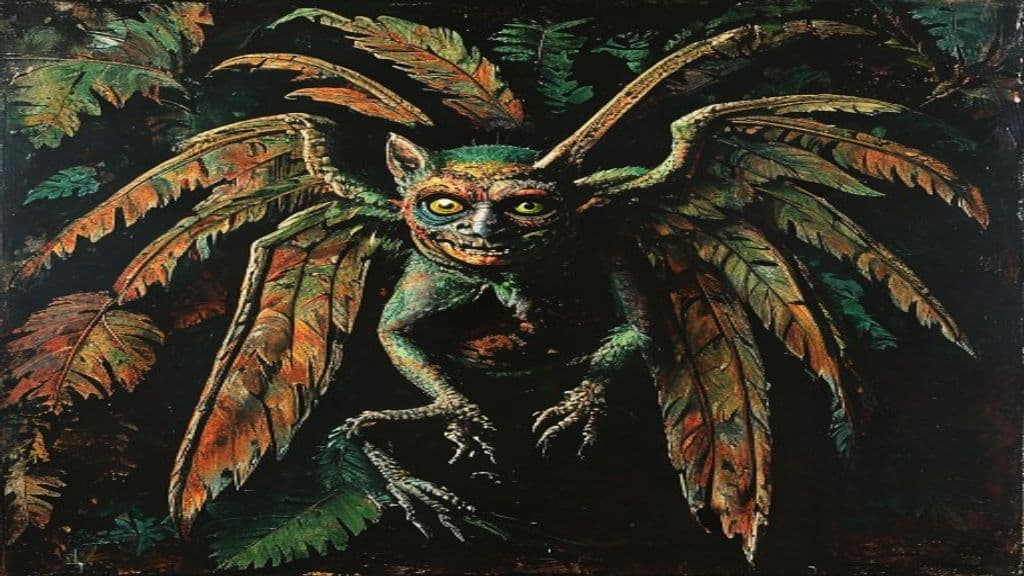
In the Late Post‑Classic Kʼicheʼ narrative preserved in the Popol Vuh, Camazotz appears as bat-like spirits encountered by the Hero Twins during their trials in Xibalba (the Maya underworld). The Popol Vuh episode recounts a Camazotz snatching Hunahpu's head and carrying it to a ballcourt to be used by the gods in a ballgame. The name in Kʼicheʼ is etymologised as kame 'death' + sotz' 'bat', yielding the sense 'death bat'.
Primary narrative sources describe Camazotz simply as 'bat-like spirits' active in the House of Bats; the Popol Vuh episode records a Camazotz seizing Hunahpu's head. Classic‑period Maya iconography depicts leaf‑nosed bats (the bat motif associated with Camazotz) with prominent nasal appendages and sometimes shown exhaling vapour; these images are read as representations of a bat way‑spirit or nahual. Exact anthropomorphic detail in the Popol Vuh summary is not specified beyond 'bat-like.'
Attested behaviours are: physical aggression toward humans (in the Popol Vuh a Camazotz seizes Hunahpu's head), service to underworld lords during trials in Xibalba, and—in Classic iconography—representation as a way‑spirit that brings disease, depicted as exhaling unhealthy vapours. Sources do not provide an exhaustive list of powers (e.g., no explicit primary‑text claims of shapeshifting or speech in the supplied summaries).
Weaknesses
- otherNo specific weaknesses recorded in the cited sources
Wards
- otherNo specific protective rites or wards against Camazotz are attested in the provided sources
Hun Hunahpu
Hun Hunahpu is a mythic ancestral figure in the Kʼicheʼ Maya Popol Vuh narrative: one of two brothers (with Vucub‑Hunahpu) who were lured into Xibalba, sacrificed, and whose severed head was suspended in a trophy tree and changed to a calabash. The calabash-head's juice impregnates Xquic, producing the Hero Twins (Hunahpu and Xbalanque); later the Twins recover their fathers' remains but cannot fully resuscitate them. Some scholars compare Hun Hunahpu with the Classic-period Tonsured Maize God, though this identification is debated in the sources provided.
Huracán (Hunraqan / U Kʼux Kaj)
Huracán (Mayan: Hunraqan), often rendered in Kʼicheʼ as U Kʼux Kaj ('Heart of Sky'), is a Kʼicheʼ Maya creator deity associated with wind, storm, fire, and lightning. He takes part in the cosmogonic attempts to create humanity and is the agent of the Great Flood who calls land up from the waters.
Jacawitz
Jacawitz is a Postclassic Kʼicheʼ Maya mountain-and-fire deity, patron of the Ahaw Kʼicheʼ lineage and member of a triad with Tohil and Awilix. Associated with a temple-pyramid at Qʼumarkaj and with foundation myths locating the gods at Tollan, Jacawitz indexes mountain, fire, and lineage symbolism and likely received demanding offerings in ritual practice.
Maya Hero Twins (Hunahpu and Xbalanque)
Central culture-hero brothers of the Kʼicheʼ Popol Vuh and Classic Maya iconography, Hunahpu and Xbalanque undergo trials, avenge earlier wrongs, defeat the lords of Xibalba by trickery and a ballgame, transform other beings, and are finally transformed into celestial bodies associated with sun and moon. They mediate between human society, the maize cosmos, and the underworld and appear in both colonial textual tradition and Classic Maya art.
Calydonian Boar
A singular monstrous boar sent by the goddess Artemis (Diana) to ravage Calydon in Aetolia as punishment for a king's failure to honour her rites. The beast functions in Greek myth as a tangible incarnation of divine wrath that provokes the assembly of renowned heroes—notably Meleager and Atalanta—for a great hunt whose outcome produces both heroic glory and social conflict.
Calypso
Calypso is a name attested across many cultural registers; within classical-mythological mention in the supplied sources it appears as a nymph who detained Odysseus for seven years. The provided materials are primarily a disambiguation of uses (places, music, taxa, media) rather than a sustained folkloric dossier on a single spirit-entity.
Camael
Camael is presented in mainstream Christian angelology as an archangel associated with love, peace, and harmony. Separately, an archival excerpt uses the same name for a spirit described as a 'demon' who appears in dreams and to those who summon him and who instructs humans in violent and sexualized acts; these are distinct, conflicting portrayals in the supplied sources.
Camarina (Καμάρινα)
Camarina is an Oceanid in Greek mythic/toponymic tradition, presented as a daughter of Oceanus and the eponymous nymph of the ancient city Kamarina (Camarina) in southern Sicily. She is understood as a localized water-nymph who personified the town's water-source (spring or fountain) and served as the city's divine namesake.
Camenae
The Camenae are a group of Roman female deities associated with springs, wells, childbirth, and prophetic or poetic inspiration. In Roman literary tradition they were later identified with the Greek Muses and invoked as sources of poetic breath and occasional protectors in labor.
Camilla
Camilla is a legendary Volscian warrior maiden appearing in Virgil's Aeneid (Book 11). Presented as an exceptional human fighter and huntress who leads Volscian forces against the Trojans, she is celebrated for her speed and martial skill and is slain in battle during the Latium wars.
Cancer (the Crab)
In Greek myth and uranography, Cancer is a large crab or crayfish that appears as a minor antagonist in the Heracles cycle (sent against Heracles during the Lernaean Hydra episode) and is immortalized as the constellation Cancer, a member of the Zodiac.
Candyman
A modern urban-legend ghost figure originating in Clive Barker’s short story and adapted into a film franchise; Candyman is a named, summoned presence bound to a violent historical death and sustained by stories, belief, and traumatic community memory. In the films he is most commonly invoked by speaking his name repeatedly into a mirror and appears as a violent, hook‑handed apparition tied to histories of racial injustice in an urban housing setting.
Community Record
- [1]Camazotz (Wikipedia). Wikipedia: 'Camazotz means "death bat" in the Kʼicheʼ language'; Popol Vuh summary; Classic Maya iconography notes.wiki
- [2]Camazotz (Wikidata). Wikidata entry for Camazotz (linked data record).other
- [3]Batman Camazotz | Kimbal Estudio (Archive). Archive entry referenced in source list (modern/popular culture usage).other
- [4]A Wrinkle in Time (2003 film) (Archive). Archive: example of modern reuse of the name 'Camazotz' as a fictional place (not part of Maya tradition).other
- [5]Stranger Things: 'Escape From Camazotz' (Archive). Archive: modern popular culture reuse of the name 'Camazotz' (cited in provided materials).other