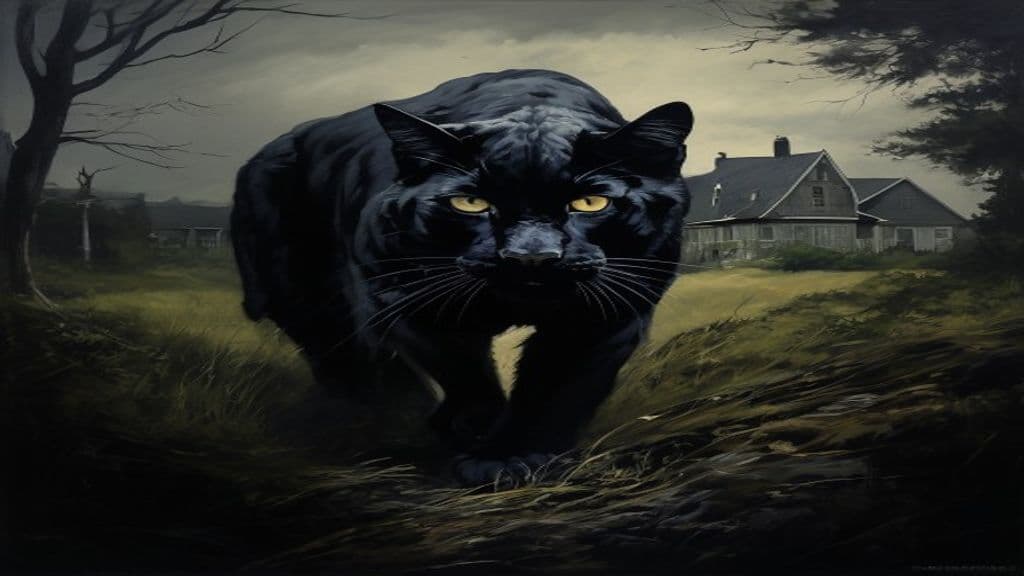
The Canterbury Panther emerges from modern reports and local news accounts rather than traditional mythology. Sightings of a large black cat in Canterbury go back to before the 1970s; a notable early incident occurred in 1977 when Frances Clark reported seeing a "tiger" outside her home, prompting police searches assisted by Orana Wildlife Park and subsequent discovery of paw prints and droppings at Pines Beach. Sporadic reports continued through the 1990s (recorded sightings in 1996 and 1999) and into the 2000s, with police searches noted in 2001, 2003 and 2006. The legend persists in local media and popular culture, and occasional claimed specimens have been subjected to scientific testing (for example, a 2020 specimen whose DNA was reported to match a standard domestic cat).
Accounts characterise the creature as an unusually large, black-furred cat variously described in headlines and witness reports as a "black panther" or, in at least one early 1977 report, a "tiger." Beyond size and black coloration the supplied sources give no consistent morphological detail.
No supernatural abilities are ascribed in the sources; reported behaviours are those of an animal at large: being sighted by residents, leaving paw prints and droppings, and eluding capture during organised searches. Explanatory commentary in the sources favours prosaic accounts—misidentification of very large feral cats, cases of gigantism, or escaped captive animals—and documents scientific responses such as DNA testing used to identify claimed specimens (a 2020 test concluded the specimen was "just a standard cat by the looks of the DNA").
Weaknesses
- othercivic and scientific investigation (police searches, zoo roll-calls, DNA testing)
Wards
None recorded.
Camilla
Camilla is a legendary Volscian warrior maiden appearing in Virgil's Aeneid (Book 11). Presented as an exceptional human fighter and huntress who leads Volscian forces against the Trojans, she is celebrated for her speed and martial skill and is slain in battle during the Latium wars.
Cancer (the Crab)
In Greek myth and uranography, Cancer is a large crab or crayfish that appears as a minor antagonist in the Heracles cycle (sent against Heracles during the Lernaean Hydra episode) and is immortalized as the constellation Cancer, a member of the Zodiac.
Candyman
A modern urban-legend ghost figure originating in Clive Barker’s short story and adapted into a film franchise; Candyman is a named, summoned presence bound to a violent historical death and sustained by stories, belief, and traumatic community memory. In the films he is most commonly invoked by speaking his name repeatedly into a mirror and appears as a violent, hook‑handed apparition tied to histories of racial injustice in an urban housing setting.
Canotila
Canotila (Lakota: čanotila) are small tree‑dwelling forest spirits in Lakota (Sioux) tradition, described as little tree dwellers who function as messengers from the spirit world and are reported to appear to people in dreams.
Cantabrian Neptune
A Roman-name sea-deity invoked in ritual contexts along the Cantabrian coast; attested in fragmentary sources as the sacred agent associated with the open sea in local ritual taxonomy rather than a richly attested autonomous Cantabrian personality.
Cantabrian brown bear
A remnant population of the Eurasian brown bear (Ursus arctos arctos) confined to the Cantabrian Mountains of northern Spain, treated in scientific and conservation contexts as a distinct local population with significant ecological and conservation importance.
Caoineag
The 'Weeper' of Scottish Highland tradition — an invisible spirit heard wailing near waterfalls before a disaster befalls a clan, a Highland variant of the Irish Banshee.
Cap-o'-Rushes
Cap-o'-Rushes is the title and heroine of an English folktale collected by Joseph Jacobs. The story is classed among international folktale types (principally ATU 510B) and opens with the 'Love Like Salt' motif; it tells of a daughter who disguises herself in a garment of rushes, works as a kitchen maid, attends secret balls, causes recognition by hiding a ring in a dish, and engineers reconciliation by ordering a saltless wedding feast so her father remembers his earlier words.
Capaneus
Capaneus (Ancient Greek Καπανεύς) is a mortal warrior of the generation known as the Seven against Thebes, famed in Greek and Roman literary tradition for exceptional size and strength and for extreme pride; his taunt that even Zeus could not stop him results in divine execution by a thunderbolt as he scales the walls of Thebes. Later authors (Statius, Dante) reuse him as a figure illustrating hubris and blasphemy.
Capella
Capella (α Aurigae) is the brightest star in the northern constellation Auriga, historically named for a goat (Latin Capella, Greek Aix) and treated across cultures as a calendrical and weather sign as well as an architectural orientation marker. Astronomically it is a quadruple star system composed of two close yellow-giant primaries and a distant pair of red dwarfs and is one of the sky's brightest X-ray sources.
Capetus Silvius
Capetus Silvius is a legendary ancestral king in early Roman/Latin foundation tradition, listed among the kings of Alba Longa and presented in genealogical/regnal sequences as a descendant of Aeneas and a dynastic link to later eponymous figures such as Tiberinus.
Capheira
Capheira (also Kapheira) is a Rhodian Oceanid (Okeanid) nymph in Greek mythology, attested as one of the daughters of Oceanus who, together with the Telchines, was entrusted by Rhea to nurse and protect the infant god Poseidon. She appears in concise mythographic summaries but lacks independent cultic or iconographic attestation in the supplied sources.
Community Record
- [1]Canterbury Panther — Wikipedia. Wikipedia, 'Canterbury Panther' entry (accessed as provided in research notes).wiki
- [2]Canterbury Panther — Wikidata Q129677540. Wikidata item classifying the Canterbury Panther as a New Zealand urban legend.wiki