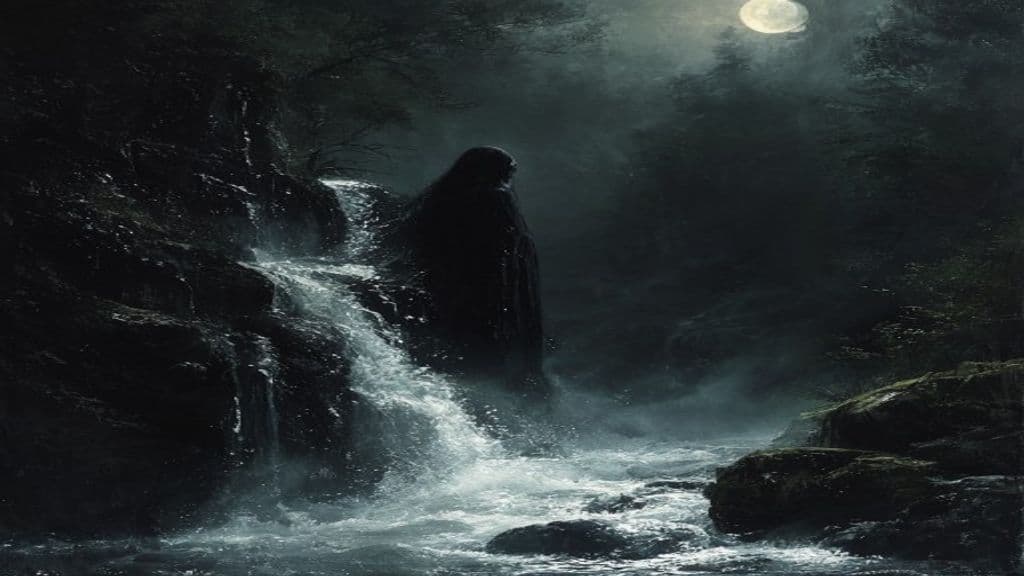
The Caoineag ('weeper' or 'wailing one') was heard rather than seen, wailing near waterfalls in the hours before a tragedy struck a Highland clan. She was specifically attached to particular clans, and her lament was the signal that deaths were coming. Unlike the Irish Banshee who warned specific families, the Caoineag's wail presaged large-scale losses — battles, massacres, drownings.
Never seen — only heard. Her voice was a high, keening wail rising from waterfall spray at night. Some traditions describe her as a small woman but she was not observed directly.
Her wailing preceded disaster and mass death within the clan. She could not be summoned or communicated with. Hearing her was simply foreknowledge of coming catastrophe with no power to prevent it.
Weaknesses
- conditionCannot be prevented — she is a portent, not a cause
Wards
- ritualThere is no ward — prayer and preparation are the only responses
Baobhan Sith
A Scottish Highland vampire fairy — a beautiful woman in a green dress who appears to men alone in the wilderness and drains their blood, her deer hooves hidden beneath her skirts.
Cat Sídhe
A large black fairy cat of Irish and Scottish tradition with a white spot on its chest, who could steal a corpse's soul before burial if allowed to leap over it.
Cú Sídhe
The supernatural fairy hound of Celtic tradition — enormous, dark green or white, who hunts in eerie silence and whose triple bark is a death omen.
Each-Uisge
The most dangerous water horse in Scottish Highland folklore — haunting sea-lochs and mountain lakes, more violent than the river kelpie, known for consuming its victims whole.
Kelpie
A Scottish shape-shifting water horse that appears as a beautiful tame horse near lochs and rivers, then drowns and devours any rider foolish enough to mount it.
Selkie
A seal-being from northern Atlantic coastal folklore said to shift between seal and human forms by removing or donning a seal skin. Tales focus on intimate relations with humans, the selkie's longing for the sea, and the narrative motif of a hidden skin that prevents return to the ocean.
Sluagh
The host of the unforgiven dead in Irish and Scottish tradition — a restless swarm who travel from the west, steal souls, and attack the living, whom they carry off into their dark company.
Cantabrian Neptune
A Roman-name sea-deity invoked in ritual contexts along the Cantabrian coast; attested in fragmentary sources as the sacred agent associated with the open sea in local ritual taxonomy rather than a richly attested autonomous Cantabrian personality.
Cantabrian brown bear
A remnant population of the Eurasian brown bear (Ursus arctos arctos) confined to the Cantabrian Mountains of northern Spain, treated in scientific and conservation contexts as a distinct local population with significant ecological and conservation importance.
Canterbury Panther
A New Zealand urban-legend of a large black panther or "Canterbury Cat" said to roam the Canterbury Region. Reported sporadically from before the 1970s into the 21st century, the phenomenon is treated in sources as modern phantom-cat sightings subject to civic investigation and scientific demystification.
Cap-o'-Rushes
Cap-o'-Rushes is the title and heroine of an English folktale collected by Joseph Jacobs. The story is classed among international folktale types (principally ATU 510B) and opens with the 'Love Like Salt' motif; it tells of a daughter who disguises herself in a garment of rushes, works as a kitchen maid, attends secret balls, causes recognition by hiding a ring in a dish, and engineers reconciliation by ordering a saltless wedding feast so her father remembers his earlier words.
Capaneus
Capaneus (Ancient Greek Καπανεύς) is a mortal warrior of the generation known as the Seven against Thebes, famed in Greek and Roman literary tradition for exceptional size and strength and for extreme pride; his taunt that even Zeus could not stop him results in divine execution by a thunderbolt as he scales the walls of Thebes. Later authors (Statius, Dante) reuse him as a figure illustrating hubris and blasphemy.
Community Record
- [1]The Gaelic Otherworld. Campbell, John Gregorson. 1900. Superstitions of the Highlands and Islands of Scotland. James MacLehose.folk
- [2]Celtic Mythology. MacKillop, James. 1998. A Dictionary of Celtic Mythology. Oxford University Press.academic