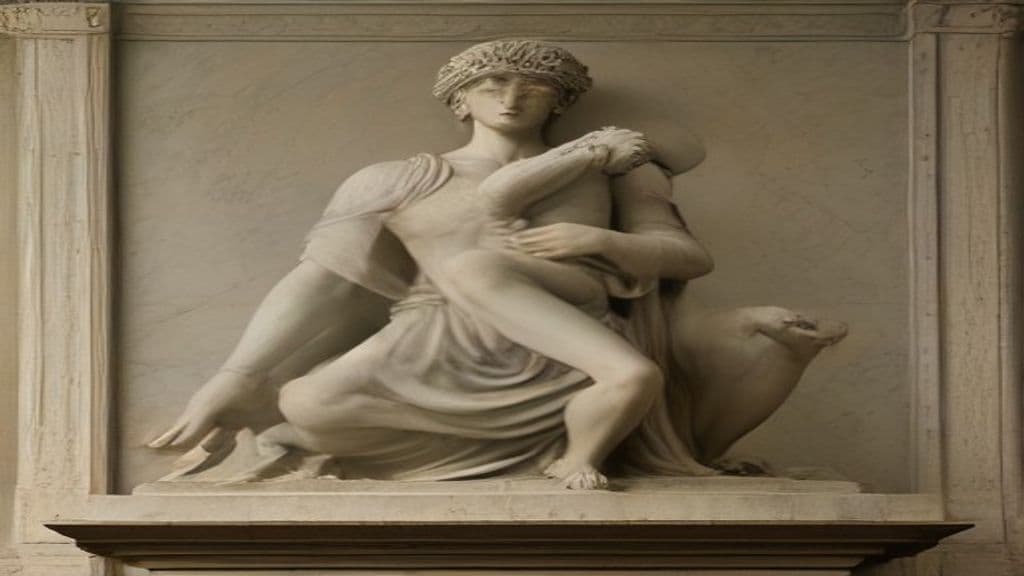
Capys appears in multiple interconnected strands of Greco‑Roman legendary history rather than a single unified origin tale. In Trojan genealogies he is listed among the dynastic figures of the Dardanian/Trojan network (one recension names him in descent from Assaracus). In Roman legendary chronologies a Capys is counted among the kings of Alba Longa and is presented as a descendant of Aeneas; one annalistic listing gives a conventionalized reign of 963–935 BC. These usages reflect the name's role as an eponymous ancestor or dynastic link within the merged Trojan‑Roman foundation myths rather than an origin as a supernatural being.
Classical and genealogical sources do not provide a consistent visual or iconographic description of Capys as a person. The surviving literary depiction most often cited is a later poetic portrayal: in Thomas Babington Macaulay's Lays of Ancient Rome the figure called Capys is presented as "blind and well advanced in years" when seized by a prophetic frenzy. That depiction is a Victorian literary rendering and not an independent classical iconographic tradition.
Sources treat bearers of the name Capys as human figures with social and narrative roles: kingship (as a king of Dardania and as a king of Alba Longa in Roman genealogies), prudent counsel (a Trojan named Capys is reported to have warned against admitting the wooden horse), and—in later poetic imagination—prophecy (Macaulay stages Capys as an elder who issues prophetic portents). There is no evidence in the cited material that Capys possesses inherent supernatural powers beyond conventional prophetic speech attributed in literary treatments and ancestral authority within genealogical lists.
Captain Comet
Captain Comet (Adam Blake) is a DC Comics superhero, a human metahuman described in-source as the 'first man of the future' whose metagene was triggered by a comet at his birth. Introduced in the 1950s Strange Adventures series, he functions as a solo adventurer and occasional team member in Earth- and space-spanning science-fiction stories.
Captain Deudermont
Captain Deudermont is a mortal human naval captain and recurring character in the Forgotten Realms novels. He commands the ship Sea Sprite, fights pirates along the Sword Coast, and acts as a reformer/leader in plotlines involving the city of Luskan and related maritime voyages.
Captain Nazi (Baron Albrecht Krieger)
Captain Nazi (Baron Albrecht Krieger) is a fictional superhuman antagonist created in American comic books (Fawcett Comics; later DC Comics). Introduced in Master Comics #21 (December 1941), he was presented as a genetically engineered 'perfect specimen' created to fight for Adolf Hitler and the Axis powers and later reappears in modern continuities as a revived or re-used Neo‑Nazi-themed antagonist.
Captain Triumph
Captain Triumph is a Golden Age American comic-book superheroal persona: Lance Gallant, who merges with the ghost of his dead twin Michael by touching a T-shaped birthmark and becomes a costumed wartime-era crimefighter. Created for Quality Comics' Crack Comics (first appearance January 1943), he functions as a patriotic pulp champion rather than a traditional folkloric spirit.
Captain Ultra
Captain Ultra is a Marvel Comics costumed superhero persona (primary civilian identity Griffin Gogol; an alternate 2099 variant named Morty Gogol exists in Marvel Year‑in‑Review material). Introduced in Fantastic Four #177 (1976), the character was created within a comics spoof context and has appeared sporadically in comics and animated adaptations, characterized by broad superhuman abilities counterbalanced by a severe fear of fire.
Captain Universe
A comic-book persona produced when the extra-dimensional Uni‑Power (an emissary of the Enigma Force) bonds with a host, temporarily granting that individual cosmic energies and the mantle of 'Captain Universe' to address crises across scales.
Caradoc
Caradoc is a semi-legendary heroic/ancestral figure from Welsh and Arthurian tradition, remembered in medieval genealogies and romances as a ruler of Gwent and as a Knight of the Round Table. He is treated in the sources as a human hero whose life is affected by wondrous events (enchantment, serpent-affliction, knightly tests) rather than as an independently supernatural being.
Caradocus (Karadawc)
Caradocus (Middle Welsh: Karadawc) is a legendary Cornish ruler attested in medieval pseudo‑histories, principally Geoffrey of Monmouth's Historia regum Britanniae, where he functions as a noble counselor, envoy, and peacemaker in the narrative linking Britain and Magnus Maximus. He is presented as a historical/legendary human figure rather than a supernatural being.
Caradog ap Bran
Caradog ap Bran is a legendary Welsh prince, son of Bendigeidfran (Bran the Blessed), known from the Second Branch of the Mabinogi (Branwen ferch Llŷr) and medieval triadic lists. He is presented as a senior chieftain left to defend Britain whose men are slain during Caswallawn's treachery, and who dies of grief at their deaths.
Carassa de Barcelona
No reliable information about a folkloric or supernatural entity called 'Carassa de Barcelona' is present in the supplied sources. References in the materials relate to Barcelona's street naming, Christmas markets, and neighborhood culture, but none document an entity by this name.
Carbuncle (heraldry)
A heraldic charge consisting of eight radii or spokes: four forming a common cross and four forming a saltire. The term 'carbuncle' also names a deep-red cabochon gemstone (usually almandine garnet) and, separately, a folkloric legendary creature in South American tradition associated with gemstones; however, in the sources provided the heraldic sense is a visual emblem rather than a supernatural being.
Cardys
Cardys is not attested in the provided sources as a coherent supernatural being; the name appears primarily as a surname, a set of toponyms (Cardy, Missouri; Cardys Rock), and as a short early‑modern printed title element ('The boke of the new cardys...'). A single Wikidata line lists 'Cardys' as a 'mythical Cretan, father of Clymenus,' but no supporting mythographic material is provided in the available sources.
Community Record
- [1]Capys - Wikipedia. Wikipedia contributors, 'Capys,' Wikipedia, The Free Encyclopedia.wiki
- [2]Capys (son of Assaracus) - Wikipedia. Wikipedia contributors, 'Capys (son of Assaracus),' Wikipedia, The Free Encyclopedia.wiki
- [3]The Prophecy of Capys (poem) — Lays of Ancient Rome (Archive.org / LibriVox descriptions). Archive.org / LibriVox entry for Macaulay, Lays of Ancient Rome, description of 'The Prophecy of Capys.'literary
- [4]Lays of Ancient Rome (text). Macaulay, Thomas Babington, Lays of Ancient Rome (text available via Archive.org).literary
- [5]Capys — name occurrences (Attalus index). Attalus.org, 'Capys: in ancient sources' (name-index and citations).other
- [6]Wikidata entry for Capys. Wikidata, 'Capys' entry.wiki