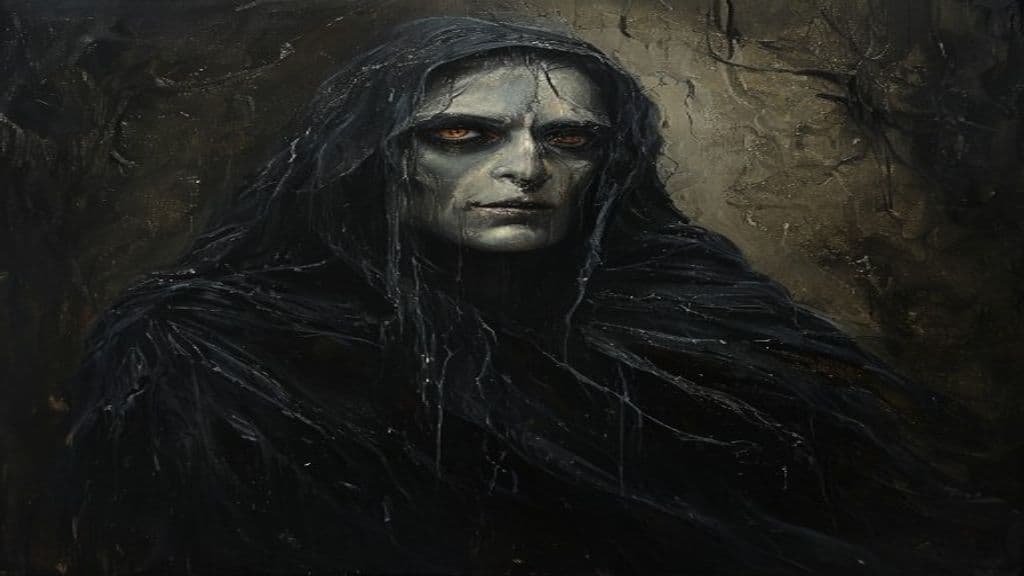
According to Kartlis Tskhovreba, a compilation of medieval Georgian chronicles, Caucas is considered the ancestor of the Vainakh peoples and part of a larger group of siblings sharing a common parent with him, Targamos.
No physical description is mentioned in the source material.
Given his role as an ancestral figure rather than a supernatural entity, there are no descriptions of powers or behaviors attributed to him. He is part of a legendary narrative highlighting genealogy and shared ancestry within medieval Georgian society.
Apsat
Male deity in Georgian mythology, associated with birds, animals, and possibly horses; connected to hunting, game provision, and thunder/lightning. (Note: - Power tier: Primordial (due to his association with cosmic forces like thunder/lightning) - Origin story: More specific information is needed, as the source material only mentions the possible etymo)
Kartlos
In Georgian mythology, Kartlos is the 'father of all Georgians' and a patriarchal figure, part of a war against giant Titan king Nebrot. (Note: - Power tier: Greater (controlled a large territory, but not described as a deity-level figure) - Appearance: Add that there is no physical description provided in the source material - Abilities: Spe)
Lamaria (Georgian Tradition)
In Georgian mythology, Lamaria is a goddess associated with the hearth, cattle, women, and fertility of grain fields. (Note: 1. The article states Lamaria is associated with cattle and women, but the source does not specify her association with women, only protecting them during childbirth. 2. Power tier: Less specific abil)
Mtskhetos
Epic hero and legendary founder of the city of Mtskheta in Georgian mythology, son of Kartlos. (Note: - Power tier: Minor Spirit (since there's no indication of deific or powerful regional abilities) - Abilities and behaviors: lack of specific information on his abilities and behaviors means they shou)
Ochokochi
Malevolent entity from Georgian mythology with a unique physical feature and violent tendencies towards humans. (Note: 1. Power tier should be Ancient (deity-level) as it's unclear if Ochokochi is considered cosmic in Georgian mythology. 2. Add sensory cues based on the source material description of his physical appe)
Q'ursha
Legendary dog in Georgian mythology, associated with the culture hero Amirani. (Note: 1. Power tier: Based on the description of its abilities (thunderous bark, extraordinary agility and power), it should be classified as a Greater entity, not Minor Spirit. 2. Appearance: The source ma)
Cattle of Helios
A herd of sacred, immortal oxen belonging to the sun-god Helios in Greek myth. Pastured on the island Thrinacia, their slaughter by Odysseus' crew in the Odyssey precipitates supernatural signs and divine vengeance by Helios (and Zeus).
Caturvyūha
A theological/doctrinal model in early Vaiṣnava tradition describing four earthly emanations (vyūhas) of the Supreme deity—originally Nārāyaṇa and later Viṣṇu—named Vāsudeva (central), Saṃkarṣaṇa (Balarāma), Pradyumna and Aniruddha. The concept maps localized Vrishni hero cults onto a system of divine manifestation reflected in early Mathura/Kushan sculpture and later Vaishnava liturgical categories.
Catwoman
Catwoman is a fictional human character originating in American comic books, primarily the Batman series. Portrayed most often as Selina Kyle, she is a skilled burglar, antiheroine and recurring romantic interest/foil to Batman, whose persona is themed around feline imagery and behavior.
Caucon
Caucon (Ancient Greek Καύκων, Kaukōn) is a mythic Greek hero and eponymic founder attested in two principal traditions: an Arcadian prince counted among the sons of Lycaon and an Eleusinian/Messenian priestly figure credited with transmitting the rites of the Great Goddesses from Eleusis to Andania. He functions as a local ancestral hero invoked in cult and political aetiologies rather than as a consistently divine or demonic being.
Cauld Lad of Hylton
A localized North‑East English folk being tied to Hylton Castle, variously described as the ghost of a murdered stable boy or as a domestic brownie/elf/barghest; known for nighttime kitchen mischief, crying "I'm cauld," and being "laid" by the gift of clothing.
Cavalcante de' Cavalcanti
A historical Florentine nobleman depicted by Dante in Inferno Canto X as a damned soul among the heretics in the sixth circle of Hell; in the poem he briefly speaks to the pilgrim, expressing concern for his son Guido. His placement and condition are literary devices within Dante's moral-theological topography rather than folkloric hauntings.
Community Record
- [1]Kartlis Tskhovreba. Compiled by Leonti Mroveli in the 11th century.literary
- [2]