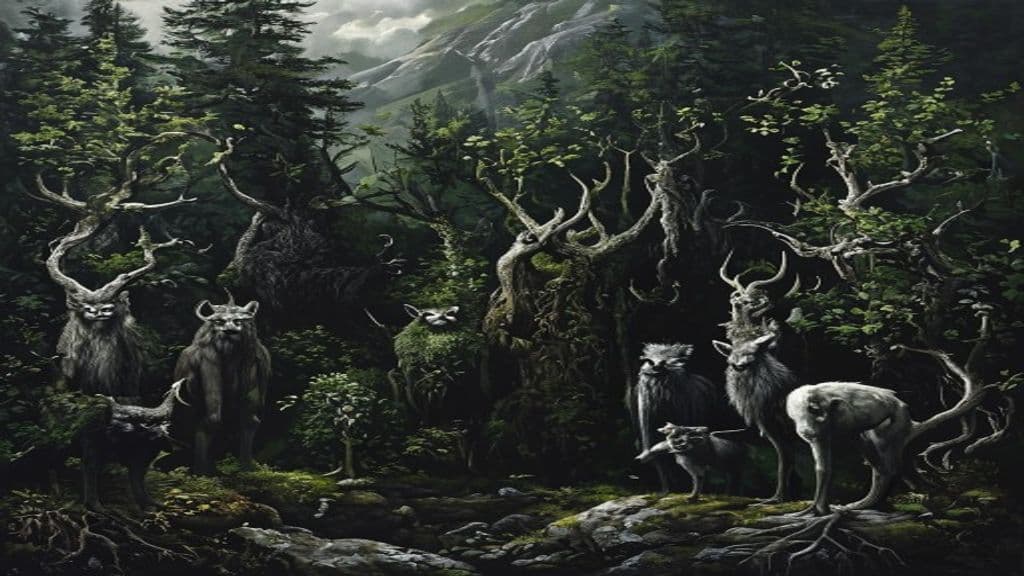
The origin of Celtic mythology is tied to the oral traditions of the Insular Celts, with most surviving mythology belonging to Irish and Welsh cultures. These stories were passed down through generations before being written down by Christian scribes in the Middle Ages.
Physical descriptions of Celtic mythological beings vary greatly, but often they are associated with natural features such as animals, plants, or landscapes.
Celtic mythological beings exhibit a wide range of powers and behaviors, including control over nature (e.g., fertility, prosperity), protection and chaos, destruction, and underworld domains. Their abilities can also be tied to specific locations, times, or conditions.
Weaknesses
- conditionLoss of native languages and traditions
- ritualChristian scribes' influence
Wards
- ritualDruidic rituals
- symbolSacred sites (e.g., holy wells)
- substanceSpecific artifacts (e.g., the Sword of Light)
Abarta (Ábartach)
Abarta (also Ábartach) is a figure of Irish myth who, in surviving accounts, tricks Fionn mac Cumhaill's warriors by giving them a supernatural grey horse that bears them into the Otherworld. Sources variably identify him as a member of the Tuatha Dé Danann or as a Fomorian; after the incident he is compelled to release the captured warriors and is refused entry to the Fianna.
Abcán (Abhcán)
Abcán (modern spelling Abhcán) is a named dwarf poet and musician of the Tuatha Dé Danann in Irish myth. He appears in a small number of narratives as a musician whose art has soporific power and as the ferryman who brings the goddess Ruad from the Otherworld to the human world.
Abhean
Abhean is a named poet of the Tuatha Dé Danann in medieval Irish literature, described as a poet in particular of Lugh and recorded as having been killed by Óengus before Midir in a poem by Fland Mainistreach preserved in the Lebor Gabála Érenn.
Achtland
Achtland is a figure from Irish tradition who, according to the surviving account, was a mortal woman famed for rejecting mortal suitors who married a member of the Tuatha Dé Danann and crossed into the síde to become immortal as his wife.
Aed (Aodh)
Aed (Old Irish Aodh) is a named supernatural figure in Irish myth attested in variant genealogies: in some traditions he is one of the Children of Lir, while in others he appears as a son of the Dagda. His name derives from the Old Irish word for 'fire' and he appears in narratives that place him among the aristocratic households of the Tuatha Dé Danann/Daoine Sidhe.
Aengus
Aengus (Óengus, Aonghus) is a member of the Tuatha Dé Danann in Irish myth, portrayed as a youthful, attractive figure associated with love, youth, poetic inspiration and seasonal/solar symbolism; he is linked to Brú na Bóinne (Newgrange) and appears as fosterer, protector, enchanter and avenger in multiple tales.
Ailill Angubae
Ailill Angubae is a human figure in the Irish tale The Wooing of Étaín, presented as the brother of High King Eochaid Feidlech who falls desperately in love with his brother's wife, Étaín. His unrequited passion leads to a wasting illness and a failed rendezvous when the Tuatha Dé Danann figure Midir casts him into an enchanted sleep.
Airmed
Airmed (Airmid) is a healer and keeper of herbal knowledge among the Tuatha Dé Danann in Irish myth. Daughter of Díán Cécht and sister of Miach, she preserves the lore of healing plants, gathers herbs at Miach's grave, and is named among enchanters who sang over the well of Sláine to restore the wounded.
Amaethon
Amaethon is a figure from medieval Welsh mythology, son of Dôn and a member of the Children of Dôn, identified as a mythic ploughman whose actions (notably a theft from Arawn) figure in the Cad Goddeu ('Battle of Trees'). He is primarily attested in medieval prose and later poetic tradition as an agricultural specialist and participant in otherworld conflict.
Aos Sí
Aos Sí are a broad class of supernatural beings in Gaelic (Irish and Scottish) folklore associated with the mounds and liminal places of the landscape. They are variously described as descendants or later forms of the Tuatha Dé Danann, ancestral or nature spirits, or otherworldly folk who coexist with humans and can be helpful or dangerous when offended.
Arawn
Arawn is the ruler (king) of Annwn, the Otherworld in medieval Welsh narrative. He appears most prominently in the First Branch of the Mabinogi, where he exchanges places with the mortal Pwyll for a year and a day and is associated in folklore with the Cŵn Annwn (Hounds of Annwn) and other supernatural animals.
Badb
Badb is an Irish supernatural female figure associated with warfare, death, and prophecy. She commonly appears as a crow or raven and as a wailing omen, acts on battlefields to sow confusion and foretell slaughter, and is often treated as one member of the triadic Morrígna.
Community Record
- [1]