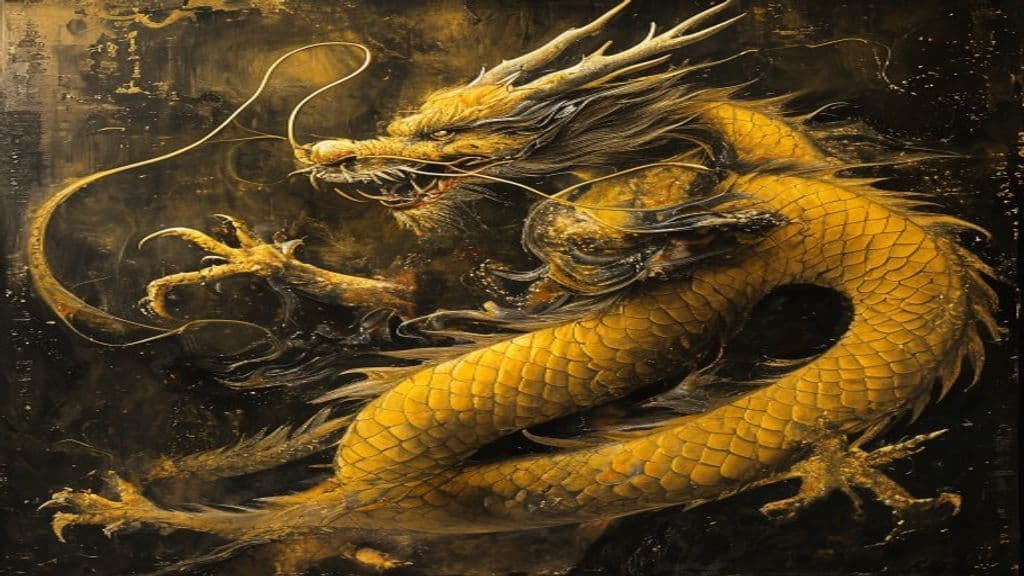
In Vietnamese mythology, Chông Tị is one of the Four Immortals, indicating that he exists outside of the mortal realm and possesses extraordinary longevity.
Chông Tị appears on a yellow or golden dragon, suggesting an association with celestial or divine entities rather than human form.
As one of the Four Immortals, Chông Tị is likely associated with wisdom, strength, or spiritual guidance. His immortality implies extraordinary powers and abilities.
Four Holy Beasts
A set of four sacred animals in Chinese and broader East Asian cultural and astronomical tradition, mapped to the four cardinal directions and used as auspicious, protective, and cosmological symbols in literature, architecture, and material culture.
Lạc bird
A mythical creature in Vietnamese culture, considered the national bird of Vietnam. (Note: * Remove "national bird of Vietnam" from summary, as it only mentions the Lạc bird is considered one. * Power tier should be set to Unknown or Unspecified, as no information is available on its abilit)
Mụ bà (Mười hai Bà mụ)
A collective of twelve female tutelary figures in Vietnamese folk religion who act as midwives and household guardians of newborns, responsible for teaching infants early life skills and auspicious traits. They are ritually acknowledged in some regions at a special ceremony when a baby is one month old.
Thuận Thiên (sword)
Mythological sword imbued with magical power associated with Emperor Lê Lợi's liberation of Vietnam from Ming occupation. (Note: 1. Power tier: Reduce to Greater (powerful regional) as Thuận Thiên's abilities are tied to a specific ruler and region, rather than being on a deity-level. 2. Origin story: Clarify that Lê Lợi procla)
Thần Trụ Trời
A Primordial deity responsible for creating the world by establishing pillars in Vietnamese mythology. (Note: 1. Power tier: Primordial (consistent with being a creator deity) 2. Add sensory cues (e.g., description of pillars, sound, or other unique characteristics associated with Thần Trụ Trời's presence) 3)
Tản Viên Sơn Thánh
One of The Four Immortals in Vietnamese mythology, associated with the Ba Vì mountain range and the romance of Sơn Tinh - Thủy Tinh. (Note: - Power tier should be Greater (Tản Viên Sơn Thánh is a regional deity, not on the level of a cosmic entity) - Appearance section needs to be added - Abilities need more specific details from source m)
Âu Cơ (Vietnamese Mountain Snow Goddess)
Immortal goddess associated with mountains, snow, and fertility in Vietnamese creation myth. (Note: - Power tier should be Ancient (deity-level) rather than Primordial (cosmic), as there's no indication she has cosmic powers. - Abilities: While fertility and creation are associated with Âu Cơ, stati)
Chut
Household spirit in Belarusian mythology associated with domestic spaces and activities, responsible for bringing prosperity and success through offerings, but capable of cruel revenge if neglected. (Note: 1. Power tier: Lowered to Lesser, as it seems more consistent with "regional" or local influence rather than deity-level abilities. 2. Appearance: A note should be added that no physical description i)
Chuvash dragon (Verechelen / Vĕreśĕlen)
A serpentine supernatural being from Chuvash legend, described in sources as a large snake-like creature that can have wings, breathe fire, shapeshift, and in some variants possess multiple heads. The creatures are embedded in Volga-Bulgar regional legend and appear in place-based tales tied to sites such as Bilär and Alabuğa.
Chía
Chía is the Moon deity of the pre‑Columbian Muisca (Chibcha‑speaking) peoples of the central highlands of present‑day Colombia. She was the focus of an institutionalized cult with a dedicated Moon Temple at the town of Chía and calendar‑based ceremonies conducted by the chyquys (priests of the sacred calendar).
Chōchin'obake
A Japanese yōkai depicted as an animate or transformed paper/silk lantern (chōchin). Best known from Edo-period and later pictorial, theatrical, and popular-culture imagery, it functions as a stock visual character of an object-turned-obake rather than as a widely attested regional oral spirit.
Chōchinbi
Chōchinbi (提灯火, "paper-lantern fire") are regionally reported Japanese atmospheric spirit-lights treated as a variety of onibi. Tales describe them as lantern-like floating flames seen near footpaths, rice fields, riverbanks, and graveyards, sometimes vanishing when approached and sometimes associated with animal yōkai or resentful human spirits.
Community Record
- [1]Wikipedia: Chông Tị. encyclopedia article on Chông Tị, a Vietnamese mythological figure.wiki