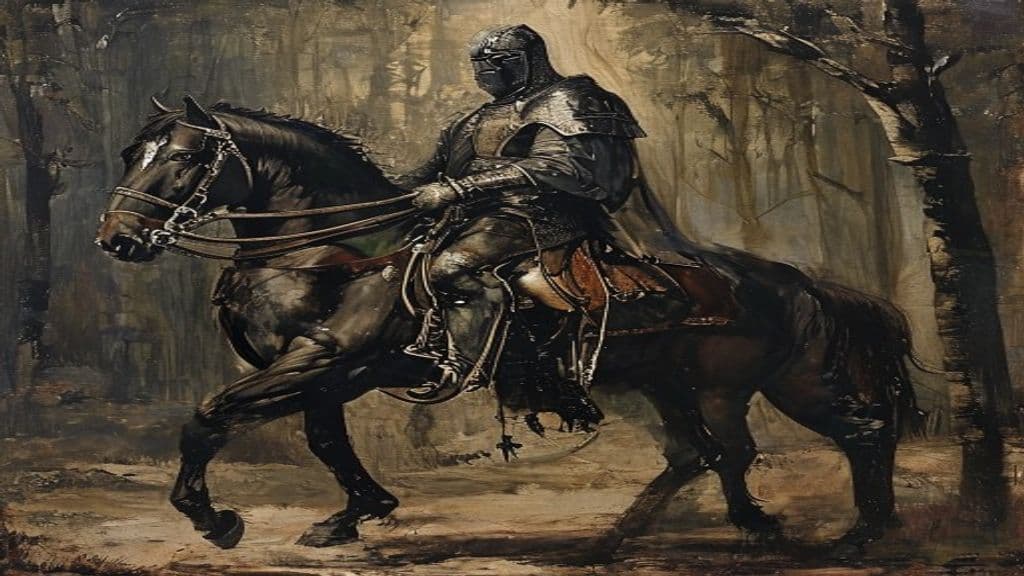
Within the supplied materials Cheval Bayard is attested as part of the corpus of medieval chansons de geste (for example association with The Four Sons of Aymon / Renaud de Montauban). The excerpts provided do not include a full origin narrative; they place Bayard as a traditional marvelous horse figure embedded in those tales. Separate modern summaries and podcast treatments recast or refer to a horse called Cheval Bayard in contemporary folkloric discussion, but no primary origin myth beyond the medieval literary association is recorded in the provided sources.
The provided sources do not supply a consistent physical description of Cheval Bayard. Medieval references (not included in full in the supplied excerpts) traditionally portray Bayard as a notable marvelous steed, but the excerpts here contain no verified details of color, size, or distinguishing marks. Modern podcast summaries emphasize behavior rather than morphology.
Primary medieval-material association: Bayard is presented in the supplied material as a marvelous/legendary horse figure embedded in chansons de geste (The Four Sons of Aymon), implying the character functions as an extraordinary steed in narrative contexts, though the supplied excerpts do not enumerate specific supernatural abilities. Separately, two modern podcast summaries portray a figure called Cheval Bayard as a horse that undermines riders' confidence and can negatively affect domestic life (summarized as "a horse who just wants to make you feel bad about your riding ability...and also destroy your marriage"). These modern portrayals are cited in the supplied notes and are distinguished from the medieval literary attestations.
Guinevere
Guinevere is a named human royal figure in the Arthurian literary tradition: an early-medieval princess who becomes Queen of Britain as the wife of King Arthur. In medieval and later romance she functions as a central human agent whose relationships (notably with Arthur, Lancelot, and Mordred) and narrative experiences (abduction, adultery, rescue) drive major plot consequences for the kingdom.
Mélusine
Mélusine is a European folkloric female freshwater spirit and locus guardian often depicted human above the waist and serpentine or fish‑tailed below. In medieval French romance she marries a human lord under a conditional taboo (commonly Saturday) and is associated with wealth, castle‑building, and as an ancestral figure for certain noble houses.
Chernoglav
Chernoglav (Old Icelandic Tjarnaglófi; Polish Chernogłów/Chernoglov) is a sparsely attested local war or victory deity reported in medieval Old Icelandic accounts of Rügen (Jasmund). The Knýtlinga saga describes him as a god of victory who 'went with them on military campaigns' and records that his cult resisted Christianization longer than some others before being taken years later.
Cherub
In Abrahamic religious literatures a cherub (Hebrew kərūḇ, pl. kərūḇīm; English cherub/cherubim) is a class of exalted celestial being associated with the divine presence, guardianship of sacred space, and service near God. Descriptions range from the composite, winged hybrid creatures of prophetic visions and Near Eastern art to later Western artistic renderings as chubby winged putti; their rank and appearance vary across Jewish, Christian, and Islamic traditions.
Cherubim
Cherubim are a class of non-human, winged supernatural beings in the Abrahamic religious corpus and related traditions. They function primarily as guardians and attendants of a divine presence—appearing around thrones, the Ark, sacred trees, and in liturgical representation—and the term has been adopted in various devotional and modern cultural contexts.
Chervona Ruta
Chervona Ruta (Ukrainian: Червона рута, lit. 'Red Rue') is a Ukrainian cultural motif that refers both to a plant of ambiguous identification (variously associated with the rue genus Ruta or with rhododendron) and to a hugely popular song written by Volodymyr Ivasiuk in 1968 which spawned recordings, covers, and a namesake music festival.
Chesias
Chesias (Ancient Greek: Χησιὰς, Khēsiàs) is a named nymph in Greek mythology, described in the sources as "the fairest of the nymphs," wife of the Samian river-god Imbrasus, and mother of the Naiad Ocyrhoë. She is attested as a local nature-nymph associated with the island of Samos.
Chevalier Onulphe d’Aa / Ridder Onulfe van Aa
A processional giant effigy associated with the municipality of Anderlecht; recorded in a Wikidata entry as a civic festival figure rather than a personal supernatural being. The source gives only name variants and classification as a processional giant, with no further descriptive or narrative detail.
Chhaya
Chhaya (Sanskrit: छाया, Chāyā) is the personified goddess of shadow in Hindu tradition, presented in myth as a shadow-image or substitute-consort of the sun god Surya. She functions within the solar household as a standing-in wife and mother of notable offspring (notably Shani, Tapti, and Savarni Manu) and figures in narratives that explain aspects of cosmic order and lineage.
Chhinnamastā (Chhinnamasta)
Chhinnamastā is a fierce Hindu mother-goddess of the Tantric Mahavidya group, commonly depicted self-decapitated and associated with transformative, death-and-life symbolism within Shakta/Tantric sadhana. She is worshiped in esoteric ritual contexts and has an established cult presence (notably a Shakti Peetha temple in eastern Nepal).
Chi (螭)
Chi (螭) is attested in the provided sources only as an entry on a general disambiguation page identifying 螭 as "a dragon" within a Chinese lexical/mythological listing. No further mythological, ritual, or descriptive information about this entity is present in the supplied materials.
Chiaffredo
Chiaffredo is a locally venerated Christian saint in Piedmont, Italy, regarded as patron of Saluzzo. The cult centers on a discovered skeleton/relics near Crissolo and functions within Catholic devotional practice (pilgrimage, indulgences, relic translation), with later legendary association to the Theban Legion and disputed historicity.
Community Record
- [1]The Four Sons of Aymon (Renaud de Montauban) — Wikipedia listing (medieval romance corpus). Wikipedia, entry for The Four Sons of Aymon (used to indicate the medieval corpus in which Bayard appears).literary
- [2]Wikidata entry: Cheval Bayard. Wikidata entity Q2680281 (labelled 'Procession figure' in the supplied excerpt).other
- [3]Myths and Legends podcast: 400 - Celtic folklore: The Baddies (podcast summary mentioning Cheval Bayard). Podcast episode summary (supplied excerpt): describes a horse framed as "a horse who just wants to make you feel bad about your riding ability...and also destroy your marriage."folk
- [4]Castbox listing: 400: Celtic folklore: The Baddies (podcast). Alternate podcast hosting listing cited in the supplied materials that repeats the modern summary of the horse as an antagonistic figure.folk
- [5]Wikipedia: Lutin (example of clustered French folkloric creatures in supplied materials). Wikipedia entry for 'Lutin' included in the supplied notes to show contextual clustering of French folkloric beings; not a direct source about Bayard.wiki
- [6]Fanny mène l'enquête (archive listing) — modern children's/horse fiction present in supplied materials (contextual). Listed among supplied modern horse-related materials; indicates modern cultural interest in equine figures but does not document Bayard-specific folklore in the provided excerpt.other
- [7]Un cheval pour Mélodie (archive listing) — modern horse fiction (contextual). Listed among supplied modern horse-related materials; included for contextual presence of horse narratives in provided notes.other
- [8]Un concours à New York (archive listing) — modern horse fiction (contextual). Listed among supplied modern horse-related materials; included for contextual presence of horse narratives in provided notes.other