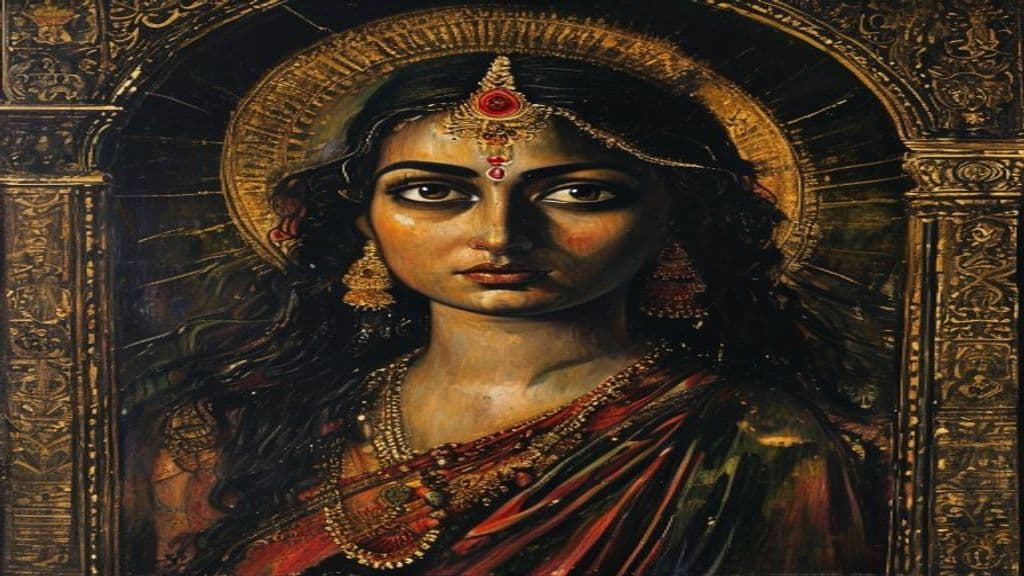
In the oldest strata of the tradition the look-alike substitute figure appears in Vedic material (Rigvedic layers) as a woman called Savarna or Sadrisha ('same-kind') placed in the household of the sun-god in place of Saranyu/Sanjna. In later epic and Purāṇic retellings that double is explicitly reinterpreted as Chhaya, literally the 'shadow' or 'shade' (Sanskrit chāyā), produced as Saranyu/Sanjna's shadow or reflection and left with Surya when Saranyu departs (often because she cannot endure Surya's radiance). Textual variants persist: some sources treat Chhaya as the shadow-born substitute, while others (e.g., Bhagavata Purana) present her genealogically as a sister of Sanjna (daughter of Vishvakarma). Across these accounts she becomes the mother of children (most commonly Shani, Tapti, Savarni Manu) whose origins provide etiologies for moral and cosmic functions.
Descriptions in the surviving summaries emphasize Chhaya's resemblance to Saranyu/Sanjna: she is a 'look-alike' (Sadrisha, Savarna) or shadow-image/reflection rather than a distinctively described figure. Specific physical details beyond her being the same in outward appearance as Surya's true wife are not given in the cited sources. Purāṇic iconographic prescriptions (Markandeya Purana, Vishnudharmottara Purana) instruct that images of Surya include Chhaya among his consorts, indicating an established pictorial presence beside the sun god.
The sources frame Chhaya's functions narratively: she stands in as a substitute-wife for Saranyu/Sanjna and thereby bears children by Surya (accounts vary in which children are attributed to her). She demonstrates humanlike domestic behaviors and partiality toward her own offspring; this partiality is the trigger for conflict in the myths. Chhaya also pronounces a damaging curse upon Yama in some versions (e.g., Harivamsa/Markandeya Purana variants), an act which in the narratives has tangible consequences later mitigated by Surya. The texts treat these acts as mythic agency within family dynamics rather than cataloguing a suite of universal supernatural powers.
Weaknesses
- conditionexposure by questioning or confrontation
Wards
None recorded.

Adi (asura)
Adi is attested in modern reference works as the name of an Asura who 'appears in the Matsya Purāṇa.' Beyond this single-line citation in secondary sources, no descriptive material about the figure is provided in the supplied research notes.
Adi Shakti
Adi Shakti (also Adi Parashakti, Mahadevi, Adya Shakti) is the primordial feminine power in Hindu/Shakta theology, regarded as the ultimate reality (Para Brahman) and the source from which all goddesses and gods manifest. She is both an impersonal cosmic principle (Mulaprakriti) and a focus of devotional invocation in temples, mantras, and pilgrimage sites such as Shakti Peethas.
Adi Vinayaka
Adi Vinayaka (Ādi Vināyaka; also called Nara Mukha Vinayaka) is a named iconographic and devotional form of the Hindu god Ganesha portraying the deity with a human head, described in sources as the form before the episode of decapitation by Shiva. It is rarely worshipped and appears in a small number of South Indian shrines and in devotional/musical repertoires.
Aditi
Aditi is a major Vedic goddess in Hindu tradition who personifies the boundless, infinite cosmic principle and functions as the maternal matrix from which many celestial deities (the Ādityas and other groups) are born. In the Vedic hymns she is invoked as a protective liberator who guards petitioners, provides wealth and safety, and frees devotees from hindrances such as sin and sickness.
Agni
Agni is the Vedic personification of fire in Hindu tradition: a sacred, mediating principle that manifests as terrestrial fire, atmospheric lightning, and celestial sun, and that receives and conveys sacrificial offerings. Prominent in the Rigvedic corpus, Agni functions as sanctifier, witness of rites of passage, and a transformational inner principle in later Upanishadic literature.
Ahalya
Ahalya is a mytho-legendary woman of South Asian (primarily Hindu) narrative tradition, described as created by the god Brahma, married to the sage Gautama, seduced (or tricked) by Indra, cursed by her husband, and ultimately redeemed by Rama. Her tale is a locus for themes of creation, desire, curse/penance, and redemption and she is counted among the ritual-mnemonic panchakanya.
Aindri (Indrani / Shachi / Paulomi)
Aindri (commonly rendered in sources as Indrani, also called Shachi or Paulomi) is a Hindu goddess presented as the queen-consort of Indra. She is depicted in the available material as a courtly queen associated with beauty, pride and kindness who also appears in at least one account as an active martial participant in the devas' battles with asuras.
Akshayavata
In Hindu mythology, Akshayavata is a sacred banyan tree and/or lake that symbolizes eternal life. It is mentioned in both Hindu and Jain traditions and associated with the Puranas. (Note: - The power tier should be "Greater" or at least "Ancient", as it is associated with the Puranas, which are considered ancient texts. - No specific physical description is provided, but that doesn't m)
Alakshmi
Alakshmi is an inauspicious female supernatural figure in Hindu tradition, presented as the negation or shadow-counterpart of the prosperity-goddess Lakshmi. She personifies poverty, grief, jealousy and social discord and is managed in domestic ritual and festival practice.
Alamelu
Alamelu (also Alamelu Manga / Alarmel Mangai) is a South Indian devotional name for the goddess Padmavati, identified in sources as an avatar of Lakshmi and the consort of Venkateswara; the name is also used widely as a female personal name and in titles of cultural works in Tamil and Telugu contexts.
Amrita (Buddhist tradition)
In the context of Indian religions, particularly within Hinduism and Buddhism, Amrita is a divine elixir that grants immortality and eternal life. (Note: - Power tier should be Ancient (deity-level), not Primordial. - Origin story appears accurate but lacks specificity on when Amrita was first mentioned in the Rigveda; add more detail. - Abilities are )
Ananta (Infinite)
Ananta (Sanskrit: अनन्त, 'without end') is primarily an epithet of Vishnu and a symbolic principle of infinity that is personified as the cosmic serpent Shesha. In Puranic imagery Ananta/Shesha forms the multi‑headed couch and canopy for Vishnu as he rests on the cosmic waters between cycles of creation (pralaya), and thus underwrites cyclical cosmogenesis.
Community Record
- [1]Chhaya (Wikipedia). Wikipedia, 'Chhaya' (accessed in supplied research notes)wiki
- [2]Wikidata entry for Chhaya. Wikidata entry Q19011154 (referenced in supplied research notes)other