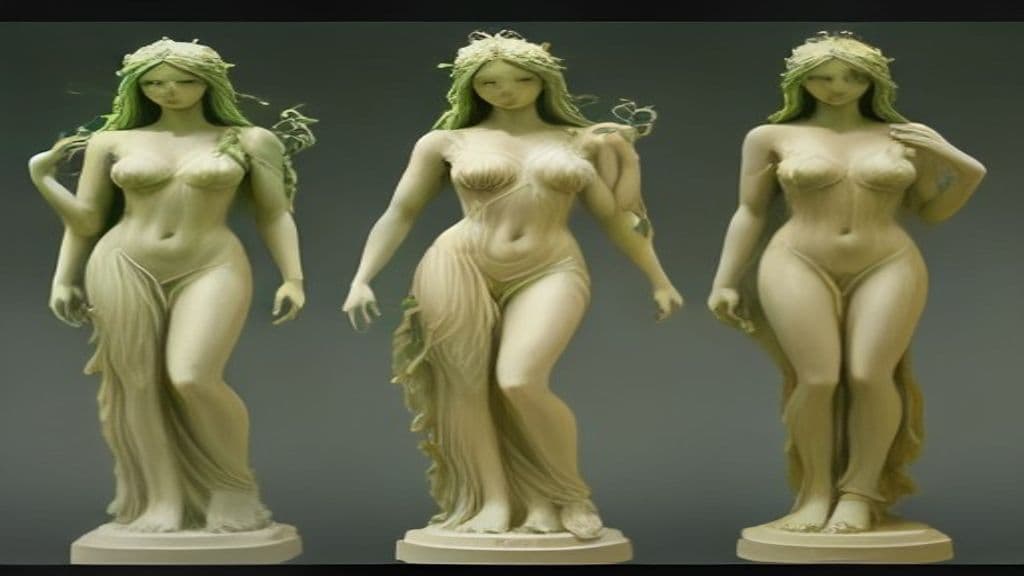
The name Chloris (Greek Χλῶρις, from χλωρός chlōrós, 'greenish-yellow', 'pale green', 'fresh') appears attached to several mythic women rather than a single unified origin narrative. In the collected summaries of Greek tradition a Chloris is described as a nymph loved by Zephyrus (the West Wind), situating that figure among nature-spirits associated with winds and vegetation; another Chloris is named as the wife of Neleus, king of Pylos, embedding her in royal genealogies and heroic-era dynastic history; yet another is listed among the Niobids (the children of Niobe) and thus connected to the Niobid cycle of familial tragedy; and a Chloris identified as daughter of Orchomenus is said to have married the seer Ampyx (Aregonis variant) and borne the famed seer Mopsus. Sources note that some references clearly point to distinct characters while others may refer to the same named figure with variant details, reflecting the multiplicity and local variation inherent in Greek mythic naming and genealogical traditions (Wikipedia: Chloris).
The surveyed sources do not supply consistent or detailed iconographic descriptions for a single Chloris figure. Because Chloris functions as a personal name applied to multiple women—nymphs and mortal queens—the extant summary material records roles (a wind-loved nymph; a queen of Pylos; a Niobid; a mother in a seerly lineage) without unified bodily or sartorial attributes. The etymology of the name (from χλωρός, 'green/pale/fresh') implies an evocative association with greenness and vegetal imagery in poetic contexts, but the provided materials do not record canonical physical descriptions tied to any one Chloris (Wikipedia: Chloris).
The sources do not ascribe a standardized set of supernatural powers to Chloris as a category. Individual attestations place Chloris within roles that carry narrative functions—consortship with a god (the nymph loved by Zephyrus), dynastic motherhood (wife of Neleus; mother of Mopsus), or membership in a tragic sibling group (a Niobid)—but they do not attribute explicit magical faculties, hostile behaviors, hauntings, or ritual agency to Chloris herself. Where connected to a prophetic figure (her son Mopsus), the prophetic ability is ascribed to the offspring rather than to Chloris in the provided summaries (Wikipedia: Chloris).
Community Record
- [1]Chloris. Wikipedia, 'Chloris' page (entry summarizing multiple mythic figures and name etymology)wiki
- [2]Chloris (Wikidata entry). Wikidata item Q2147082 (notes homonymous uses including plant genus)other
- [3]Chloris: Luminarium Renascence Editions (Smith). Luminarium (collection referencing classical names and usages)other
- [4]Chloris (plant). Wikipedia, 'Chloris (plant)' (used here to distinguish botanical homonymy from mythic name)wiki
- [5]Chloris (archive audio listing: Grønirisk/Chloris chloris). Archive listing demonstrating non-mythic uses of the lexical item 'Chloris' (bird name), included to clarify homonymy in the datasetother