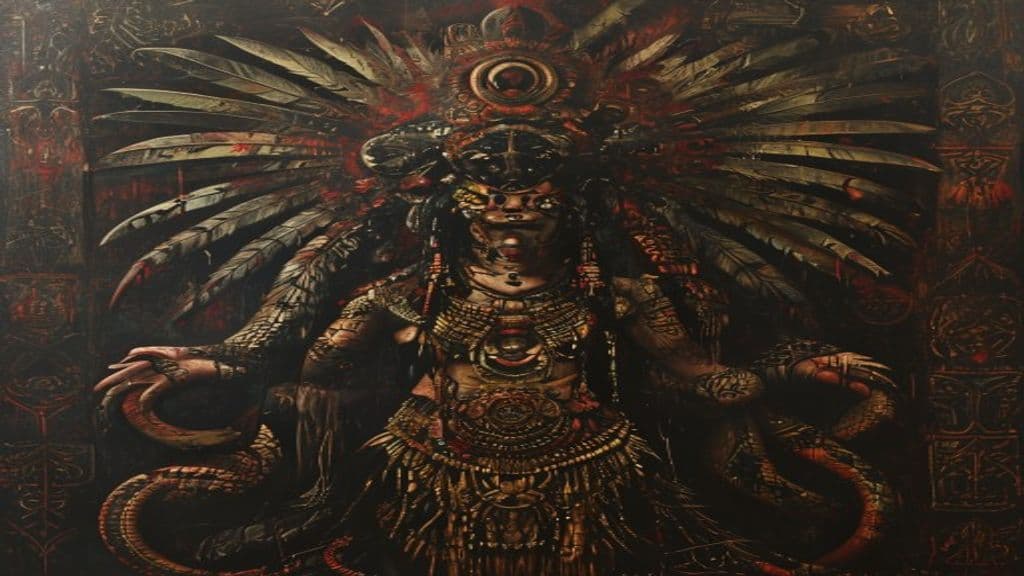
In the Mexica cosmological account summarized in the available sources, Coatlicue occupies a progenitor role: she is named as the mother who brought forth the moon, the stars, and Huītzilōpōchtli, the principal god associated with the sun and war. The sources present her as a foundational maternal figure in creation narratives and note that other important female deity-titles—most notably Toci (rendered 'our grandmother') and Cihuacōātl ('snake woman', patron of women who die in childbirth)—are seen as aspects or identifications of Coatlicue, situating her within a network of maternal, kinship, and childbirth-related meanings in Mexica religious thought.
Traditional iconography commonly associated with Coatlicue in modern reference works (as reflected in the cited summary material) emphasizes snake imagery and a composite maternal-earth visual identity. She is widely known by the epithet often translated into English as 'She of the Serpent Skirt' and in modern descriptions is connected with snake motifs (the element -coātl, 'snake', appearing in related titles such as Cihuacōātl). While the present source set does not supply a full primary-source iconographic catalogue, available summaries and usages present Coatlicue as a terrestrial/maternal deity strongly linked to serpentine dress and mortuary motifs in Aztec representational practice.
Sources identify Coatlicue's principal role as giving birth to major cosmological entities—the moon, the stars, and the deity Huītzilōpōchtli—which frames her as a maternal progenitor within Mexica cosmogony. Through her identification with Toci and Cihuacōātl, she is associated with the social and ritual domains surrounding grandmothership and the fate of women who die in childbirth. Modern theatrical and literary treatments reuse and dramatize these birthing and life-death cycle themes, but the cited materials limit claims to her status as mother of celestial bodies and as an archetypal maternal figure rather than specifying additional supernatural faculties.
Chalchiuhtlicue
Chalchiuhtlicue is a principal Nahua/Aztec water deity associated with groundwater, rivers, streams and other waters, and with fertility, childbirth, ritual bathing and purification. She is a calendrical and cultic figure in central Mexican religion who, in mythic tradition, presided over the era of the Fourth Sun and caused a prolonged flood that destroyed that world-age.
Clytia
Clytia (also Clytie) is primarily an Oceanid of Greek myth famed for unrequited love for the sun-god Helios and a narrative metamorphosis; the name also appears for several other mortal or semi‑divine women in classical genealogies. Separately, Clytia is a modern scientific genus of cnidarians (e.g., Clytia hemisphaerica) used in developmental biology.
Clytie (Oceanid)
Clytie (Ancient Greek: Κλυτίη / Κλυτία) is an Oceanid — a daughter of the Titans Oceanus and Tethys — best known in Greek myth for her unrequited love for the sun-god Helios, her role in revealing his affair with Leucothoe, and her metamorphosis into a sun-turning plant (traditionally described as a heliotropic flower in later summaries).
Clytius
Clytius is a personal name (Ancient Greek Κλυτίος, Klytios) borne by numerous distinct figures in Greek myth — including several mortal warriors, princes, attendants, and at least one Giant counted among the earth-born opponents of the Olympian gods. As a Giant Clytius appears in Gigantomachy narratives and vase-painting iconography; as a mortal the name recurs in epic genealogies and lists. The lexical form also survives in modern taxonomic usage for insects and butterflies but this reception is separate from the ancient mythic tradition.
Clytoneus
Clytoneus is a personal name in ancient Greek mythic genealogies and epic narrative borne by at least two mortal figures: an Argive genealogical ancestor (also attested as Clytius) linked to seafaring descendants, and a Phaeacian prince, son of Alcinous and Arete, who competes in the athletic games for Odysseus in the Odyssey.
Clíodhna
Clíodhna is a female otherworld figure from Irish myth and Munster folk tradition, portrayed in medieval narrative as a member of the tuatha dé Danann and later as the queen of the sióga/banshees of South Munster (Desmond). She is associated with healing birds, enchanted gifts (notably three birds and an emerald cup in the Book of Lismore), place‑names in County Cork, and a range of narratives in which she aids, loves, and sometimes harms mortals.
Cnossia
Cnossia is a minor female figure in Greek mythic genealogies, identified in surviving secondary references as either a nymph or a slave associated with King Menelaus of Sparta and named as the mother of his son Xenodamus. Her name links her to the city of Cnossus (Knossos) on Crete, but no independent narratives or cultic roles are attested in the available sources.
Coblyn (coblynau / coblynod)
A small, mine-associated Welsh spirit (plural coblynau or coblynod) that inhabits mines and quarries. Coblynau make peculiar knocking sounds used by miners to locate rich veins, imitate miners' work ineffectually while dressed in miner-like clothes, are generally considered helpful and lucky, but withdraw assistance if miners act greedily or are disrespectful.
Coblynau
Coblynau (singular coblyn) are small gnome-like mine and quarry spirits from Welsh folklore. They are reported in folkloric summaries as haunting underground workings, making knocking sounds, and—according to some miners' tales—occasionally indicating locations of ore or riches.
Cocijo
Cocijo is the Zapotec rain, thunder and lightning deity and the personified sacred force of storms and fertility in pre‑Columbian Oaxaca. The Zapotec word cocijo means "lightning" and names both the meteorological phenomenon and this primary divine figure, who is credited in Zapotec tradition with creative acts and who received ritual offerings including bloodletting and human sacrifice.
Cockatrice
A medieval and early-modern Western legendary hybrid beast, typically described as a two‑legged serpent- or dragon‑bodied creature with the head and some features of a rooster; famed in bestiary tradition and later literature for a lethal gaze/touch and for arising from an unnaturally incubated rooster's egg.
Coel Hen
Coel Hen (Old Welsh: Coil, "Coel the Old") is a legendary ancestral-king and eponymous founder in medieval Welsh and Brittonic tradition, placed by genealogies in the Hen Ogledd (the Old North) in the late Roman / early post‑Roman period. He appears at the head of multiple royal pedigrees as progenitor of the Coeling and is later conflated in twelfth‑century pseudo‑histories with a Colchester/Helena strand linking him to Roman narratives.
Community Record
- [1]Coatlicue - Wikipedia. Wikipedia entry 'Coatlicue'wiki
- [2]Coatlicue - Wikidata. Wikidata item Q829508other
- [3]Danza del maíz // Ecos (Festival synopsis). Festival Internacional Cervantino program synopsis (archive.org)literary
- [4]Raíces 198 11042015 Mirsa Islas (audio credit: 'Tenochtitlan Coatlicue'). Radio program credit referencing 'Tenochtitlan Coatlicue' (archive.org)other
- [5]From the Bloc 11 Cafe: Interview (mentions Coatlicue in literary context). Interview and program materials referencing literary uses of Coatlicue (archive.org)other