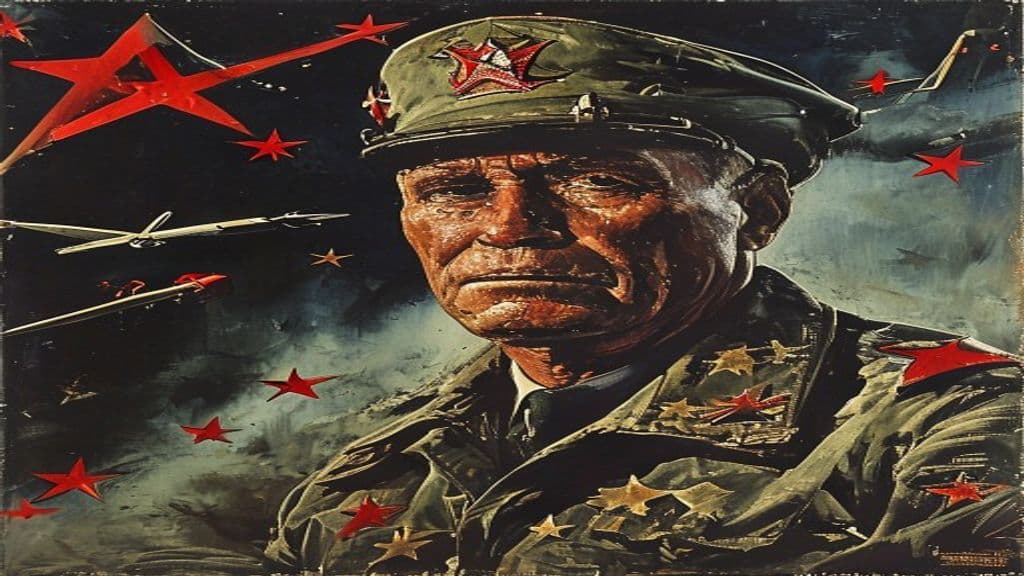
The Colonel Tomb identity emerged among U.S. Navy aviators during the latter part of the Vietnam War as an archetypal enemy ace used to personify and explain aerial combat losses and victories. Sources indicate the legend likely formed from a combination of radio signals intelligence (SigInt) mishearings or callsigns, photographs of North Vietnamese MiG aircraft bearing many victory stars, and the reputations of real VPAF aces such as Nguyễn Văn Cốc. Historians and contemporaneous analysts find no North Vietnamese confirmation of an individual named Tomb/Toon; instead the name appears to be an anglophone rendering linked to noisy intelligence and interpretive practices.
No verified personal portrait or eyewitness physical description of a pilot named Colonel Tomb was released by North Vietnamese authorities. Visual material that fed the legend consisted of photographs of North Vietnamese fighters with many red victory stars—most notably a MiG-17 tail number 3020 (often identified in U.S. accounts as 'the Colonel's aircraft') and a MiG-21 tail number 4326—rather than any image of a named pilot. VPAF practice of recording victory stars on airframes regardless of which pilot flew them complicates interpretations of those photos.
In folklore, Tomb was credited with exceptional aerial combat effectiveness—commonly cited as having shot down 13 American aircraft—but these tallies are legend-based attributions rather than verified individual combat records. The story's alleged behaviors and successes derive from collective attribution, battlefield reporting, and the interpretation of SigInt and imagery rather than documented single‑pilot actions; VPAF records and reporting did not publish a biography or photo for an individual matching the name.
Coilus (Coel)
Coilus (also rendered Coel or Coelus in Latinized forms) is a legendary king of the Britons presented in the medieval pseudo‑history tradition, most notably in Geoffrey of Monmouth's Historia Regum Britanniae. In those accounts he is a human dynastic ruler associated with Roman upbringing, peaceful relations with Rome, and succession within a Geoffreyian royal sequence leading to Lucius.
Cold Higham
A village in Northamptonshire, England with a long history dating back to Roman times. It lacks any associated mythology or supernatural significance. (Note: * Power tier: Not specified or implied in source material. * Origin story: Summary already covers the historical background; consider removing the duplicate information. * Appearance, Abilities, Senso)
Cold spot (paranormal)
A cold spot is an anomalous localized drop in ambient temperature that, in contemporary paranormal discourse, is taken as an indicator of the presence of a ghost or unseen presence. It is described in modern sources as an environmental symptom rather than a personified spirit or agent.
Collared mangabey
The collared mangabey (Cercocebus torquatus) is a real species of Old World monkey native to parts of West and Central Africa. Documented in biological and conservation literature, it is treated as a non-supernatural, arboreal primate of conservation concern rather than a folkloric entity.
Collective Man
A Marvel Comics fictional identity formed by five Chinese quintuplet brothers (the Tao-Yu brothers) who can merge into a single superhuman body. Presented in comic-book storylines as government‑trained agents, contest participants, and occasional adversaries or allies, their powers have varied across issues from five‑person fusion to large‑scale assimilation and size augmentation.
Colonel Heeza Liar
Colonel Heeza Liar is a recurring fictional animated character created by J. R. Bray for early American silent animated shorts (debut 1913). He is a comic archetype: a boastful, retired adventurer and lion hunter, modeled mainly on Theodore Roosevelt and used in serialized film gags rather than as a supernatural being.
Coloniatherium cilinskii
Coloniatherium cilinskii is an extinct genus and species of meridiolestid mammal from the Late Cretaceous La Colonia Formation of north-central Chubut Province, Argentina. Described from jaw fragments, isolated teeth, and petrosals, it is regarded as a large mesungulatid interpreted as part of a distinctive endemic South American Mesozoic mammal radiation.
Colt Pixie
A regional variety of pixie from Southern and South West English folklore (notably the New Forest and Dorset) that appears as a scruffy pale horse or pony and is said to lead travellers and livestock astray, often compared to a Will‑o'‑the‑wisp and associated with the trickster figure Puck.
Columba (Colmcille)
Columba (Colmcille) is an early medieval Irish abbot, missionary and monastic founder venerated as a Christian saint who led the Hiberno-Scottish mission and founded Iona Abbey. Sources depict him as a historical, sanctified human leader — teacher, manuscript owner/copyist, and political actor — rather than a nonhuman spirit.
Columbina
Columbina (also Colombina/Colombine) is a theatrical stock character of the commedia dell'arte tradition: a clever comic servant, often cast as a love interest and foil within romantic and social plots. She is a non-supernatural dramatic persona enacted by actors across centuries of performance, illustration, and adaptation.
Cometes
Cometes (Ancient Greek: Κομήτης) is primarily a Greek personal name borne by several otherwise unrelated mythic figures in classical sources. The term also recurs in modern scientific, commercial, and artistic contexts (taxonomic genera, species names, product names, and usages referring to comets), but there is no single folkloric or spirit-class entity called Cometes in the provided sources.
Commander Kraken
Commander Kraken is a fictional Marvel Comics character: a self-styled modern-day pirate and maritime criminal antagonist who fought heroes such as Namor and Iron Man, was revealed as a member of Hydra (head of its naval division in one issue), and after his death appears among the dead as a member of Pluto's jury in an underworld storyline.
Community Record
- [1]Colonel Tomb. Wikipedia, 'Colonel Tomb' pagewiki