
Accounts vary by textual and regional tradition. In passages of the Ganesha Purana Buddhi and Siddhi appear during Brahmā's worship (Ganesha causes them to appear so Brahmā can offer them back), while in another Ganesha Purana variant they are described as born from Brahmā's mind and given to Ganesha. The Śiva Purāṇa contains a marriage‑competition narrative in which the daughters of Prajāpati (identified with Siddhi and Buddhi or related figures) are involved in Ganesha's marital associations. Tantric sources (e.g., the Ajitāgama) describe forms of Ganapati flanked by two wives (dārā/dārāyugalam). These differing narratives reflect regional and sectarian variation in how Ganesha's attendant figures are configured.
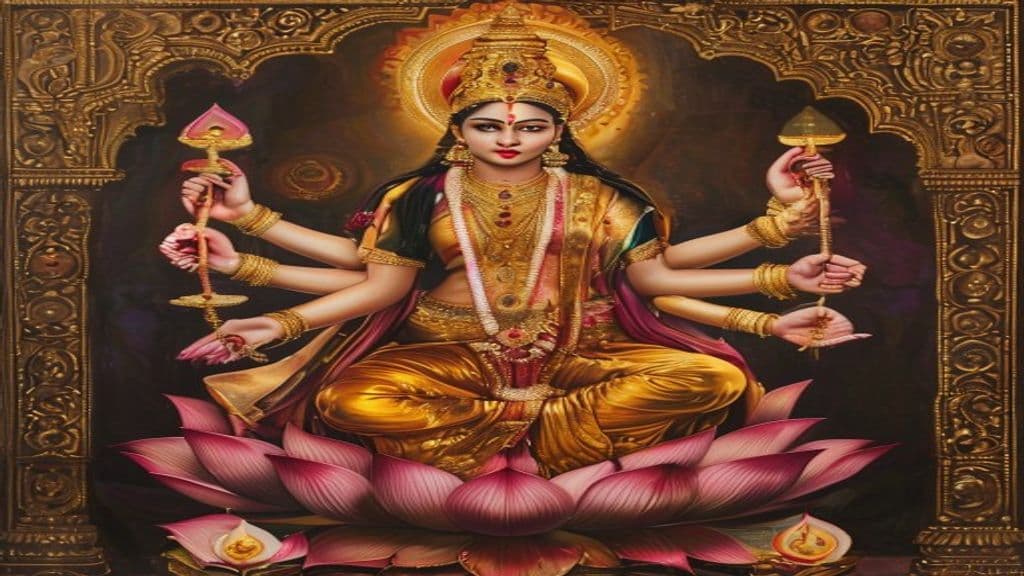
Descriptions in the supplied sources are primarily iconographic and positional rather than detailed anthropomorphic accounts. Siddhi and Buddhi are frequently depicted standing to the right and left of the central Ganesha image in sanctums (for example, the Morgaon temple garbhagṛha). The Aṣṭa‑siddhi are represented in later iconography as a group of young women surrounding Ganesha (visual examples include Raja Ravi Varma's painting where attendants carry fans). The Ajitāgama describes a turmeric‑colored Haridra Ganapati flanked by two unnamed wives, using the Sanskrit term dārā/dārāyugalam; that text thus treats these two figures explicitly with the lexical category 'wives' while remaining within a tantric classificatory context.
The consort‑figures function as personifications or emanations of qualities associated with Ganesha: Buddhi as intellect/wisdom, Siddhi as spiritual attainment/success, and Riddhi as prosperity/growth. Textual passages depict them as attendant powers that accompany or are produced by Ganesha (e.g., Ganesha causes Buddhi and Siddhi to appear in the Ganesha Purana). The Aṣṭa‑siddhi, when personified, can be employed by Ganesha as instruments in mythic action; the Ganesha Purana describes the personified Aṣṭa‑siddhi being used by Ganesha to attack the demon Devantaka. Scholarly commentary in the sources emphasizes that these women often function as shaktis—associate consciousness powers inseparable from the devatā—rather than as autonomous independent beings.
Weaknesses
- otherNo hostile weaknesses documented in provided sources
Wards
- otherNo warding or exorcistic rituals specifically targeted at Ganesha's consorts are documented in the provided sources
Community Record
- [1]Consorts of Ganesha (Wikipedia). Wikipedia, 'Consorts of Ganesha'.wiki
- [2]Vishnu with His Consorts, Lakshmi and Sarasvati (archive image and notes). Archive: Vishnu with His Consorts, Lakshmi and Sarasvati (museum/archive material cited in research notes).other
- [3]ERIC ED434851: India's Myths and Symbols through the Oral Tradition. Fulbright-Hays Summer Seminars Abroad, 1998 (India): 'India's Myths and Symbols through the Oral Tradition' (archive).other
- [4]Notre dernière création... Devatā (archive image/notes). Archive: Devatā sculpture notes (used for devatā/consort symbolism context).other