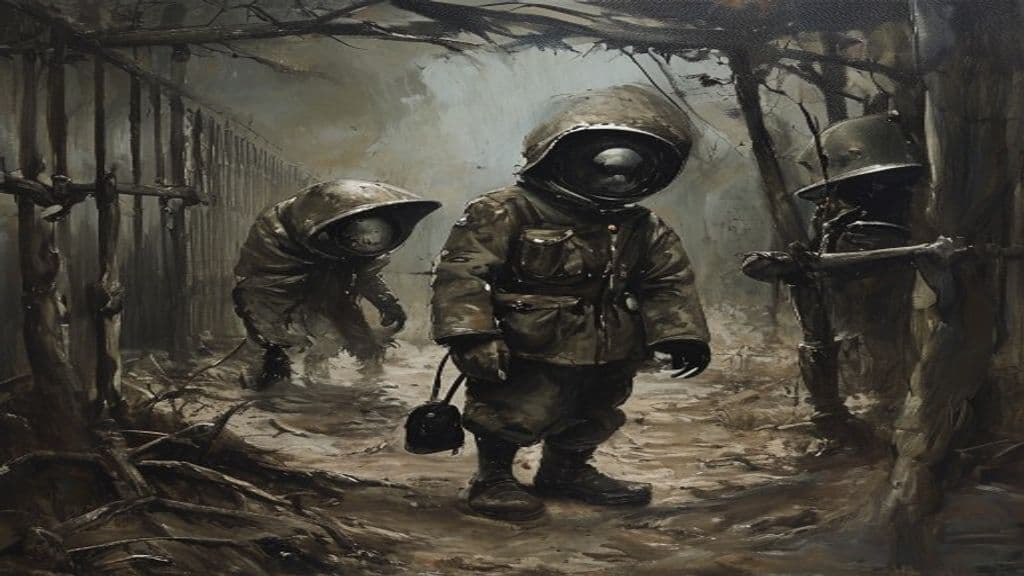
The English term "cooties" appears in early 20th-century military slang, notably among British soldiers in World War I, where it referred to lice infesting trenches. Over the 20th century the term migrated into civilian childlore as an imaginary contagion used in playground interaction. Etymological proposals in the literature include derivation from Austronesian terms (kutu/kuto meaning lice in Philippine, Malay/Indonesian, and Māori languages) and a folk/ironic coinage from "cuties"; sources present these possibilities without definitive proof.
As a playground concept, cooties have no stable visual form — they are an imagined infection with no consistent physical manifestation. Historically the wartime referent was real lice (small parasitic insects) in soldiers' trenches. In modern popular media the concept is sometimes fictionalized (for example, the 2014 film Cooties depicts an invented pathogen that transforms children into violent, flesh-eating figures), but such portrayals are creative adaptations distinct from the childlore game.
Cooties function as social-game mechanics rather than supernatural powers. In childlore a child is said to "catch" cooties through close bodily contact, touching, proximity, or contact with an opposite-sex peer of similar age; this rule-set is used to stigmatize or exclude peers and to codify social boundaries. Children may enact mock immunization or cure rituals (the "cootie shot") to grant or remove immunity within play. The wartime sense referred to the real reproductive and nuisance behaviour of lice; media adaptations attribute biological or violent behaviours to the concept, but such abilities are fictional extrapolations.
Weaknesses
- conditionsocial avoidance (play-prevention)
- ritualcootie shot (play cure/immunization)
Wards
- ritualCootie shot
- conditionAvoiding close contact (especially with opposite-sex peers)
Conan the Barbarian
Conan the Barbarian (also Conan the Cimmerian) is a fictional sword-and-sorcery heroic protagonist created by American author Robert E. Howard. Set in Howard's constructed Hyborian Age, Conan is portrayed as an extraordinary human warrior—renowned for strength, endurance, martial skill, and rugged individualism—whose adventures against human and supernatural foes form a cycle of pulp fantasy narratives and later adaptations in comics, film, and other media.
Concordia
Concordia is the Roman personification and goddess who embodies agreement and harmony, especially within marriage and in broader civic society. The name also appears in later secular toponyms and institutions derived from the same lexical root, but those are distinct from the mythological figure.
Congorilla
Congorilla is a DC Comics superhero identity formed when adventurer William "Congo Bill" Glenmorgan transfers his consciousness into the body of a legendary golden gorilla using a magic ring. Portrayed across mid-20th-century adventure strips and later superhero continuity, Congorilla functions as a protector of the African jungle and its gorillas and as an allied hero within broader DC teams.
Conomor
Conomor is a mid-6th-century Breton/Cornish ruler who in historical sources appears as a violent, ambitious political actor and in later Breton hagiography and folklore becomes a stock villain—an excommunicated count/king accused of murdering rivals, wives and children and opposed by saints such as Samson and Gildas.
Consorts of Ganesha
A set of personified feminine figures—most commonly Buddhi (intellect), Siddhi (attainment/success), Riddhi (prosperity), and the Aṣṭa‑siddhi (eight supernatural attainments)—that appear in Hindu iconography and Purāṇic and tantric texts as attendant shaktis or emanations of the deity Ganesha. They function primarily as symbolic embodiments of faculties, powers, and attainments rather than as ordinary human spouses, and their presence and identity vary by regional, sectarian, and textual context.
Cooperating God and Devil (Slavic creation myth)
In Slavic creation myths, the God and Devil cooperate to create the world, exemplifying a dualistic motif where opposing forces work together for balance. (Note: 1. Power tier: Incorrect, the source material does not specify that the God and Devil have primordial power. 2. Origin story: Needs rewording to reflect that there are multiple versions of Slavic crea)
Coraline
Coraline is the child protagonist of Neil Gaiman's 2002 British fantasy‑horror novella and its film adaptation. She is a living, human girl who discovers a parallel 'Other World' behind a bricked door in the house where her family moves and uses wit, courage, and a protective charm to confront its antagonist, the Beldam (the Other Mother).
Coraniaid
A legendary race described in medieval Welsh sources (notably the tale Lludd and Llefelys) as a plague/oppressive people in Britain whose defining trait is extraordinarily acute hearing. They are overcome in the tale by a biological concoction advised by Llefelys and by tactics that muffle speech.
Cordelia of Britain
Cordelia is a legendary British queen from the Matter of Britain (notably recounted in Geoffrey of Monmouth's tradition) remembered as the youngest daughter of King Leir who refuses flattering speech, goes into exile in Gaul, returns with an army to restore her father, rules as queen, and is ultimately captured and dies; later literary adaptations (notably Shakespeare's King Lear) rework these events for dramatic effect.
Corellon Larethian
Corellon Larethian is the chief deity of the elven pantheon (the Seldarine) in Dungeons & Dragons settings, portrayed as the creator and preserver of the elven race and patron of magic, the arts, and warfare. Corellon appears across multiple editions and campaign worlds as an organized divine power with priests, mythic history, and edition-dependent aspects such as gender fluidity.
Coresus
Coresus is a name borne by two mortal figures in Greek mythic tradition: an autochthonous founder associated with the sanctuary of the Ephesian Artemis, and a priest of Dionysus at Calydon whose unrequited love and prayer to the god bring a lethal frenzy on the city and culminate in his self-sacrifice. Both roles are attested in summaries of Pausanias' accounts preserved in modern reference works.
Coria
Coria is not attested in the provided sources as a mythological or supernatural being. The term appears in the supplied material primarily as a toponym (place-name) in Iberia and Roman Britain and as a modern surname; no documentary evidence in these sources describes a spirit, deity, or monster named 'Coria.'
Community Record
- [1]Cooties - Wikipedia. Wikipedia, 'Cooties' entrywiki
- [2]Cooties (film) - Wikipedia. Wikipedia, 'Cooties (film)' entry (media adaptation example)wiki
- [3]Worldwide Words: Question and Answer on 'cooties'. World Wide Words Q&A, discussion of etymology and usageother
- [4]WWI trench lice quotation (archival reference). Historical accounts cited in summaries noting soldiers nicknamed trench lice 'cooties' and described them as a multiplying nuisance (WWI trench usage).other
- [5]Cooties - Butterflies and Wheels. Article discussing cultural uses of 'cooties'other
- [6]Various archived audio/podcast references. Archive references mentioning storytelling and cultural notes on 'cooties' usageother