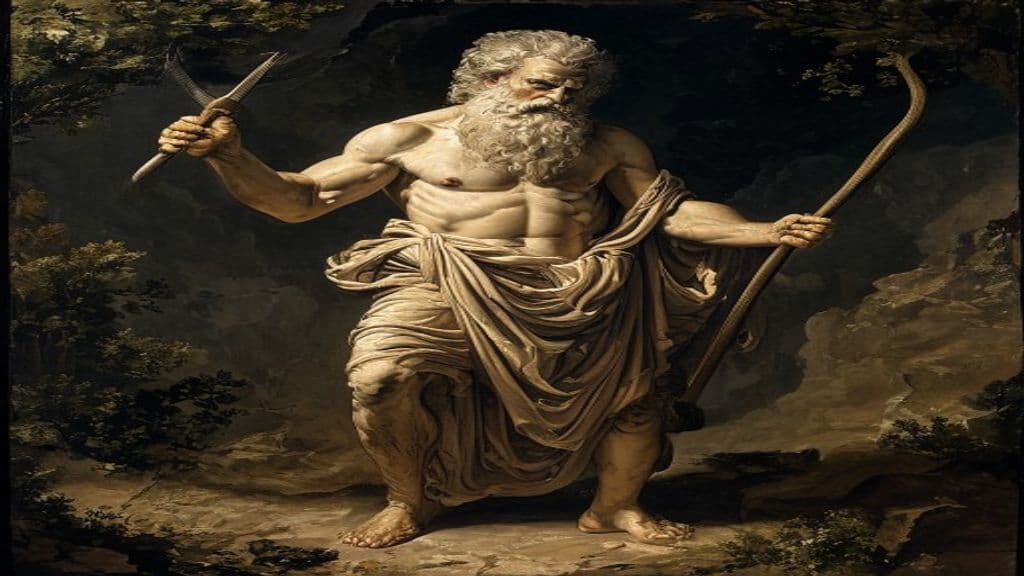
In Hesiodic and related accounts Cronus is the youngest of the Titans, children of Gaia (Earth) and Uranus (Sky). At Gaia's instigation he used a sickle (harpe) to castrate and depose Uranus, an act that reshaped the cosmos and produced several other beings from Uranus's blood. Cronus then took rulership and, according to the tradition summarized in the sources, reigned during a mythic Golden Age. Alternative genealogical placements exist in other authors (for example Plato records a tradition making Cronus a child of Oceanus and Tethys), demonstrating variation across Greek traditions. Classical antiquity later identified him with the Roman Saturn and associated him with a harvest month named after him.
Iconography and literary description emphasize Cronus's agricultural attributes rather than a fixed physical portrait: he is usually depicted carrying a harpe, scythe, or sickle — the instrument used to castrate Uranus — and classical art and literature commonly show him as an older, bearded male figure associated with agrarian symbolism. The supplied sources do not give precise bodily details (color, exact size), focusing instead on these emblematic tools and his role as a ruler.
Cronus's principal attributes in the myths are transformative, procreative, and destructive acts recounted as singular mythic events: he overthrows Uranus (thereby changing cosmic rulership), fathers the principal pre‑Olympian gods with Rhea, and attempts to avert fate by swallowing his newborn children. He is susceptible to deception (Rhea's substitution of a stone wrapped in swaddling clothes) and to force and strategy: Zeus (with various allies and, in some versions, Gaia's cunning or Metis's emetic) forces Cronus to disgorge the swallowed offspring, and the Olympians defeat the Titans in the Titanomachy, after which Cronus is confined to Tartarus in many accounts. Some local Cretan variants add episodes (Zeus hidden on Crete, nurses, Curetes, Amalthea) that surround Cronus's attempts to prevent or to reclaim his offspring. The sources also record an older cultic dimension marking him as originally associated with harvest and seasonal cycles rather than as an ongoing active agent in the living world.
Weaknesses
- conditionvulnerability to deception and force
- otherbeing compelled to disgorge swallowed victims (by emetic in some variants or by force/cunning in Hesiod)
Wards
- otherRhea's substitution (mythic ruse: a stone wrapped in swaddling clothes)
Community Record
- [1]Cronus — Wikipedia. Cronus entry, Wikipedia (as supplied in research notes)wiki
- [2]Cronus — Wikidata. Cronus entry, Wikidata (as supplied in research notes)wiki
- [3]Hesiod, Theogony (summarized in provided excerpts). Summaries of Hesiod's account as provided in research notes (castration of Uranus, swallowing of children, disgorgement, Titanomachy).literary
- [4]Pseudo-Apollodorus and classical summary notes (as referenced). Referenced variations (re-imprisonment of Hecatoncheires and Cyclopes, other narrative variants) cited in the supplied research notes.literary