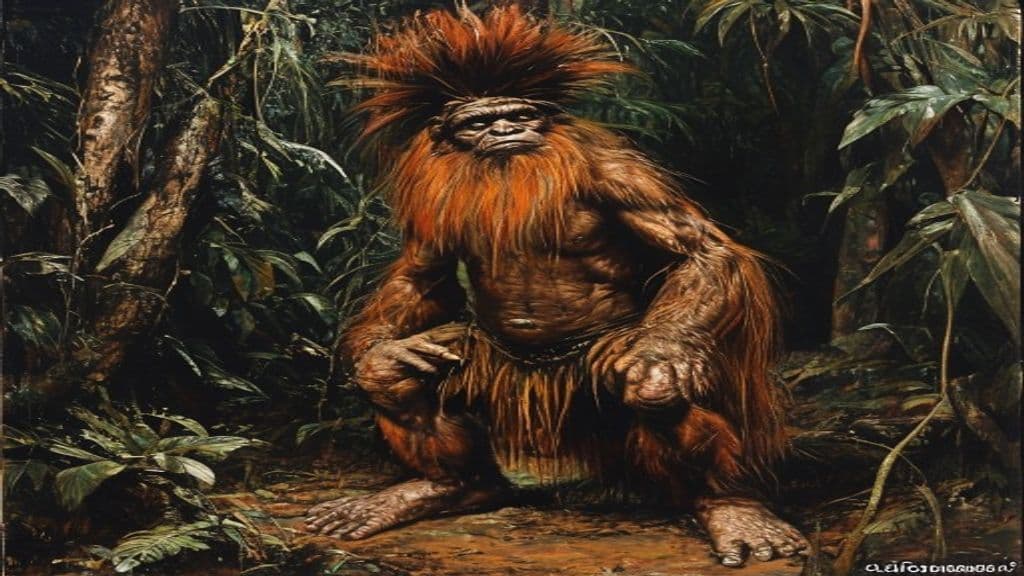
The name and concept derive from Tupi–Guarani linguistic and cultural zones and were recorded from the 16th century onward (first attested in São Vicente, São Paulo, 1560). The etymology reported in sources derives the name Curupira from Nheengatu kuru ('grain, rough') + piré ('skin'), rendered as 'rough or pimply skin'; regional conflations and transformations under European influence have altered portrayals over time.
Descriptions vary by region. Commonly the Curupira is a small-statured hominoid or 'caboclinho' with feet turned backwards (a repeatedly cited trait). Regional variants include bald or balding heads with hairy bodies (Rio Negro basin), long red/orange body hair in later portrayals (likely conflation with Caipora), bright red face or blue/green teeth (Solimões basin), enormous ears, cloven feet, or being one-eyed (Rio Tapajós basin). Lore reports a domestic life: a wife and children dwelling in hollows of dead trees, with local names for wives (e.g., Tatácy/Tatámanha in some Amazonas/Pará accounts).
Acts as a forest guardian who punishes wanton timber cutting and other destructive acts by causing people to lose their way, wander timelessly in the forest, or suffer misfortune; early accounts ascribe physical attacks that could scar bodies. The Curupira misleads trackers using its backward feet and creates confusing sounds to disorient travelers. It is portrayed variously as a trickster-like wood-sprite that foments distrust and 'bad thoughts' and as a being that can be propitiated by hunters. Lore records behavior of beating the projecting buttress root (sapopema) of trees to 'diagnose' sturdiness, linking it to monitoring forest health. In regional variants it may ride animals (deer, rabbit, pig, peccary) and sometimes rewards hunters who secretly offer favored items.
Weaknesses
- substancetobacco
- substancecachaça (sugarcane liquor)
Wards
- ritualSecret offering of tobacco
- ritualOffering of cachaça
Caipora
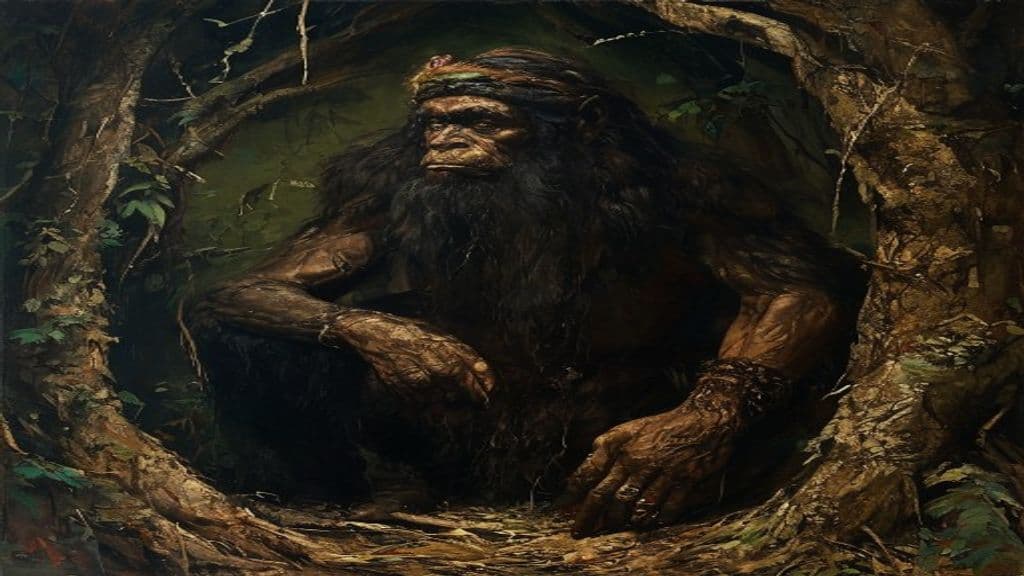
A Tupi-derived forest-dwelling being in Brazilian folklore depicted as a guardian or controller of wild animals and game; regionally variable in form and temperament, it misleads or punishes hunters who transgress forest norms and may be placated with offerings such as tobacco or alcohol.
Saci
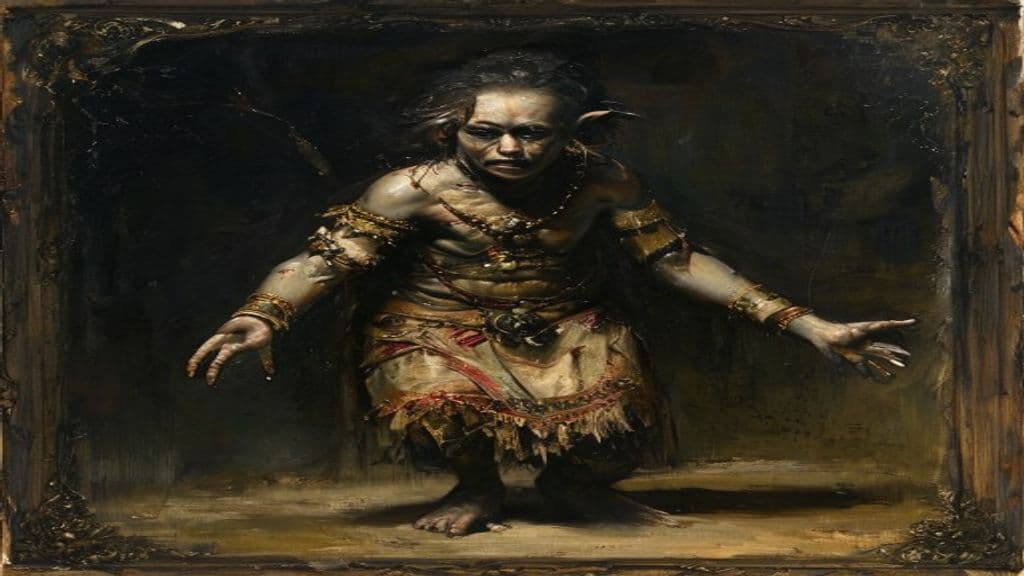
Saci is an impish mythical character of Brazilian folk tales, identified in general reference sources as a named figure within Brazilian folklore.
Caipora
A Tupi-derived forest-dwelling being in Brazilian folklore depicted as a guardian or controller of wild animals and game; regionally variable in form and temperament, it misleads or punishes hunters who transgress forest norms and may be placated with offerings such as tobacco or alcohol.
Caipora
A Tupi-derived forest-dwelling being in Brazilian folklore depicted as a guardian or controller of wild animals and game; regionally variable in form and temperament, it misleads or punishes hunters who transgress forest norms and may be placated with offerings such as tobacco or alcohol.
Culhwch
Culhwch is a mortal heroic figure of medieval Welsh narrative tradition, protagonist of the tale Culhwch and Olwen. A noble-born youth and cousin of Arthur, his story centres on a quest to win Olwen by completing a series of impossible tasks (anoethau) with the aid of Arthur and his warriors.
Culsu
Culsu is an attested name listed among Etruscan deities and legendary figures in modern compilations. Available sources provide only nominal attestation (the name and a modern label of 'goddess'); no independent ancient narratives, functions, iconography, or rituals are recorded in the supplied materials.
Cult of Dionysus
A cult associated with the Greek god Dionysus, patron deity of wine, fertility, theater, and ecstasy. (Note: 1. Factual claim: The article states that Dionysus's original name 'Dionysus' (Διόνυσος) is derived from Linear B tablets as 𐀇𐀺𐀝𐀰 (di-wo-nu-so). However, the source material does not support this )
Cunizza da Romano
Cunizza da Romano (c.1198–1279) is a historical Italian noblewoman of the da Romano family who appears as a named soul in Dante Alighieri’s Divine Comedy (Paradiso Canto IX), located among the blessed of the heaven of Venus and presented as an exemplum of lives shaped by love.
Cupid
Cupid (Latin: Cupīdō or Amor) is the Roman god of desire, erotic love, attraction, and affection, depicted in classical and later Western art and literature as a youthful, often winged figure whose arrows inspire love or aversion.
Curetes
The Curetes (Greek Κουρῆτες, Kouretes) are a named group of ritual attendants or minor divine retainers associated with Aegean and Anatolian mother-goddess cults—primarily Rhea and Cybele. They are attested in ancient sources and modern reference works as dancing servants or ritual personnel whose name also survives in urban toponymy (e.g., Kouretes/Curetes Street at Ephesos).
Cusco Quechua
Cusco Quechua (Qusqu qhichwa simi / Qusqu runasimi) is a regional variety of Southern Quechua spoken in the city and Department of Cusco, Peru. It is part of the Southern Quechua grouping (including Puno and Bolivian varieties) and is the variety used and promoted by the Academia Mayor de la Lengua Quechua in Cusco; sources note debates over vowel analysis and orthography and list the variety as vulnerable in language-vitality metadata.
Cuélebre
A legendary long‑lived reptilian guardian from Asturian and Cantabrian folklore, depicted as a giant winged serpent or dragon that inhabits caves and watery liminal places, guards treasure, and is sometimes said to hold xanas (fairy‑like beings) captive. Folktales attribute to it senescent physical changes, a miraculous healing byproduct, and specific folkloric countermeasures.
Cyane
Cyane (Ancient Greek Κυάνη, Kuánē, 'dark blue') is a Sicilian water-nymph (naiad) associated with a spring or pool near Syracuse. In myth she attempts to block Hades' abduction of Persephone, pleads by citing her own consensual relationship with the river-god Anapus, and—after failing—dissolves into the waters of her pool; the spring is thereafter sacred and named for her.
Cyanippus
Cyanippus (Greek: Κυάνιππος) is a personal name attested for at least three distinct mortal men in Greek mythic traditions: an Argive/Achaean warrior-king connected to the Trojan Horse cycle, a Thessalian hunter whose dogs kill his wife, and a Syracusan who omitted worship of Dionysus and whose divinely induced crime leads to oracle-driven expiation. He is presented as human rather than as a supernatural being.
Cybele
An Anatolian mother goddess (Phrygian Matar Kubileya) whose cult centers on mountains, city protection, fertility, and wild nature; adopted and reinterpreted by Greek and Roman religion where she became associated with ecstatic rites, a eunuch priesthood (the Galli), and the Roman Magna Mater cult.
Cybernary
Cybernary is a fictional comic-book character and the title of a WildStorm series; presented as a cybernetically enhanced human whose body and systems carry or host other consciousnesses. Originating in 1990s American comics, Cybernary functions as a cybernetic anti‑heroine and narrative construct within post‑apocalyptic / cyberpunk superhero fiction.
Community Record
- [1]Curupira - Wikipedia. Wikipedia contributors. 'Curupira.' Wikipedia, The Free Encyclopedia.wiki
- [2]Curupira - Wikidata. Wikidata entry Q16861723.other
- [3]The Curupira Legend. Cristiana de Souza, 'The Curupira Legend' (archive.org).folk
- [4]Our World : BBCNEWS (archive). BBC 'Our World' (archive.org).other