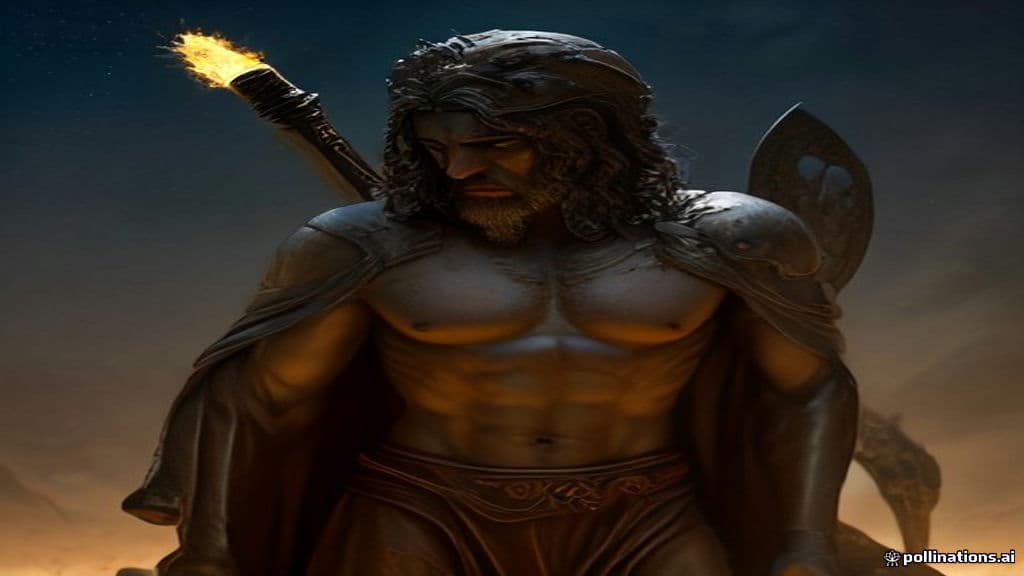
The name Κυάνιππος appears in multiple independent Greek narrative contexts rather than as a single origin tale. In one tradition Cyanippus is presented as an Argive connected to heroic genealogies (variously given as son of Aegialeus and Comaetho or son of Adrastus and Amphithea) who fought at Troy and entered the wooden horse; after the war he ruled Argos briefly before dying childless and being succeeded by Cylarabes (attested in summaries of epic/genealogical sources and scholia, and cited in modern reference summaries). A second tradition names Cyanippus as the Thessalian son of Pharax whose passion for hunting and consequent neglect of his young wife Leucone produces a domestic tragedy: his hounds mistake Leucone for game, tear her apart, and the husband commits suicide in grief (attested in Parthenius-like myth summaries). A third tale, recorded in Parallela Minora/ Pseudo-Plutarch summaries, casts a Syracusan Cyanippus who fails to venerate Dionysus; the god causes a drunken frenzy in which Cyanippus violates his daughter Cyane, after which an oracle identifies an impious man whose death will end a plague and Cyane kills her father and herself, fulfilling the oracle's prescription.
Ancient sources do not provide a consistent physical description across the traditions. One literary attribution (Ibycus, cited in later summaries) describes Cyanippus of Troy as 'the most handsome man who fought at Troy,' but beyond that isolated epithet the accounts lack sustained iconographic or bodily detail. Each narrative focuses on role and action (warrior-king, hunter, impious citizen) rather than on standardized appearance.
No supernatural powers are ascribed to Cyanippus in the provided sources; he is consistently presented as a mortal man whose notable capacities are social and narrative: martial prowess and handsome appearance in the Trojan/Argive tradition (entered the Trojan Horse and fought at Troy), exceptional hunting skill or obsession in the Thessalian episode (owner of hounds whose misdirected attack causes tragedy), and the social-religious failing of omitting sacrifice to a god in the Syracusan episode (which prompts divine intervention by Dionysus). Divine effects that befall or are enacted through Cyanippus (drunkenness and rape) are explicitly attributed to Dionysus in the Syracusan account, not to Cyanippus himself.
Weaknesses
- conditionmortality and human passions
Wards
- ritualproper veneration/sacrifice to Dionysus
Community Record
- [1]Cyanippus (Wikipedia). Wikipedia, entry 'Cyanippus' (summary of classical traditions and variants).wiki
- [2]Cyanippus (son of Pharax) (Wikipedia). Wikipedia, entry on the Thessalian Cyanippus (son of Pharax) describing the Leucone episode.wiki
- [3]Parallela Minora (Pseudo-Plutarch). Pseudo-Plutarch, Parallela Minora (as preserved and summarized), containing the Syracusan Cyanippus/Dionysus/Cyane account.literary
- [4]Myths UVic: Cyanippus entry. Myth summary collating classical attestations for Cyanippus traditions (reference summary).other
- [5]Apollodorus / Argive genealogical summaries (archive references). Collected classical genealogical material and library summaries used in modern reference entries regarding Argive/Cyanippus genealogies and Trojan association.other