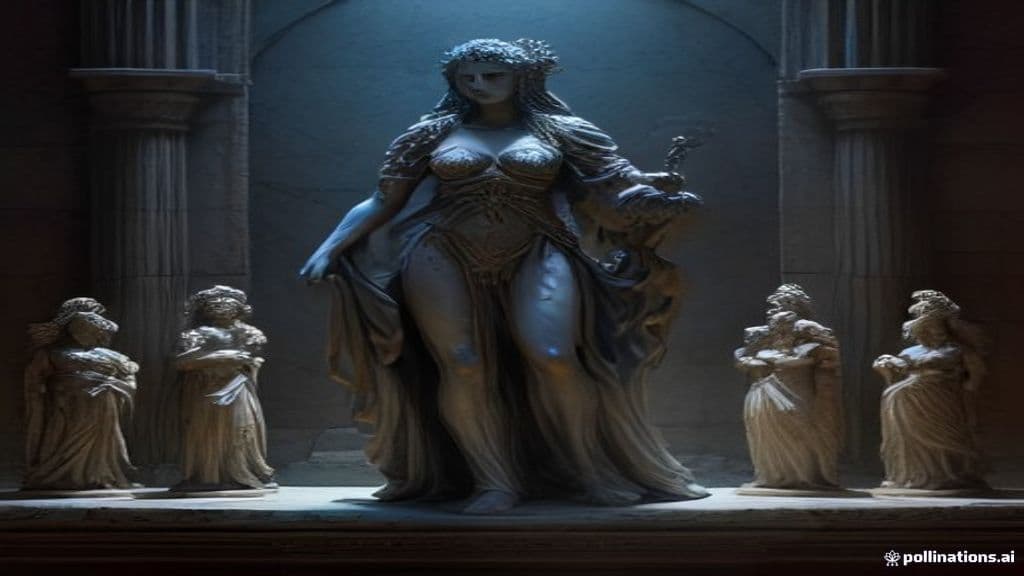
Sources present Cybele as an indigenous Anatolian/Phrygian 'Mother' figure (Phrygian Matar Kubileya) tied to mountains and local landscapes; at Pessinos her cult form took the shape of an aniconic black meteoric iron stone. Later Greek and Roman authors assimilated and reinterpreted her, linking her to Greek mother‑goddesses (Rhea, Gaia, Demeter) and, in Roman tradition, presenting her as Magna Mater following a Sibylline oracle in 205–204 BC. Scholarly notes suggest possible antecedents in Neolithic Anatolian imagery (Çatalhöyük) and a possible onomastic connection or influence from the Kubaba tradition, but contemporary Phrygian textual evidence is limited and reconstructions remain interpretive.
Phrygian iconography shows attendant lions and a bird of prey and small libation vases; in some local cults the goddess was represented aniconically (notably an unshaped black meteoric iron stone at Pessinos). As a protector of cities she is sometimes depicted wearing a mural crown. Greek ritual imagery emphasizes a lion‑drawn chariot and attendant ecstatic followers; later Roman representations integrate these Hellenic elements into the Magna Mater iconography.
Sources attribute to Cybele a protective, tutelary function for cities and rulers and a mediating role at boundary zones (civilized/wild; living/dead). Her cult practices in Greek reception are described as ecstatic and disorderly (wild music, wine, processional chariot), and her cult developed a distinctive eunuch priesthood, the Galli. In Roman state practice she was invoked as an allied protector (Magna Mater) during crises, brought to Rome by state decree on the advice of a Sibylline oracle. Ritual practices linked to her cult include pit‑type libation and blood offerings in Phrygian contexts and, in the Roman imperial era, the taurobolium and criobolium sacrifices, though detailed procedural texts are not provided in the supplied sources.
Weaknesses
- otherNo specific personal vulnerabilities attested in supplied sources
Wards
- ritualCivic adoption/invocation (Roman conscription of the cult — aniconic stone at Rome)
- otherNo household or prophylactic warding practices against Cybele are described in the supplied sources

Rhea
Rhea is a principal mother goddess of the Titans in ancient Greek religion and mythology, daughter of Gaia and Uranus, sister and consort of Cronus, and mother of major Olympian deities. In Roman reception she is identified with the Magna Mater (the Great Mother), reflecting continuity of her maternal and cultic role across Greek and Roman traditions.

Attis
Attis is a mythic consort and semi-divine cult figure associated with the Anatolian Mother Goddess (Cybele / Agdistis). He functions as a vegetation-associated beloved whose self-castration, death, and ritual rebirth form the core myth enacted by his priests and festivals, especially around the vernal equinox in Phrygia, Greece and later Rome.

Agdistis
Agdistis is a Phrygian-origin deity incorporated into Greek and Roman mythic tradition, described in ancient sources as born with both male and female sexual organs and closely associated with the Great Mother goddess (Cybele) and the Attis cycle. The figure functions as an origin-mythic cause for features of the Cybele/Attis cult (notably the existence of eunuch priests) and is tied to specific sacred sites around Pessinus and a Mount Agdistis/Agdus rock.
Community Record
- [1]Cybele — Wikipedia. Wikipedia contributors. 'Cybele.' Wikipedia, The Free Encyclopedia.wiki
- [2]Wikidata: Cybele. Wikidata entry Q70392029 for 'Cybele'.other
- [3]413 Ethnography Episode 2: Blanche Cybele Derby (archive). Archive.org listing (personal name reference; does not provide ancient cult details).other
- [4]Transparent Illuminati Agenda, Saturn's Wife, & Reversed Role Worship... (archive). Archive.org listing (modern media reference; not a primary source on ancient cult).other