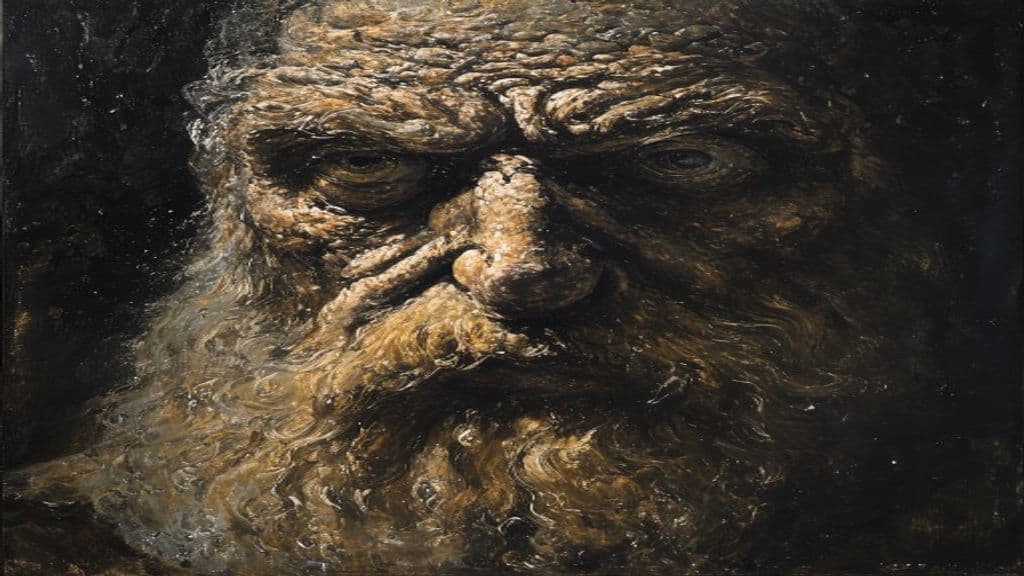
Sources present multiple origin strands rather than a single origin story. In Hesiod's Theogony a set of three named Cyclopes—Brontes, Steropes, and Arges—appear in the mythic, cosmogonic generation and serve as divine smiths who forge Zeus's thunderbolt, Poseidon's trident, and Hades' Helm of Darkness. A separate Homeric tradition treats Cyclopes as a non‑civic pastoral people (the most famous individual being Polyphemus) who live apart from human polities in caves and act as dangerous ‘others.’ A later etiological tradition attributes large, prehistoric masonry (the so‑called Cyclopean walls at sites like Mycenae and Tiryns) to Cyclopes as legendary builders. These strands coexist in the Greek literary and folkloric corpus as alternative explanations for extraordinary skills, monstrous otherness, or massive architecture (sources: Hesiodic tradition, Homeric tradition, and later encyclopedic summaries such as the supplied Wikipedia entry).
Across the supplied sources the defining and consistent physical trait is a single central eye ('one‑eyed') placed on the face; they are otherwise described as giant or very large humanoid figures. Homeric Cyclopes (e.g., Polyphemus) are depicted as massive, cave‑dwelling shepherds—humanlike but of great size—while other traditions emphasize prodigious bulk and strength sufficient to handle enormous stones. No detailed iconography (specific proportions, color, dress) beyond 'one‑eyed' and 'giant' is attested in the materials provided (sources: Homeric episode references, Hesiodic lists, Wikipedia summary).
Abilities vary by tradition in the sources. In Hesiod the Cyclopes possess extraordinary smithing and artisan skill, forging potent divine instruments (Zeus's thunderbolt, Poseidon's trident, Hades' Helm of Darkness), which places them among world‑ordering craft forces. In the Homeric model they are powerful, pastoral, solitary figures whose behavior includes brutality toward outsiders (Polyphemus eats members of Odysseus's company) and violation of hospitality norms; they display superhuman physical strength (able to handle and throw large stones) although explicit magical powers are not described in the provided texts. Later popular summaries and modern adaptations amplify physical strength and monstrous violence, but these are receptions rather than ancient attestations (sources: Hesiodic tradition, Homeric tradition, supplied summaries).
Weaknesses
- othervulnerability to cunning and physical injury (Homeric Polyphemus blinded by Odysseus' trick)
Wards
None recorded.
Aegaeon
Aegaeon is a name used in ancient Greek myth for multiple figures, most notably a Hecatoncheir sometimes equated with Briareus and also borne by several localized personages (an Arcadian prince, a son of Lycaon, and occasional Giants). The name carries maritime and stormy connotations (etymologized as 'goatish', 'stormy', or 'Aegean') and in some traditions marks a primordial, multiform monstrous kin of the gods.
Aleuas
Aleuas (Greek: Ἀλεύας; Modern Greek: Alevas) is a figure in ancient Greek tradition presented as a mythical king and seer of Thessaly and the eponymous ancestor of the noble Aleuadae family of Larissa. The name also appears for distinct historical individuals and as a modern scientific/commercial homonym, but classical sources treat Aleuas as a legendary human ancestor rather than a recurring supernatural class.
Erechtheus
Erechtheus is a mythic-heroic foundational figure of ancient Athens whose identity blends an autochthonous, earth-born ancestor-king with a localized cultic name often syncretized with Poseidon; he functions as eponymous progenitor of the Erechtheidai and as the focus of ritual memory on the Acropolis (the Erechtheion).
Inachus
Inachus (Ἴναχος, Inachos) is a mythic ancestral figure of Argos who functions both as the region's eponymous first king/priest and as a river-divinity descended in some accounts from the Titans Oceanus and Tethys. He appears in etiological narratives that tie Argive territory, cult, and seasonal hydrology to a pre-Olympian generation of river-gods and founders.
Limnades
Limnades (Ancient Greek: Λιμνάδες) are classically attested nymphs associated with lakes in ancient Greek literature. They function as the lake-dwelling subgroup within the broader taxonomy of nymphs and are referenced as resident or offspring-attendants of named lake deities such as Bolbe.
Prometheus
Prometheus is a Titan of ancient Greek myth credited as a benefactor and culture-bringer to humanity, most famously for stealing fire from the Olympian gods and giving it to people. He is portrayed as intelligent and forward-looking (etymologically associated with 'forethought'), and as punished by Zeus for his transgression.
Salmacis
Salmacis is a naiad — a freshwater nymph tied to a specific spring near ancient Halicarnassus in Caria. In classical literature (notably Ovid) she appears in the Hermaphroditus narrative: her passionate pursuit and prayer are the occasion for the fusion of Hermaphroditus' and her bodies, and the spring acquires a reputation for making men 'effeminate and soft.'
Cychreides
Cychreides (Greek Κυχρείδης) is a serpent- or dragon-like monster of Greek myth associated with the island of Salamis and, in some variants, with the goddess Demeter. Traditions differ: it is variously portrayed as a terrorizing beast slain or driven off by humans, a serpent kept by Demeter (including as one of the pair that drew her chariot), or as an epithet applied to the hot‑tempered Cychreus himself.
Cychreus
Cychreus is a legendary local hero and king of Salamis in Greek tradition, son of Poseidon and the nymph Salamis, variably portrayed as slayer, keeper, or figurative ‘dragon’ in traditions that connect him to cult practice and Athenian political uses.
Cyclopean Masonry (Greek Tradition)
In Greek tradition, Cyclopean masonry is an architectural style characterized by massive limestone boulders roughly fitted together without mortar, associated with the mythical one-eyed giants. (Note: * Power tier: Primordial seems too high for an architectural style; consider Lesser or Greater. * Appearance: While massive structures can be imposing, unease or foreboding is more subjective interpre)
Cycnus (son of Ares)
Cycnus (Ancient Greek Κύκνος) is one of several mythic personages named ‘Cycnus’ whose narratives culminate in transformation into a swan; the son of Ares is one attested bearer of that name within the wider Greek motif of human/divine metamorphosis into the bird and occasional stellar aetiology linking the figure to the constellation Cygnus.
Cycnus of Aetolia
Cycnus (Kyknos) of Aetolia is a mythic Aetolian prince, traditionally described as a son of Apollo by Hyrie/Thyrie and situated in Calydonian/ Aetolian narrative cycles. He appears in sources as a semi-divine youth, variously cast as a princely figure involved in erotic episodes (traditionally the beloved of Phylius in some retellings) and as a combatant referenced in heroic/martial catalogues and poetic metamorphosis traditions.
Community Record
- [1]Cyclopes (Wikipedia). Wikipedia: Cyclopes — summary of ancient Greek and later Roman traditions distinguishing Hesiodic, Homeric, and Cyclopean masonry strands.wiki
- [2]The Cyclops by Euripides (Internet Classics Archive). Euripides, The Cyclops — dramatic treatment preserving pastoral and satyr‑chorus contexts that align with the Homeric pastoral/cave‑dwelling depiction.literary
- [3]Cyclops (MarvelDirectory — modern adaptation summary). Modern popular culture summaries that amplify superhuman strength and giant size; cited here only as reception and not as ancient attestations.other
- [4]Cyclops (Fantastic Four foe) — marvunapp. Popular culture reference illustrating later fictional elaborations of Cyclops' strength; not a primary ancient source.other