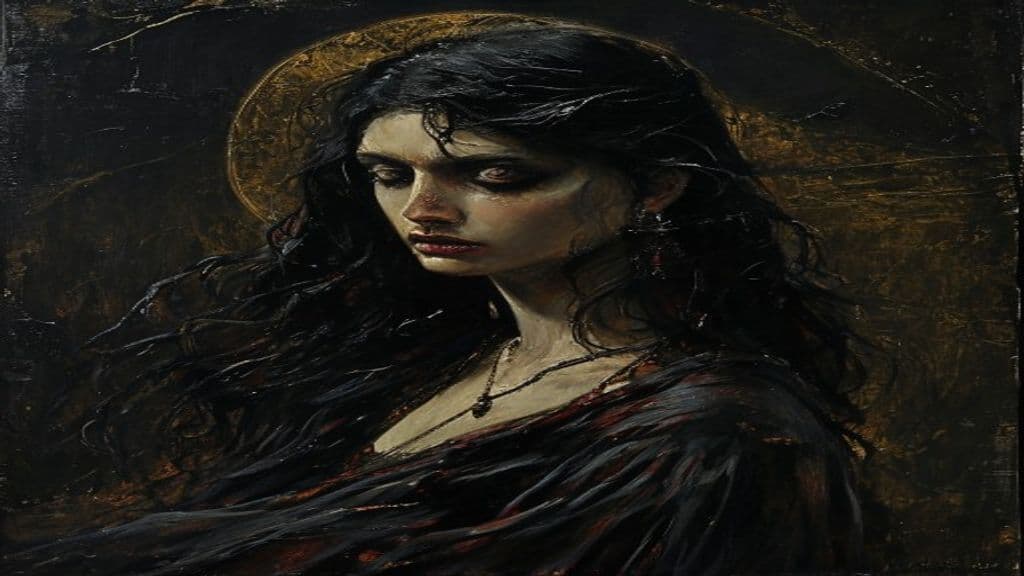
The cited sources present the vernacular term daayan/ḍāin as etymologically linked to the Sanskrit dakini. Medieval Hindu texts (Bhagavata Purana, Brahma Purana, Markandeya Purana, Kathasaritsagara) describe dakinis as female paranormal entities associated with pātāla and as attendants of Kali characterised in those texts as fiendish and flesh‑eating. The available material frames this linguistic and conceptual connection but does not provide a specific continuous historical narrative tracing dakinis directly into contemporary daayan belief.
The provided sources primarily identify the daayan as a female spirit or ghost — often the restless spirit of a woman who suffered a traumatic or unresolved death — but do not supply consistent standardized visual traits or a detailed physical description in the cited material.
Cited descriptions emphasise that a daayan is a malevolent, vengeful supernatural agent. The linked dakini imagery in medieval texts depicts such female fiends as flesh‑eating attendants of Kali; from those texts the literature associates daayans with predatory, harmful behaviour toward humans. The available sources do not enumerate a specific list of additional powers (e.g., shapeshifting, flight, possession) for the daayan itself.

Nagin
Nagin refers in the supplied sources to the female form of the South Asian serpent-being (Nāginī / Nagini) and to popular-media uses of that figure (film and television). Sources identify Nāginī as the feminine form of Nāga, note a locally worshipped form (Nagini or Naiṇī Devī) in the Central Himalaya, and link the term to folkloric shape‑shifters called Ichchadhari Nāgas as well as to multiple cinematic and television adaptations.
Cú Sídhe
The supernatural fairy hound of Celtic tradition — enormous, dark green or white, who hunts in eerie silence and whose triple bark is a death omen.
Căpcăun
A monstrous antagonist in Romanian folktales, the căpcăun is typically depicted as a dog-headed ogre who kidnaps and eats people (especially children and young women). It functions narratively as an embodiment of evil alongside other Romanian monsters such as the zmeu and balaur.
Cŵn Annwn
Cŵn Annwn are the spectral hounds of the Welsh Otherworld (Annwn), portrayed in medieval Welsh tradition as white dogs with red ears that hunt under the authority of Annwn's rulers (notably Arawn and later associations with Gwyn ap Nudd). They appear in Wild Hunt narratives as hunters of game or wrongdoers and as omens of death; later Christian commentators reinterpreted them as 'Hounds of Hell.'
D'Bari
The D'Bari are a fictional extraterrestrial, semi-humanoid, plant-like species from Marvel Comics, native to the planet D'Bari IV. Their civilization was nearly annihilated when the Phoenix Force consumed their star during the Dark Phoenix Saga; survivors and individuals appear across subsequent comic stories and adaptations.
D'Spayre
D'Spayre is a fictional extradimensional mystical entity from Marvel Comics who sustains himself by feeding on human despair, despondency, fear, and anguish. Presented as a creation of the Dweller-in-Darkness and a member of the Fear Lords, he operates on Earth to manipulate victims' minds and amplify hopelessness for psychic sustenance.
Da Siming
Da Siming (大司命) is a deified official-title in Chinese religious-cultural frameworks representing an office that administers and ‘‘makes fine adjustments to human fate.’’ The figure appears in textual and religious contexts as part of a bureaucratic cosmology of cosmic administration and is often presented as one half of a dyadic pair with Shao Siming.
Dactyls
Dactyls (Ancient Greek Daktuloi, literally "fingers") are archaic mythical figures in Greek tradition associated with Mount Ida; some traditions credit an Idaean Dactyl named Herakles with originating the Olympic Games. The term also appears in later cultural registers (poetic meter, modern astronomical naming).
Daedalion
Daedalion (Ancient Greek: Δαιδαλίων) is a figure from Greek myth: a son of Hesperos/Phosphorus, father of Chione, and brother of Ceyx who, grieving his daughter's death, attempts suicide and is transformed by Apollo into a hawk. The metamorphosis is presented etiologically to explain hawk strength and predatory habits as continuations of his character and grief.
Daedalus
Daedalus (Greek Δαίδαλος) is a legendary master craftsman, architect, and inventor of Greek mythic tradition credited with complex constructions (the Labyrinth), ingenious devices (a wooden cow), and mechanical inventions (wings for flight). He functions as an archetypal artisan whose skill alters human affairs and whose pride produces moral and social consequences.
Daeira
Daeira is an Oceanid-nymph closely associated with the Eleusinian Mysteries and the town of Eleusis in Attica. Her name means "the knowing one," and ancient sources present her variously as a local progenitor, a bearer of esoteric initiation knowledge, and in multiple traditions equated or contrasted with major goddesses such as Persephone, Demeter, Aphrodite, Hera, and Hekate.
Daemon (classical)
In classical Greek and Roman contexts a daemon (daimon) denotes an intermediary spirit or nature-being that can be benevolent, ambivalent, or morally mixed. Daemons occupy an ontological position between gods and humans and appear as personal guiding signs, place-linked spirits, or participants in local cultic life rather than as categorically evil entities.
Community Record
- [1]Daayan (witch) — Wikipedia. Wikipedia contributors. "Daayan (witch)." Wikipedia, The Free Encyclopedia.wiki
- [2]Daayan — Wikidata entry. Wikidata entry Q7728601: 'Daayan'.other
- [3]SSSHHHH.... PHIR KOI HAI Episode 29 (DAAYAN BANI DULHAN) - Archive listing. Archive.org listing for television episode titled with 'daayan'.other