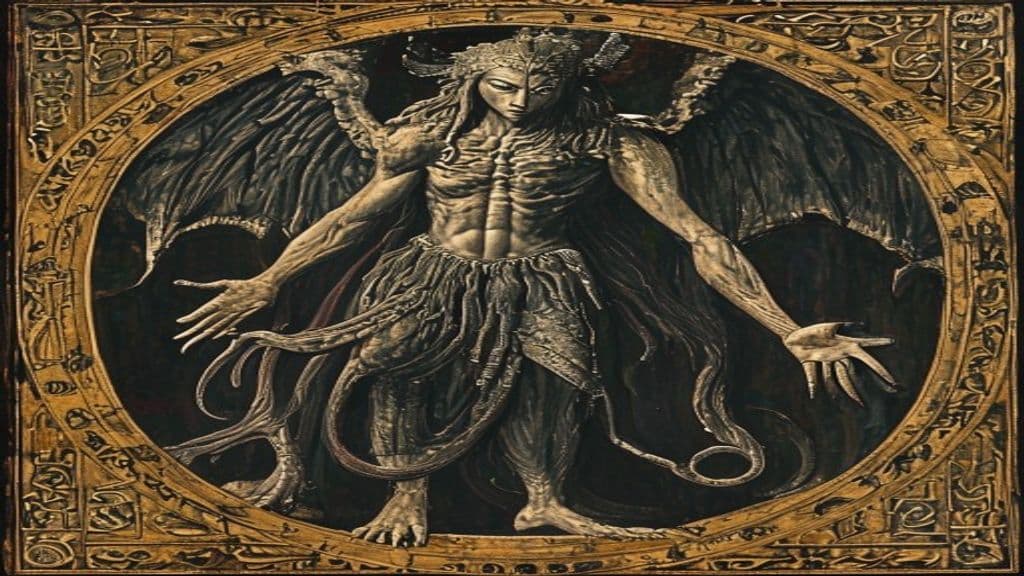
Primary ancient sources and modern scholarship present Dagon as a longstanding high-ranking local god of inland Syria and the middle Euphrates with principal cult centers at Tuttul and Terqa and attestations in city-states such as Mari and Emar. In inland Euphrates settlements he was regarded as a “father of gods,” lord of the land and a source of royal legitimacy; Mesopotamian god-lists later equated him with Enlil and Hurrian tradition equated him with Kumarbi, reflecting theological syncretism. Modern linguistic scholarship (notably proposals by Lluís Feliu and supported by Alfonso Archi) argues the theonym likely derives from a pre-Semitic Syrian substrate rather than the medieval or folk etymologies that connected the name to fish or grain.
The supplied sources do not preserve a consistent or standardized ancient iconography for Dagon: there is no primary-source anthropomorphic or zoomorphic description established across his attestations. Medieval Hebrew exegetical associations linking the name to Hebrew דָּג (dāg, “fish”) produced later imaginations of piscine features, but modern scholarship (as summarized in the provided survey) treats the fish-derivation and consequent fish-like depictions as incorrect and not supported by the ancient cultic record. Temples and cult installations are attested archaeologically/textually, but surviving materials in the supplied corpus do not include a definitive visual type for the god.
In the evidence summarized by the supplied academic synthesis, Dagon’s functions are cultic and political rather than described as a catalogue of magical feats: he operates as a senior paternal deity—“father of gods”—a lord of the land, a god of prosperity and a legitimizer of kingship in inland Syrian contexts. Mesopotamian and Hurrian syncretisms equate his role with Enlil and Kumarbi respectively, indicating shared high-ranking functions in ordering divine and royal authority rather than literal identity. Biblical narrative sources portray him as the focus of Philistine cultic thanksgiving for military victory (e.g., Judges 16:23–24), but extrabiblical archaeological evidence for a Philistine national cult centered on Dagon is described in the supplied materials as lacking or uncertain. The supplied corpus does not ascribe a set of specific magical powers, possession phenomena, or narrowly defined supernatural actions to Dagon beyond these cultic and legitimating roles.
Weaknesses
- othernone attested in sources
Wards
- othernone attested in sources

Enlil
Enlil is a principal deity of ancient Mesopotamia, originally preeminent in the Sumerian pantheon as a supreme lord who orders the world by separating heaven (An) from earth (Ki). His principal cult center was the E-kur temple at Nippur, and his cult practices focused on daily offerings and priestly care of his cult statue; mythic traditions portray him as both benefactor and punisher in the administration of cosmic and social order.
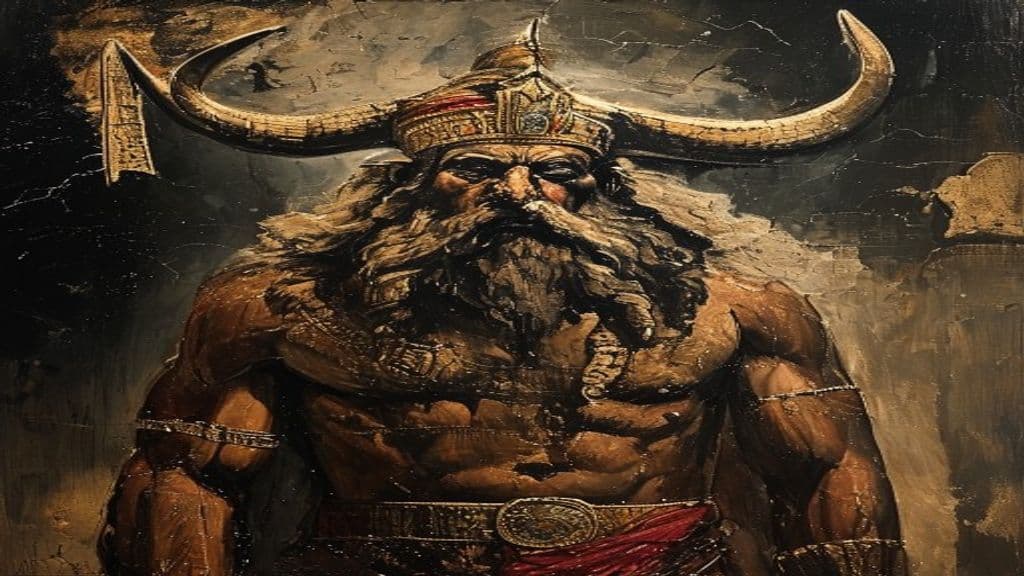
Hadad (Haddu / Adad / Iškur)
Hadad is the ancient Near Eastern storm and rain deity attested across Levantine and Mesopotamian traditions (Ugaritic Haddu, Akkadian Adad, Sumerian Iškur). He is a high-ranking weather-lord associated with rain, thunder, fertility of fields, and a dual capacity to nourish crops and to unleash destructive storms; he plays central roles in temple cult, royal ideology, and mythic battles (notably the Ugaritic Baal Cycle).
Community Record
- [1]Dagon — Wikipedia. Wikipedia, entry 'Dagon' (summary of ancient attestations, temples, functions, etymology and reception).wiki
- [2]Dagon — Wikidata. Wikidata item for Dagon (noting modern homonyms and data aggregation).other
- [3]What Other Gods? (sermon citing Judges 16:23–24). Archive sermon quoting Judges 16:23–24 describing Philistine festival to Dagon.literary
- [4]Samson and Humility (Audio) — Archive. Archive audio referencing Judges narrative about Dagon (receptional evidence).literary
- [5]Dagon — Biblical Cyclopedia. Biblical Cyclopedia entry on Dagon (notes on reception and historical interpretations, including medieval etymologies).other
- [6]Dagon (short story) — Wikipedia. Wikipedia entry noting modern literary reuse of the name in H. P. Lovecraft's short story 'Dagon'.wiki