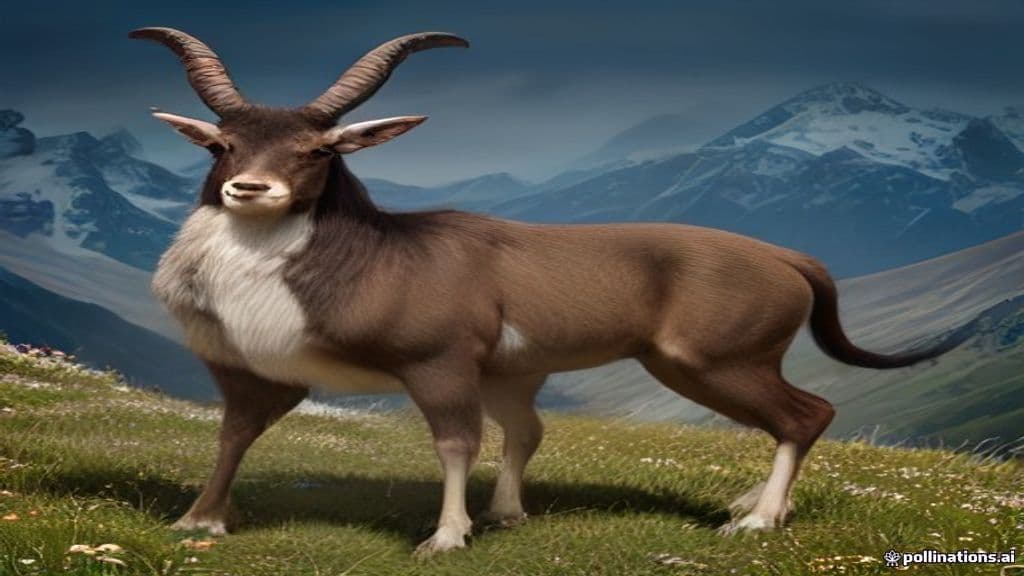
Sources do not record a single mythic origin story for the dahu. Instead, the creature appears in local mountain storytelling and practical-joke traditions; its popularity and use by mountain guides and locals to tease tourists rose with late-19th-century mountain tourism. The legend has since been diffused and institutionalized in regional popular culture (museum exhibits, organized hunts, and an April Fools' 'Dahu Sanctuary').
Described in source material as resembling a mountain ungulate such as a chamois or ibex, the dahu is a quadruped whose defining fantastical trait is marked asymmetry in limb length: the legs on one side of the body are shorter than those on the opposite side. Two named morphological variants are attested — laevogyrous (shorter left legs, walks counterclockwise) and dextrogyre (shorter right legs, walks clockwise). The young is attested in sources as a 'dahuot'.
Source accounts present the dahu's behavior in naturalistic terms tied to its anatomical asymmetry: because one side's legs are shorter, a dahu is said to walk around a mountain's slope only in one direction (either clockwise or counterclockwise depending on variant). The 'ability' emphasized in folklore is this one-sided locomotion, and culturally its chief function is as the basis for practical jokes (not as a supernatural power). The hunting-prank narrative involves accomplices imitating dahu sounds from above while another waits below with a bag, claiming the animal will roll downhill into the sack when it turns to orient itself.
Weaknesses
- otherNo traditional weaknesses attested in sources
Wards
- otherNo ritual wards attested; social skepticism and local knowledge are recorded as practical means to avoid participation in dahu hunts
Community Record
- [1]Dahu — Wikipedia. Wikipedia, 'Dahu'wiki
- [2]Quoted source material and compiled research notes (provided). Compiled research notes supplied by user (selected quotations and summaries)other