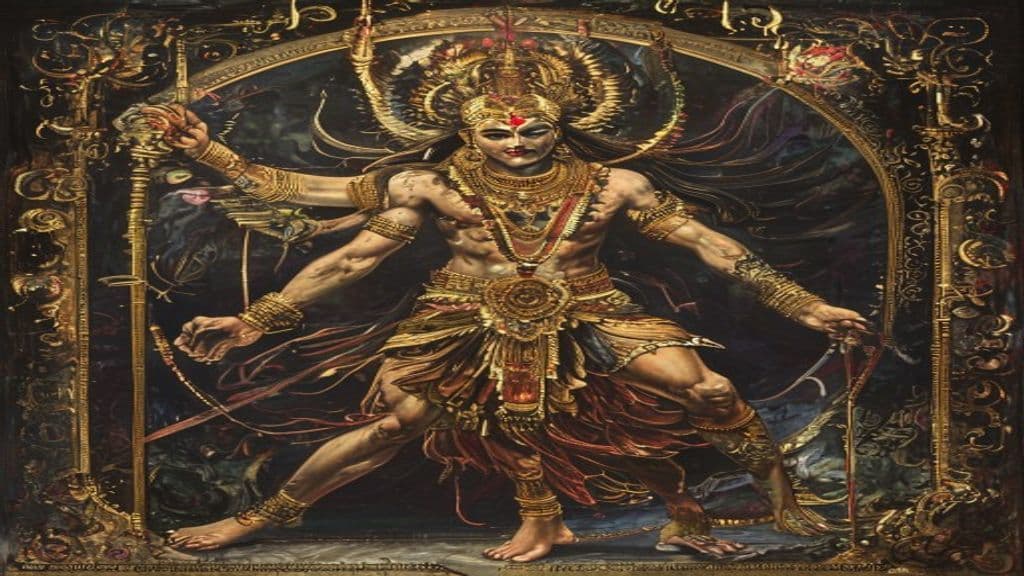
According to purāṇic genealogies summarized in the sources, Kaśyapa married sisters Aditi and Diti; Aditi gave birth to the āditya/deva classes, while Diti is the progenitress of the Daityas. The term literally marks descent from Diti. Purāṇic episodes present individual Daityas (Hiraṇyaksha, Hiraṇyakashipu, Mahabāli, Holikā, Prahlāda, etc.) as arising from that lineage and acting collectively in mythic ages to challenge the cosmic order, requiring Viṣṇu's avatāras for their overthrow (as recorded in purāṇic summaries).
The supplied purāṇic and summary sources emphasize genealogy, deeds, and narrative roles rather than a standardized morphology. Individual named Daityas receive descriptive treatment in episodes (for example, narratives of combat or flight into the ocean), but there is no consistent, class-wide physical description in the provided materials.
As a class Daityas are portrayed as powerful, martial, and politically active: several prominent Daityas 'overran the earth' and mounted cosmic challenges to the devas, prompting Viṣṇu-avatāras for containment or defeat. Individual members display extraordinary potency within their stories (e.g., causing cosmic disorder, resisting gods). Interpretive commentaries summarized in the sources also treat Daityas symbolically as embodiments of 'separative consciousness' or titanic, divisive psychic forces rather than merely moral evil.
Weaknesses
- othervanquished by Viṣṇu avatāras
- conditionsubject to ethical/spiritual transformation (soteriological submission in interpretive readings)
Wards
- otherdivine intervention (recourse to Viṣṇu's avatāras as the mythic means of protection/defeat)
- conditioncultivation of sattva / ascetic discipline (Manusmṛti classification implies spiritual disciplines as normative counters to daityic tendencies)

Dagr
Dagr is the Old Norse personification of the day: a luminous being who rides across the sky on the horse Skinfaxi, bringing daylight in the mythic cosmology preserved in the Poetic Edda and Prose Edda. The lexical item Dagr functions both as the common noun for 'day' and as a proper name for this mythic actor.
Dahu
A legendary mountain creature from francophone regions of France, Switzerland and adjacent Alpine valleys, presented in folklore as a goat-like animal with markedly asymmetrical limb lengths; primarily known as the subject of prank 'dahu hunts' and a staple tall tale and tourist joke rather than a true supernatural being.
Dai (Daini / Dai witch) — Assamese (unconfirmed)
No reliable information about an Assamese supernatural entity called Dai (also cited as Daini or 'Dai witch') is present in the provided sources. The available materials include general disambiguation and unrelated archive items that do not describe such a folk entity, so details about its nature, attributes, or cultural role cannot be documented from these sources.
Daidarabotchi
Daidarabotchi is a gigantic humanoid yōkai in Japanese tradition credited with creating and reshaping large-scale landscape features — its footprints form lakes and ponds and its movements are said to have made or moved mountains. It appears in classical place-records (Fudoki) and regional lore, most prominently in Hitachi/Ibaraki and Mount Togakushi traditions.
Daikokuten
Daikokuten (大黒天) is a syncretic Japanese deity of fortune, wealth, and household/professional prosperity. Originating from the Buddhist/Hindu figure Mahākāla and transformed within Chinese and Japanese religious contexts, Daikokuten functions as a protector of monastic kitchens and, in Japan, as a beneficent patron of farmers, cooks and occupations tied to money.
Daimon Hellstrom
Daimon Hellstrom is a fictional Marvel Comics character, presented in-universe as the human son of an infernal being and a mortal woman. Portrayed variously as an occult investigator/exorcist, sorcerer, and at times ruler of an infernal dimension, his stories explore the struggle between inherited demonic heritage and chosen humanity.
Daji
Daji (妲己, Dájǐ) is a figure in Chinese narrative and popular religious-cultural materials who blurs human and spirit categories: historically remembered as the favorite consort of King Di Xin of Shang but in later legend and fiction identified as a fox‑spirit (often a nine‑tailed or thousand‑year fox) that possessed or impersonated the woman and precipitated moral and political decline.
Daken (Akihiro)
Daken (Akihiro) is a fictional Marvel Comics character: the mutant son of Wolverine who was raised and conditioned by Romulus. Introduced in Marvel's Wolverine titles, he has served alternately as antagonist, antihero, and later a reformed team member, and at one point becomes bonded to a demon called Bagra-ghul.
Dakinī
A dakini is a feminine spiritual figure attested in Hindu and Buddhist literature and in Himalayan Vajrayāna cultural contexts; sources in this set characterize the dakini as a type or class of goddess and as a figure embedded in tantric and Himalayan religious landscapes. Specific iconography, powers, and ritual formulas are not documented in the supplied sources.
Dakkhin Rai
Dakkhin Rai is a locally venerated territorial sovereign of the Sundarbans (mangrove forests of West Bengal, India and Bangladesh), regarded as ruler of beasts and dangerous spirits and commonly associated with the tiger. Forest users propitiate him before entering the mangroves; he features in contested narratives alongside Bonbibi, Shah Jangali and Bara Khan Ghazi.
Dakki (Dakkiya)
Dakki (romanized also as Dakkiya in the query) is presented in the supplied sources as a fictional antagonist in the Japanese manga Hoshin Engi. Within the manga's summary she is described as a Sennin who murdered the protagonist Taikobo's family; the work itself is inspired by the Chinese novel Investiture of the Gods.
Daksha
Daksha (Sanskrit: दक्ष) is a mythic Prajapati and creator-agent in Hindu textual tradition, remembered as a progenitor who presides over yajna and begets lineages. He appears in Vedic, Itihasa, and Puranic sources as a ritual expert and patriarch whose actions in the Daksha yajna narrative produce major mythic consequences (Sati's self-immolation, Shiva's wrath, origin of Shakti Peethas).
Community Record
- [1]Daitya — Wikipedia. Wikipedia article 'Daitya' (access provided in research notes).wiki
- [2]Daitya — Wikidata. Wikidata entry for Daitya (referenced in research notes).wiki
- [3]Srimad Bhagavatam: Canto 7 - Chapter 5 (excerpt). Srimad Bhāgavatam episode cited in research notes; archive recording excerpt (Madan Mohan) also provided.literary
- [4]Archive: madan-mohan-prabhu-alachua-florida-december-2-2016-sb-3-18-1-2. Audio archive of Srimad Bhāgavatam passage referenced in research notes.literary
- [5]Pankaj Oudhia film indexes (archive listings). Ethnobotanical/film archive items indexed in research notes that list 'daitya' among terms but do not provide ritual detail.other
- [6]Daitya Sudan Temple — Wikipedia. Wikipedia entry for a temple named using 'Daitya' (local/topographical evidence of term usage).wiki
- [7]Harivamsha Purāṇa summary (as cited). Purāṇic genealogical summary (Harivamsha) referenced within the Wikipedia article cited in research notes.literary
- [8]StackExchange discussion (classification questions). Community discussion cited in research notes illustrating classification debates (Daitya vs Danava, etc.).other
- [9]HollowOrbs — Daitya (folk retellings). Online retellings and folk-variant narratives referenced in research notes (treated as narrative variants).folk