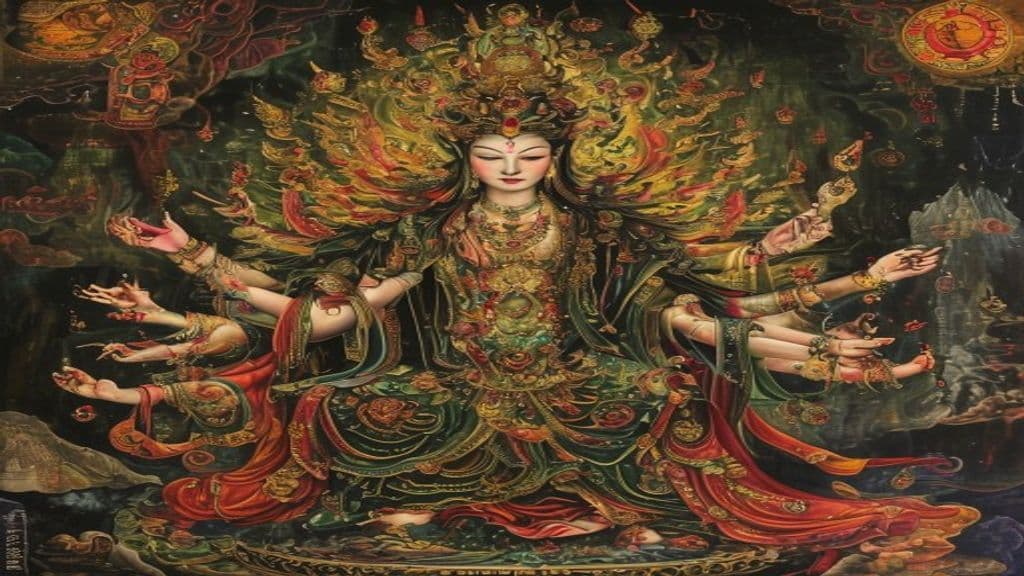
The provided sources do not present an origin narrative for dakinis. The term appears in Hindu and Buddhist contexts in the supplied materials as a class of feminine mythic figures invoked in tantric and meditative settings; no single mythic origin or foundational story is given in the excerpts available.
The supplied texts do not provide a consistent, detailed physical description of dakinis. In the Longchen Nyingthik Refuge Assembly visualization they are listed among the numerous yidam deities and dakas that surround the central figures of the mandala, implying they are visualized as part of a deity-filled assembly in meditative practice. Other excerpts use the term collectively (for example, a tantric master being described as leader of many dakinis) but do not record standardized iconography or bodily features in the provided material.
Within the provided sources dakinis function as figures present in tantric assemblies and meditative visualizations and appear in hagiographic contexts associated with accomplished tantric practitioners. One hagiographic source describes Naropa as 'the venerable leader of 100,000 dakinis,' which signifies their role as an entourage or class of supernatural feminine figures connected to advanced practitioners; however, the excerpts do not enumerate concrete powers, mundane behaviors, or specific interactions (such as causing illness or granting particular boons).
Community Record
- [1]Dakini - Wikipedia. Wikipedia, 'Dakini' (accessed source excerpt)wiki
- [2]Dakini - Wikidata. Wikidata entry Q1127224 (classification as mythical character; source excerpt)other
- [3]Hagiographic reference: Naropa described as leader of 100,000 dakinis. Archive excerpt: 'Naropa was "the venerable leader of 100,000 dakinis."'literary
- [4]Visualization of the Refuge Assembly of the Longchen Nyingthik Dzogchen. Archive excerpt: 'They are surrounded by numerous yidam deities of the four tantras, dakinis, and dakas.'; instructions to 'First, visualize yourself in a pure realm, wonderful and pleasing.'literary