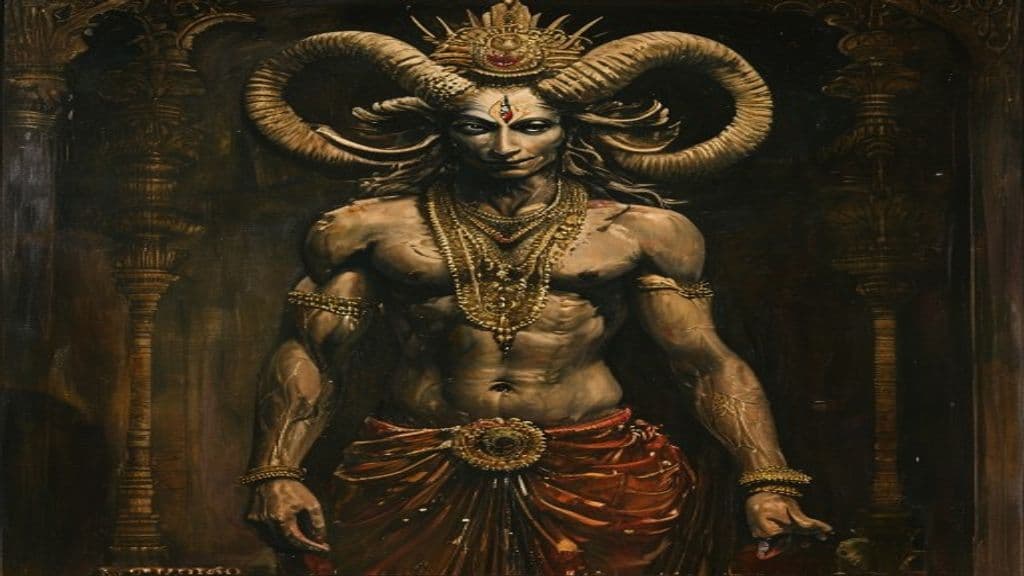
In Vedic layers Daksha is attested as an Aditya associated with priestly skill; in later Itihasa and Puranic narratives he is elaborated as a Prajapati and a mind-born (manasaputra) son of the creator Brahma. Across these texts he functions as an organizer and progenitor: he begets many daughters who become spouses of gods and ancestors of creatures. Narrative cycles record his prominent role in a sacrificial episode (the Daksha yajna) in which family conflict leads to Sati's self-immolation, Shiva's retaliation, and the subsequent reconfiguration of cultic and geographic sacred sites (e.g., the Shakti Peethas).
Sources describe Daksha as a man with a stocky body and a handsome face in traditional iconography; Puranic narratives and later iconographic traditions also record that after his beheading by Virabhadra he was resurrected with the head of a goat or ram. The ram/goat-head motif appears in later Puranic accounts and is attested alongside the yajna motif in some Vedic/Yajurvedic strata (Taittiriya Samhita) according to the sources.
Daksha functions mythically as an expert in sacrificial ritual (yajna), a progenitor who begets numerous children and organizes lineages, and an authoritative ritual host (yajamana). In narrative episodes he pronounces curses (for example upon Chandra, the moon, explaining waxing and waning), presides over large sacrifices, and—through his actions and insults—sets events in motion that are checked or punished by other divine powers (notably Shiva and his emanation Virabhadra). These capacities are presented as narrative/mythic functions rather than as prescriptive occult skills for human practitioners in the provided sources.
Weaknesses
- otherSubject to punishment by other deities (e.g., beheading by Virabhadra as Shiva's emanation)
- otherCurses and their modification (narrative mechanism; e.g., curse on Chandra altered after intervention)
Wards
- otherNo traditional warding rites attested in the provided sources (Daksha is an institutional/mythic figure rather than a household spirit to be warded against)
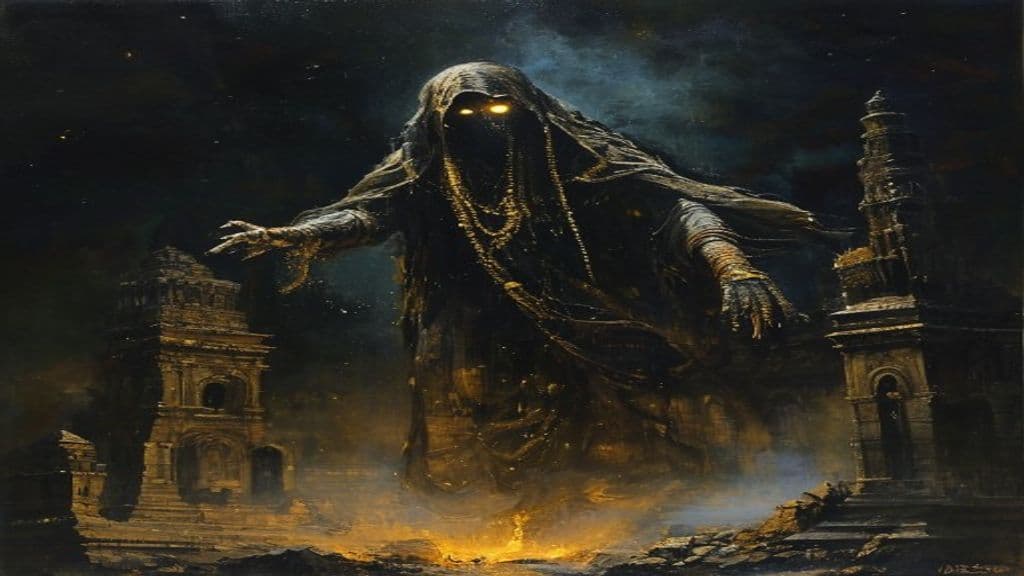
Brahmarakshas
The most learned and terrible of spirits — the ghost of a Brahmin who misused his scriptural knowledge in life and was condemned after death to be both demon and scholar, haunting places of learning.

Virabhadra
Virabhadra is a fierce martial emanation of the Hindu god Śiva, created in wrath to punish those responsible for the self-immolation of Śatī at the Dakṣa yajña. Presented in Purāṇic narratives as a powerful warrior commanding heterogeneous troops, he carries out destructive missions but is ultimately subordinate to Śiva and can be pacified.
Daitya
Daitya (Sanskrit: दैत्याः) denotes a hereditary race or clan of powerful asura-type beings in Hindu purāṇic and epic tradition, described as the descendants of the sage Kaśyapa by his wife Diti. They appear in genealogies and narratives as collective kin-groups whose notable members (e.g., Hiranyaksha, Hiranyakashipu, Mahabali) confront the devas and provoke divine (Viṣṇu) avatāras.
Daji
Daji (妲己, Dájǐ) is a figure in Chinese narrative and popular religious-cultural materials who blurs human and spirit categories: historically remembered as the favorite consort of King Di Xin of Shang but in later legend and fiction identified as a fox‑spirit (often a nine‑tailed or thousand‑year fox) that possessed or impersonated the woman and precipitated moral and political decline.
Daken (Akihiro)
Daken (Akihiro) is a fictional Marvel Comics character: the mutant son of Wolverine who was raised and conditioned by Romulus. Introduced in Marvel's Wolverine titles, he has served alternately as antagonist, antihero, and later a reformed team member, and at one point becomes bonded to a demon called Bagra-ghul.
Dakinī
A dakini is a feminine spiritual figure attested in Hindu and Buddhist literature and in Himalayan Vajrayāna cultural contexts; sources in this set characterize the dakini as a type or class of goddess and as a figure embedded in tantric and Himalayan religious landscapes. Specific iconography, powers, and ritual formulas are not documented in the supplied sources.
Dakkhin Rai
Dakkhin Rai is a locally venerated territorial sovereign of the Sundarbans (mangrove forests of West Bengal, India and Bangladesh), regarded as ruler of beasts and dangerous spirits and commonly associated with the tiger. Forest users propitiate him before entering the mangroves; he features in contested narratives alongside Bonbibi, Shah Jangali and Bara Khan Ghazi.
Dakki (Dakkiya)
Dakki (romanized also as Dakkiya in the query) is presented in the supplied sources as a fictional antagonist in the Japanese manga Hoshin Engi. Within the manga's summary she is described as a Sennin who murdered the protagonist Taikobo's family; the work itself is inspired by the Chinese novel Investiture of the Gods.
Daksha yajna
A significant mythological event in Hindu tradition, the Daksha yajna is a ritual-sacrifice organized by Daksha that has far-reaching spiritual and mythological implications. (Note: - Power tier should be Ancient (deity-level) instead of Primordial, as the Daksha yajna is a significant mythological event caused by the wrath of a deity (Shiva), rather than a cosmic power. - Appear)
Dakuwaqa
Dakuwaqa is a Fijian shark deity and powerful sea-being who functions in tradition as both a fierce sea monster and a guardian of islands and fishermen. In recorded myths he can threaten islands in specific narratives but also becomes protector of places and is placated by offerings such as kava libations.
Dalaketnon
A Visayan Philippine engkanto lineage associated with Dalakit/Balete trees; portrayed as an elitist, tree‑dwelling supernatural people who host feasts, abduct humans, and bind victims by compelling them to eat enchanted black rice. Contemporary media elaborates additional powers and aristocratic styling.
Dali (Goddess)
Patron deity of hoofed wild mountain animals in Georgian mythology, associated with hunting and the natural world. (Note: 1. Power tier should be Greater, not Ancient, given that Dali's abilities are deity-level but not cosmic. 2. Origin story could benefit from a more direct quote or clearer summary of how she is introd)
Damarwulan
Damarwulan is a Javanese legendary human hero central to a cycle of courtly-epic narratives and stage traditions (wayang klitik, Langendriyan, ketoprak). The figure—whose name is glossed as "radiance of the moon"—is portrayed as a princely warrior who defeats the Blambangan king Menak Jingga, suffers apparent death and is restored by a hermit, and is ultimately crowned in the Majapahit court. The story is especially associated with East Java and the Serat Damar Wulan manuscript tradition.
Damasiclus
Damasiclus (Ancient Greek: Δαμάσικλος / Δαμασίκλου), also called Amasiclus or Amasichus, is a mortal figure in Greek myth genealogies presented as a Spartan son of Icarius. He functions as a kinship node in variant traditions and is chiefly notable for his place in lineages that connect to the eponym Taenarus.
Community Record
- [1]Daksha - Wikipedia. Wikipedia entry 'Daksha'.wiki
- [2]Daksha Yagna - Story of Daksha's sacrifice and Sati Shakti. Templenet summary of the Daksha Yajna and its link to the Shakti Peethas.folk
- [3]Daksha (mythfolklore.net). Mythfolklore.net summary entry on Daksha discussing name-meaning and creative power association.folk