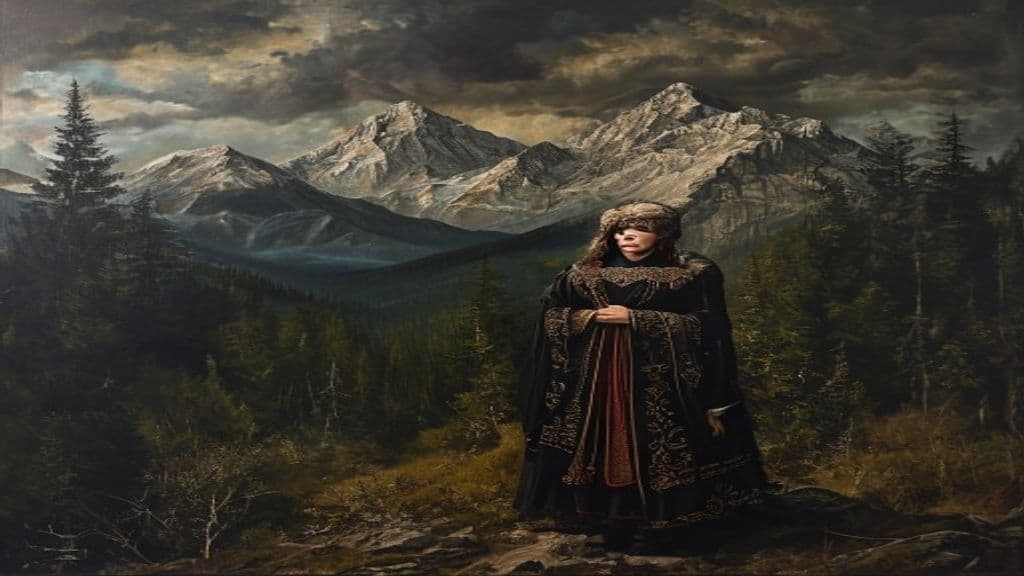
Dali is a goddess in Georgian mythology who serves as the patron deity of hoofed wild mountain animals, specifically ibexes and deer.
No physical description of Dali is given in the source material. However, her association with hunting and the natural world may imply a connection to aspects of nature such as mountains or forests.
Dali has the power to punish those who violate her taboos and grant success to hunters who obey her rules.
Weaknesses
- conditionbreaking taboos
Wards
- ritualobeying Dali's taboos
Borjgali
Symbol in Georgian tradition representing the sun and eternity, with no supernatural connotations. (Note: 1. Power tier: Lower the power tier to Lesser, as there's no indication of cosmic or deity-level abilities. 2. Abilities: Remove "supernatural" from the description, but keep in mind that the entity h)
Georgian Mythology (Overview)
A general overview of Georgian mythology, its history, and cultural context. No specific supernatural entity is mentioned. (Note: - Remove the entire article as it does not refer to a specific supernatural entity - Power tier should be "Primordial" or left blank since there is no specific entity mentioned)
Lamaria (Georgian Tradition)
In Georgian mythology, Lamaria is a goddess associated with the hearth, cattle, women, and fertility of grain fields. (Note: 1. The article states Lamaria is associated with cattle and women, but the source does not specify her association with women, only protecting them during childbirth. 2. Power tier: Less specific abil)
Dakki (Dakkiya)
Dakki (romanized also as Dakkiya in the query) is presented in the supplied sources as a fictional antagonist in the Japanese manga Hoshin Engi. Within the manga's summary she is described as a Sennin who murdered the protagonist Taikobo's family; the work itself is inspired by the Chinese novel Investiture of the Gods.
Daksha
Daksha (Sanskrit: दक्ष) is a mythic Prajapati and creator-agent in Hindu textual tradition, remembered as a progenitor who presides over yajna and begets lineages. He appears in Vedic, Itihasa, and Puranic sources as a ritual expert and patriarch whose actions in the Daksha yajna narrative produce major mythic consequences (Sati's self-immolation, Shiva's wrath, origin of Shakti Peethas).
Daksha yajna
A significant mythological event in Hindu tradition, the Daksha yajna is a ritual-sacrifice organized by Daksha that has far-reaching spiritual and mythological implications. (Note: - Power tier should be Ancient (deity-level) instead of Primordial, as the Daksha yajna is a significant mythological event caused by the wrath of a deity (Shiva), rather than a cosmic power. - Appear)
Dakuwaqa
Dakuwaqa is a Fijian shark deity and powerful sea-being who functions in tradition as both a fierce sea monster and a guardian of islands and fishermen. In recorded myths he can threaten islands in specific narratives but also becomes protector of places and is placated by offerings such as kava libations.
Dalaketnon
A Visayan Philippine engkanto lineage associated with Dalakit/Balete trees; portrayed as an elitist, tree‑dwelling supernatural people who host feasts, abduct humans, and bind victims by compelling them to eat enchanted black rice. Contemporary media elaborates additional powers and aristocratic styling.
Damarwulan
Damarwulan is a Javanese legendary human hero central to a cycle of courtly-epic narratives and stage traditions (wayang klitik, Langendriyan, ketoprak). The figure—whose name is glossed as "radiance of the moon"—is portrayed as a princely warrior who defeats the Blambangan king Menak Jingga, suffers apparent death and is restored by a hermit, and is ultimately crowned in the Majapahit court. The story is especially associated with East Java and the Serat Damar Wulan manuscript tradition.
Damasiclus
Damasiclus (Ancient Greek: Δαμάσικλος / Δαμασίκλου), also called Amasiclus or Amasichus, is a mortal figure in Greek myth genealogies presented as a Spartan son of Icarius. He functions as a kinship node in variant traditions and is chiefly notable for his place in lineages that connect to the eponym Taenarus.
Damastor
Damastor (Greek: Δαμάστωρ, Damástōr/Damastôr, lit. 'tamer' or 'subduer') is a personal name attested in ancient Greek mythic and epic sources for multiple distinct figures: a Giant who fights in the Gigantomachy and several mortal personages or patronymics (Damastorides) appearing in the Homeric cycle, notably among suitors of Penelope and in Trojan-war genealogies.
Damballa (Damballah)
Damballa is one of the most important loa (spirits) in West African Vodun and its New World continuations such as Haitian Vodou and related African-diasporic practices. Traditionally associated with serpentine imagery and sometimes depicted as a rainbow, Damballa represents a central, revered presence transmitted from the Whydah/Ouidah region of modern Benin into Caribbean Vodou practice.
Community Record
- [1]Dali (Goddess) from Georgian Tradition. Source 1academic