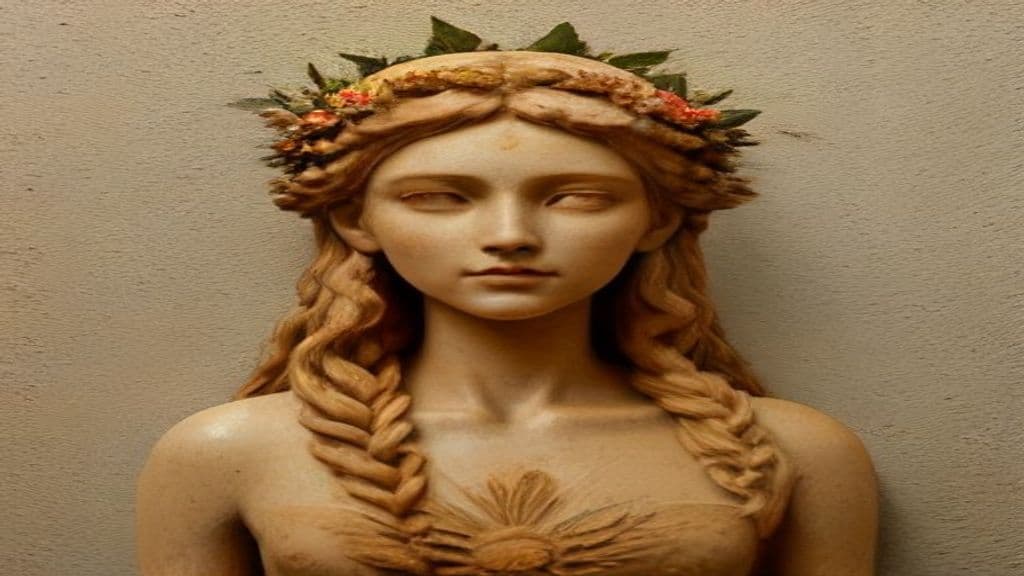
In Greek mythological genealogy, Demeter is a child of the Titans Rhea and Cronus and sister of the principal Olympian deities (Hestia, Hera, Hades, Poseidon, Zeus). Her most famous mythic narrative is preserved in the Homeric Hymn to Demeter: when Hades abducts her daughter Persephone, Demeter searches for her and, in grief and anger, withdraws her fertilizing power from the earth, producing famine; Zeus is compelled to order Persephone's partial return to resolve the crisis. Linguistic and archaeological evidence recorded in Bronze Age tablets (e.g., Linear B references like si-to-po-ti-ni-ja, 'Potnia of the Grain') and comparative etymological proposals indicate Demeter's cult has deep pre-Olympian agrarian roots and likely developed from earlier grain or earth goddesses.
Iconographically Demeter is associated with harvest imagery: flowers, fruit, and sheaves of grain or a sheaf of wheat are common attributes. She is frequently depicted alongside her daughter Persephone in cult and art. Local cult narratives record variant visual motifs, for example an Arcadian tradition in which a mourning 'Black Demeter' dresses in black and retires to a cave after being assaulted by Poseidon, at times taking animal disguise (a mare) in that regional myth. Beyond these symbolic attributes, sources do not provide a single fixed physical description.
Demeter controls agricultural fertility and the growth of crops and grains and functions as the giver of food (epithet Sito, 'she of the Grain'). Her withdrawal of favor causes the earth to fail to produce, bringing famine and death to mortals (as narrated in the Homeric Hymn to Demeter). She is also Thesmophoros ('giver of customs' or 'legislator'), indicating authority over sacred law, social customs—particularly those connected to reproduction and women's civic-religious roles—and ritual observance. Through her association with Persephone and the Eleusinian Mysteries she is implicated in beliefs about life, death, and a promised favorable afterlife for initiates.
Weaknesses
- conditionneglect of rites and cult observance
Wards
- ritualobservance of cult festivals (Thesmophoria, Eleusinian Mysteries)

Community Record
- [1]Demeter - Wikipedia. Wikipedia: 'Demeter' entry (various sections including etymology, myth, cult, and iconography)wiki
- [2]Demeter and Persephone – Mythoi Koinoi (Pressbooks chapter). Pressbooks chapter 'Demeter and Persephone' summarizing the Homeric Hymn to Demeter and related cultic materialliterary
- [3]Archive: Deusas Gregas - Demeter (digital archive). Archive collection material on Demeter and Greek goddesses (used for supplementary cult and epithet information)other