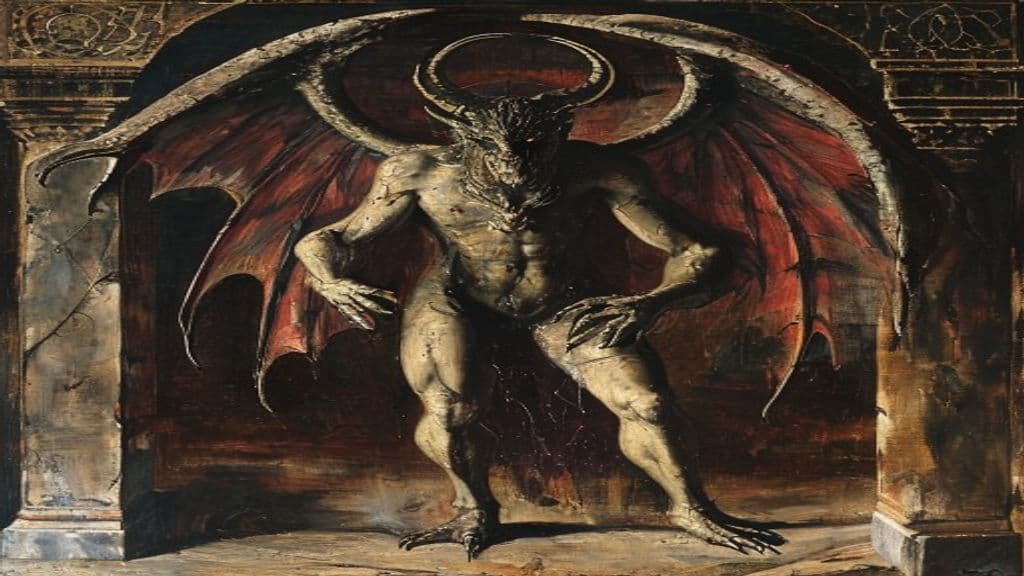
Belief in demons is ancient and cross-cultural. Some scholars and overviews often trace such beliefs back to Paleolithic-era human responses to the unknown, using agentive beings to explain disaster, disease, and other threats. The Ancient Greek daimōn originally denoted a spirit or divine power (comparable to Latin genius or numen); over time—notably through the Septuagint translation and later Christian theological developments—the term acquired more negative moral valence in many contexts. In some religious frameworks demons are independent actors, while in others they are conceived as subordinate to a single devil figure.
No systematic or consistent physical description is provided in the supplied sources. Ancient and folkloric conceptions vary widely, and the encyclopedic sources emphasize functional and conceptual roles over fixed corporeal forms.
Across traditions demons are attributed agency to cause harm: illness, destructive natural phenomena, moral temptation, social disruption, and possession in accounts that recognize demonic possession. Individual entities may specialize in particular kinds of harm. In esoteric and magical traditions (notably elements of Western esotericism and Renaissance magic), practitioners may attempt to conjure, bind, or control such spirits. Literary sources may depict demons with enhanced, story-specific capacities (e.g., a fiction summary describes an "invincible demon" that steals a magical manuscript), but such depictions are narrative rather than ethnographic.
Weaknesses
- ritualExorcism
- ritualMagical conjuration/control (binding or commanding in Western esoteric/Renaissance magical contexts)
Wards
- ritualExorcism
Haniel
Haniel is an angelic figure in Jewish and later Western angelology, traditionally counted among the seven archangels. The figure is associated with the planet Venus and is described as the governing archangel of the Kabbalistic sephirah Netzach, embodying qualities of grace, charm, and joy and appearing in later Renaissance esoteric apparatus such as John Dee's Sigillum Dei Aemeth.
Demigod (Greek Tradition)
In Greek mythology, a demigod is a being that is half-divine and half-human, often the offspring of a deity and a human or having attained divine status through other means. (Note: - Power tier: Greater (not Ancient), as demigods possess exceptional skills or powers, but do not necessarily approach deity-level abilities. - Appearance: Remove the sentence "No specific physical de)
Demiurge
A craftsman-like cosmic artisan who fashions and governs the sensible, material universe. In Platonic traditions the Demiurge is a benevolent ordering intelligence that shapes preexisting matter by imitating eternal Forms; in Gnostic systems the Demiurge is a lower ruler of the material realm whose moral status varies from ignorant/foolish to oppressive.
Demogoblin
Demogoblin is a Marvel Comics demonic, goblinoid supernatural being associated with Limbo. Presented in 1990s Spider-Man storylines, he is a self‑proclaimed holy avenger who kills those he deems sinners, and who has fused with and later been separated from the human villain Jason Macendale (Hobgoblin).
Demogorgon
A name that emerged in Latin medieval commentary and was later taken up in Renaissance and early modern literature and demonology as a powerful, primordial subterranean or infernal figure associated with fate and accountability. Modern popular culture reuses the name for monsters, but those visualizations are distinct from the medieval and Renaissance textual tradition.
Demoleon
Demoleon (Ancient Greek Δημολέων) is a mortal Trojan warrior of the Homeric tradition, named as a son of Antenor and Theano. He is portrayed as a valiant, defensive fighter who is killed by Achilles during the Trojan War; later tradition links his family to postwar foundation legends (e.g., Patavium).
Demolition Team
The Demolition Team is a fictional mercenary crew in the DC Comics universe, assembled to perform large-scale destructive operations using specialized heavy-equipment. Introduced in Green Lantern #176 (May 1984), they operate as hired specialists who clash with superheroes and law enforcement in urban settings.
Demon Cat
The Demon Cat (also called the D.C.) is a legendary ghostly feline in Washington, D.C. folklore said to haunt government buildings—most notably the United States Capitol and the White House. Tales describe ordinary cat-sized sightings that allegedly swell to enormous proportions and appear as omens before major political events; skeptical accounts attribute sightings to misperception or occupational prank culture among guards.
Demon Lord Dante
Demon Lord Dante (魔王ダンテ, Maō Dante) is a fictional primordial demon-leader from Go Nagai's manga/anime property. In the narratives Dante is an ancient combatant against autonomous 'gods', sealed in the past and later reborn or reawakened, alternating between human incarnations and fused demonic forms.
Demonassa
Demonassa (Ancient Greek: Δημώνασσα) is not a supernatural being in the supplied sources but a personal name attested to several mortal women in Greek mythographic and literary traditions and later reused in biological taxonomy. Attestations include multiple mythic genealogical figures, a rhetorical anecdote of a Cypriot lawgiver, and later literary stock-character uses (notably Corinthian sexualized roles). The same lexical form is also applied in modern zoological nomenclature (a beetle genus and insect species epithets).
Demonice
Demonice (Ancient Greek: Δημονίκη, romanized Dēmoníkē) is the personal name of two mortal women recorded in Greek mythographic and prosopographical sources: one a daughter in a Pleuronian genealogy and the other a maiden of Ephesus associated with an anecdote about Brennus. The sources treat Demonice as named human/legendary figures rather than a class of supernatural beings.
Demonice of Aetolia
Demonice (Ancient Greek: Δημονίκη, also attested as Δημοδίκη / Demodoce) is a mythic Aetolian princess in Greek genealogical tradition. She is presented as a mortal daughter of King Agenor of Pleuron who consorted with the god Ares and bore sons whose names serve as eponyms for local rivers, cities, and peoples of Aetolia and neighbouring regions.
Community Record
- [1]Demon (Wikipedia). Wikipedia contributors, "Demon," Wikipedia, The Free Encyclopedia, https://en.wikipedia.org/wiki/Demonwiki
- [2]Tome of the Undergates (fictional archive summary). Syke (archive entry), "Tome of the Undergates," Archive.org summary indicating an "invincible demon" steals the Tome of the Undergates.literary