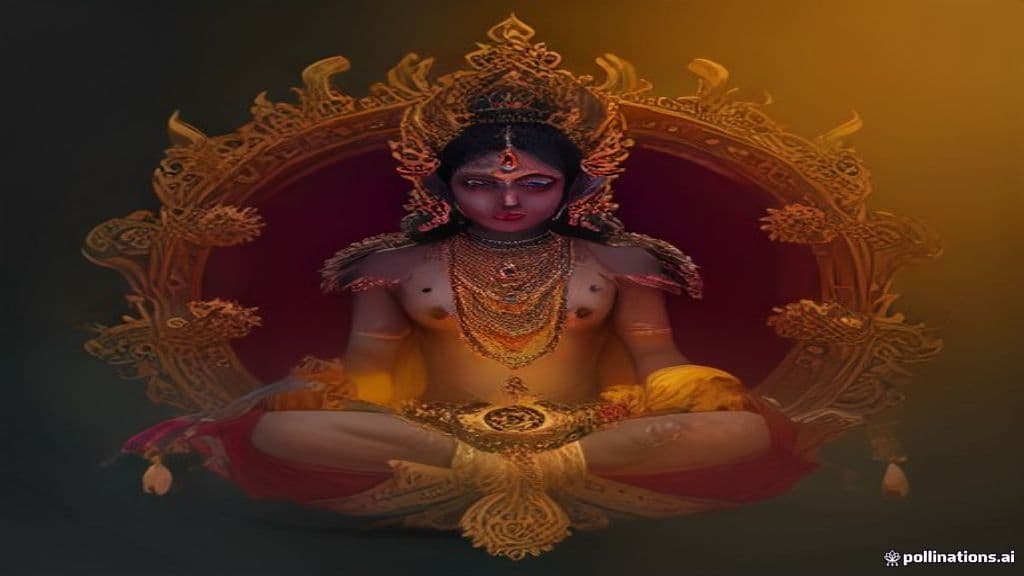
The concept arises from Indian sacred-king traditions (linked to ideas such as the chakravarti universal ruler) and was transmitted to and adapted by Indianized polities of Southeast Asia. Brahmin priests and Indian religious models were instrumental in creating the devaraja order in court ritual; inscriptions and historical examples (e.g., the case of Jayavarman II in the Khmer context) illustrate how a king was identified with a Hindu deity and ritually invested with divine essence via cult images such as the linga. Over several centuries the model was localized across Java, Cambodia, Ayutthaya and other courts, becoming integrated into temple-centered state religion and monumental programs.
Devaraja is not an independent mythic corporeal being but a sacral status embodied by the living monarch. Physical description centers on ritual embodiment: the king is identified with or represented through cult images (notably the linga/lingam when associated with Shiva) housed in mountain-temple contexts. Sources emphasize the ritual conferral of divine essence on the ruler (for example, Jayavarman II's association with Shiva and the linga) rather than a separate supernatural appearance.
The 'powers' of the devaraja are institutional and legitimating rather than catalogues of supernatural feats. As a sacral office the devaraja authorizes the monarch's divine claim to rule, demands ritual veneration, legitimates social order, and enables large-scale mobilization of labor and resources for temple construction, irrigation, and state projects. The security and prosperity of the kingdom become tied to the safeguarding of the cult image (e.g., the linga) and temple centers; priests mediate the divine link that confers and maintains royal authority.
Weaknesses
- conditionloss of ritual maintenance or priestly mediation
- conditiondamage, theft, or desecration of the cult image (e.g., the linga) or temple
- conditionpolitical overthrow or loss of institutional support
Wards
None recorded.
Community Record
- [1]Devaraja. Wikipedia, 'Devaraja' (excerpt provided)wiki
- [2]Devaraja Mangalam - Upanyasam in Tamil by Thenthirupperai Aravindalochanan Swami. Archive: Devaraja Mangalam (title noted; contents not excerpted)other
- [3]Karnataka State Archives reference (place-name use). Archive: reference to 'Devaraja Mohalla Mysore' (place-name use)other
- [4]Wikidata: The Buddha (contextual reference). Wikidata entry (used as chronological/background reference in the Wikipedia source)other