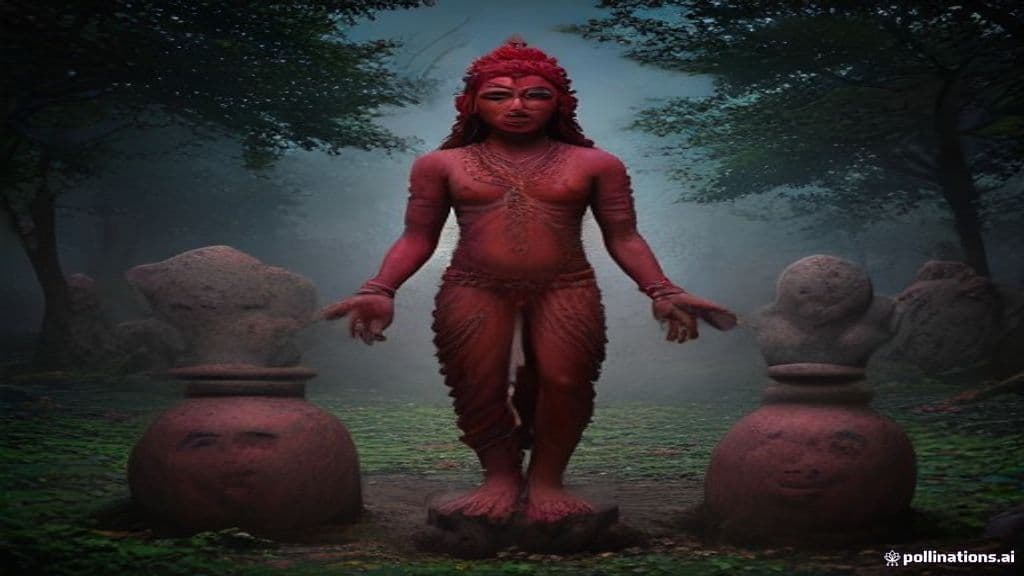
Literary texts associated with Dharmathakur (notably the Dharmamangal and later Dharma Purana compositions) present mythic episodes and narratives used in ritual contexts; one tale in the Dharmamangal depicts Dharmathakur appearing as a Brahmin who requests the cooked flesh of Luichandra, an episode involving death and restoration motifs. Scholarly commentary emphasizes that the cult is layered and regionally variable: early popular, agrarian or 'primitive' beliefs related to harvest and village well‑being have been interpreted by some scholars as antecedents, after which Aryan/Hindu and Buddhist elements were incorporated into ritual and textual forms. These points are presented in the literature as interpretive hypotheses rather than a single, unambiguous historical origin.
In the common local cult the deity is represented by a shapeless stone daubed with vermilion, usually placed under a tree or in the open; in some villages images housed in temples or anthropomorphic named figures occur. Terracotta and wooden horses (including the well‑known Bankura horse style in the region) are frequent votive objects and are culturally associated with Dharmathakur as symbolic vehicles or offerings, though local practice varies.
Sources describe Dharmathakur in terms of social and religious functions rather than discrete supernatural 'powers': he is associated with death and justice (rituals and sannyasi austerities in Gajan recall death‑like observances), with fertility and agricultural welfare in some accounts, and with wish‑fulfillment via votive exchanges (terracotta horse offerings offered when vows are fulfilled). Local traditions also assimilate or identify Dharmathakur with various pan‑Indian deities (e.g., Shiva, Surya, Varuna, Vishnu, Yama) in different contexts, reflecting syncretic and regionally variable conceptions.
Weaknesses
None recorded.
Wards
- ritualDharmer gajan / communal worship
- othervotive terracotta horse offerings
Community Record
- [1]Dharmathakur - Wikipedia. Wikipedia, 'Dharmathakur' article (as provided in research notes)wiki
- [2]Dharmamangal (summary reference). Dharmamangal summaries and references (as cited in research notes)literary
- [3]Rarher Sanskriti O Dharmathakur (Archive). Rarher Sanskriti O Dharmathakur (ed.), archived edition (as provided)other
- [4]Dharmathakur | Sahapedia. Sahapedia materials on Dharmathakur (as provided)other
- [5]Legacy of Midnapore - Chandrakona (local site reference). Local site reference to Chandrakona and Dharmathakur (as provided)other
- [6]The Curious Case of Bankura Horses (folk art commentary). Discussion of Bankura horses and regional association with Dharmathakur (as provided)folk
- [7]Gajan: An Overview | Sahapedia. Overview of Gajan festival and its forms (as provided)other