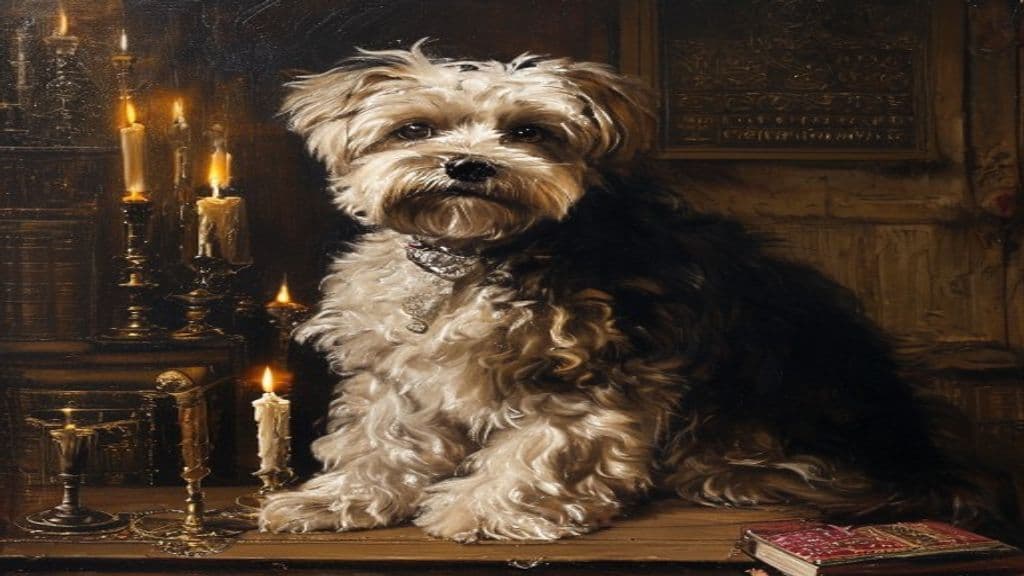
Diamond appears in retrospective anecdotes about Isaac Newton circulating in the 19th century and later. In the canonical telling, Diamond was Newton's favourite dog who upset a candle in Newton's study, setting fire to manuscripts containing notes on experiments accumulated over some twenty years. The tale appears in biographical works such as David Brewster's The Life of Sir Isaac Newton (1833) and is used by literary figures (Walter Scott in The Antiquary, and Thomas Carlyle in his essays) as an emblematic image. At least one modern summary characterizes the story as largely apocryphal and records alternative explanations (for example, a gust of wind through an open window) and even doubts that Newton kept pets.
The available sources do not supply any reliable physical description of Diamond; no contemporaneous primary details about size, color, breed, or markings are provided in the cited material. References to the dog in the 19th‑century retellings and later summaries present Diamond only by name and role in the anecdote rather than by appearance.
Diamond is not described as possessing supernatural powers in the sources; the animal's attributed 'ability' is simply the accidental upsetting of a candle that (in the anecdote) led to a fire and the loss of Newton's manuscripts. Later authors also use Diamond facetiously as a literary device—an example being an attributed quip that the dog 'discovered two theorems in a single morning' (with humorous commentary about their defects). The story is treated as literary embellishment and is disputed by some historians, who provide alternate causes for the loss of papers or question whether Newton kept pets at all.
Dhū Samawī
Dhū Samawī (Dhū Samuī, Dhu Samawi) is a pre-Islamic South Arabian deity attested in the Kingdom of Saba context and worshipped as a sky or heavenly god. He is described as 'He of the Heavenly' or 'The Heavenly One' and was called Malik al-Dhū Samāwī ('Lord of the Heavens'). His cult is attested especially in the city of Najran and in inscriptions that record cultic offerings, confession, penance, and fines.
Dhūmāvatī
Dhūmāvatī (Dhumavati) is one of the ten Mahavidyas in Tantric Shakta traditions, a fearsome aspect of the Great Goddess associated with widowhood, inauspiciousness, cremation grounds, and desolation. She is represented as an old crone figure and figures in Tantric iconographic and devotional material as the embodiment of loss and marginality.
Di Penates
In ancient Roman religion the Di Penates are household divinities (dii familiares) associated with the storeroom and the material basis of family life; they are invoked in domestic rituals and also appear as public sacred objects (Penates Publici) connected to Rome's civic cult and foundation myth. They function as guardians of household provisions and as intimate protectors of household continuity rather than as distant, high gods.
Di inferi
A ritual-technical collective in Roman religion denoting the gods and powers 'below' (the underworld), the di inferi comprise chthonic deities, ancestral forces (often overlapping with the Manes), and other underworld entities who receive burnt offerings and are propitiated outside Rome's sacred boundary.
Di sma undar jordi
Di sma undar jordi are a Gotlandic class of small, subterranean 'hidden people' (Gutnish: Di sma undar jordi; Swedish: de små under jorden) who act as caretakers of farms, people, and animals so long as they are not angered. They belong to the regional underjordiska/vættir-like tradition and are normally invisible except under a peculiar viewing condition recorded in local tales.
Dia (wife of Ixion)
Dia is a mortal woman in Greek mythic genealogies, chiefly attested as the wife of Ixion and in some traditions the mother of Pirithous. Her figure functions relationally in narratives about divine–human interaction, contested paternity, and the consequences of transgressive kinship and desire.
Diana
Diana is a Roman goddess of the countryside, wild animals and hunting, childbirth, crossroads, the night, and the Moon. In Roman religion she was equated with the Greek Artemis and absorbed much of Artemis' mythic profile; later receptions reinterpreted aspects of her in folklore and neo-pagan writing.
Diana monkey
The Diana monkey (Cercopithecus diana) is an Old World monkey native to West African primary forests. Treated in the supplied sources as a biological species of conservation concern, it is notable for a white crescent browband, complex vocal alarm system, frugivorous diet, and sociable group structure.
Diao Si
Insufficient source evidence to document a distinct Taoist spirit or demon called 'Diao Si.' The supplied material is a general overview of Taoism and does not contain attested information about an entity by this name; contextual notes indicate where such a concept might fit within Taoist cosmology, but no specific claims about origins, appearance, powers, rituals, or wards can be supported by the provided source.
Diarmuid Ua Duibhne
Diarmuid Ua Duibhne, often called Diarmuid of the Love Spot, is a heroic figure of the Irish Fenian Cycle described as a warrior and demigod-like hero fostered by the Tuatha Dé Danann. He is best known for the magical 'ball seirce' (love-spot), his role as Gráinne's lover in the Pursuit of Diarmuid and Gráinne, and for otherworldly adventures including a voyage to the Land-under-Waves.
Dictys
Dictys is a personal name applied to multiple distinct figures in Greek myth and pseudo‑historical tradition: a fisherman of Seriphos who rescues Danaë and Perseus, a sailor transformed into a dolphin by Dionysus, a centaur at Pirithous's wedding who dies in the Lapiths' battle, and the literary persona Dictys Cretensis who purports to be an eyewitness of the Trojan War.
Didaeon
Didaeon is a minor genealogical figure in Greek mythic tradition, recorded as one of the sons of King Eurytus of Oechalia and his wife (variously named Antiope or Antioche). He appears only in lineage lists and catalogues; no deeds, cult, or supernatural attributes are ascribed to him in the surviving citations.
Community Record
- [1]Diamond (dog) — Wikipedia. Wikipedia, 'Diamond (dog)'wiki
- [2]The Life of Sir Isaac Newton — David Brewster (1833) (referenced). Referenced in Wikipedia: Brewster, David. The Life of Sir Isaac Newton (1833) — cited in Wikipedia entry for Diamond (dog).literary
- [3]The Antiquary — Walter Scott (1816) (referenced). Referenced in Wikipedia: Scott, Walter. The Antiquary (1816) — uses the story in volume 2, chapter 1; cited in Wikipedia entry for Diamond (dog).literary
- [4]Essays and uses — Thomas Carlyle (referenced). Referenced in Wikipedia: Thomas Carlyle's essay invoking Newton and Diamond (cited in the Wikipedia entry for Diamond (dog)).literary