
In the medieval Irish corpus Dían Cécht appears as the specialist physician of the Tuatha Dé Danann. He is named in sources such as the Dindsenchas and related mythic narratives as a son of the Dagda in some traditions and the progenitor or father-figure of important figures (for example father of Cian and grandfather of Lugh in some genealogical traditions). He is centrally associated with events of the Tuatha Dé Danann—most prominently the Second Battle of Mag Tuired—where he ministers to the wounded at the Tipra Sláíne (Slainge’s Well). Variants of the tales present him as head of a hereditary healing household whose children (Miach, Ochttríuil/Octriuil, Airmed and others) assist in the communal healing rites and the transmission of medicinal lore.
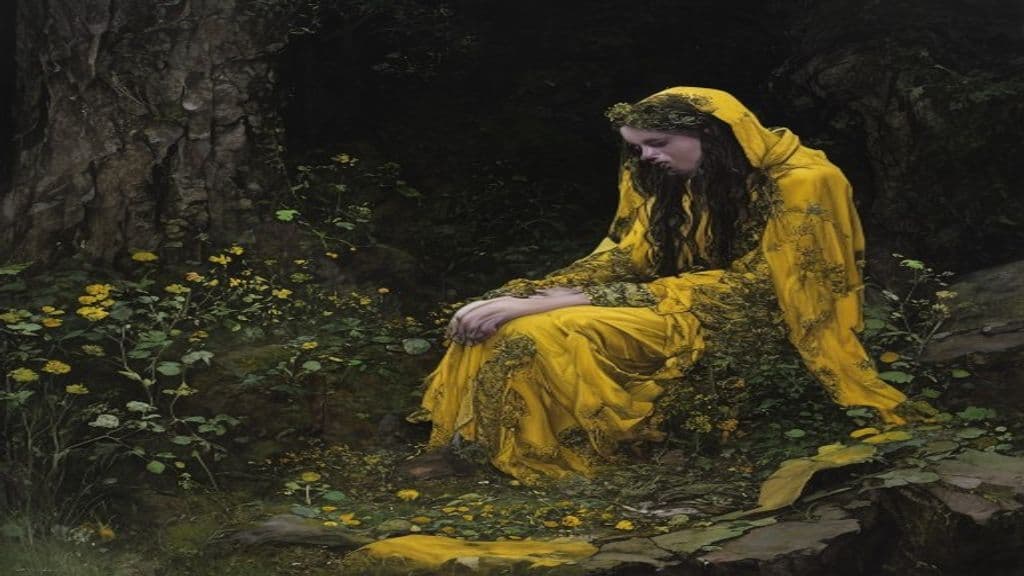
Medieval sources and surviving summaries provide little to no consistent physical description of Dían Cécht; no standard iconography or detailed portrait is attested in the cited texts. The available attestations emphasize his professional role and actions (making salves, operating the healing well, crafting Nuada's silver arm) rather than bodily characteristics, and therefore physical appearance remains unrecorded in the supplied material.
Narratively he is credited with a range of healing arts combining craft, herbal pharmacology, sacred place-based cures, and ritual language. He made a functioning silver prosthetic arm for King Nuada and administered communal cures by soaking the wounded in the Tipra Sláíne (Slainge’s Well), sometimes chanting there with his children and grinding herbs on the nearby Lusmag (Herb-plain). A salve associated with his name appears in the St. Gall charm tradition, with instructions for application (laid in the palm full of water, put into the mouth, insert two fingers). He performs surgical or investigative acts in mythic episodes (for example opening an infant's heart, finding and destroying three serpents, then disposing of their ashes into the River Barrow), showing a narrative capacity to discover and remove supernatural causes of sickness. Texts also frame explicit limits to his art: he is said to claim he could heal all save those who had been decapitated or whose brain or spinal cord had been grievously damaged. The tradition also records moral and professional flaws—jealousy that leads him to kill his son Miach after Miach surpasses him and to scatter the herbal catalogue his daughter Airmed had arranged.
Weaknesses
- conditionUnable to heal decapitation or severe brain/spinal damage
- otherProfessional jealousy / moral flaw (narratively kills his son Miach and scatters Airmed's herb-list)
Wards
- mantraSt. Gall salve charm associated with Dían Cécht (use of his salve; recitation and application as recorded in the St. Gall fragment)
Community Record
- [1]Dian Cecht - Wikipedia. Wikipedia entry 'Dian Cecht' (summarizing medieval Irish sources, charms, and narrative episodes including Tipra Sláíne, Nuada's silver arm, Miach, Airmed, and the St. Gall charm).wiki
- [2]Diancecht (James George Good) — ancienttexts.org. Summary and treatment of medieval texts concerning Dían Cécht, his family, and associated healing traditions (as reproduced on ancienttexts.org).other
- [3]Dian Cecht — Mary Jones' Celtic texts. Collected summaries and translations of Irish myth material relating to Dían Cécht, Miach, Airmed, the healing well, and associated episodes.other
- [4]The Story of Miach and His Sister | ADF: Ár nDraíocht Féin. Retelling and discussion of the Miach/Airmed narratives in which Dían Cécht kills Miach and scatters Airmed's herb-list, used here to document familial transmission and loss of herbal lore.folk
- [5]Archive: The Story of Airmed (Mythical Women 4). Popular/archival retelling of the Airmed narrative that recounts the posthumous sprouting of herbs from Miach's grave and Dían Cécht's scattering of the herbs.folk