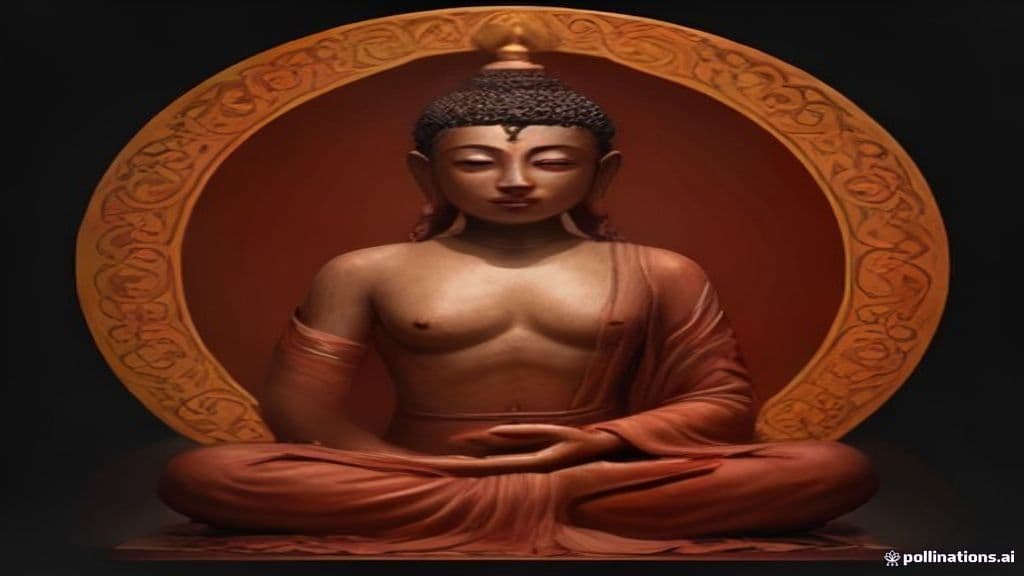
In traditional Buddhist cosmology Dīpaṅkara is narrated as one of the Buddhas of the past who attained full awakening in a remote age; sources place his life and awakening at the temporal remove of "four asankheyyas and one hundred thousand kalpas ago." In the best‑known narrative, the bodhisattva Sumedha meets Dīpaṅkara and performs an act of devotion (laying his hair or body on the ground); Dīpaṅkara gives Sumedha a niyatha vivaraṇa — a definite prediction — that he will in a future age become a Buddha called Gautama. Traditional accounts also locate Dīpaṅkara's parinirvana at Nandarama, where a stupa was said to have been erected.
In iconography Dīpaṅkara is generally represented as a Buddha, commonly seated but also frequently shown standing in regions such as China, Thailand, and Nepal. Typical gesture associations include the right hand in the abhaya mudrā (gesture of protection and reassurance); some regional images show both hands forming protective gestures. Descriptive texts (e.g., commentarial sources on the Flower Adornment) emphasize his great radiance — he is described as "radiantly bright." He is rarely depicted alone and is often accompanied in reliefs and statuary by bodhisattvas such as Mañjuśrī and Vajrapāṇi (noted in Java), or Avalokiteśvara and Vajrapāṇi (noted in Sri Lanka), and sometimes shown in triads with Buddhas who come after him (Gautama, Maitreya).
Sources portray Dīpaṅkara's principal role as recognitive and prophetic: he identifies and prophesies the future awakening of a bodhisattva (the Sumedha episode), thereby initiating the long path toward Buddhahood. As a past Buddha he functions as an exemplar whose radiance and awakened presence inspire the cultivation of the perfections. In later, regional devotional contexts (attested by the 17th century in Nepalese materials) he is also reverenced as a protector figure for particular social groups (for example, merchants and sailors) through votive images placed where protection is desired, though this patronal role is a vernacular development rather than a canonical power list.

Community Record
- [1]Dipankara (Wikipedia). Wikipedia, 'Dipankara' entrywiki
- [2]Dīpankara Buddha (Wikidata). Wikidata entry for Dīpankara Buddhaother
- [3]Dipankara Buddha predicts Buddhahood for Sumedha. Wisdom Library, 'Dipankara Buddha predicts Buddhahood for Sumedha' (Apadāna/Commentary material)literary
- [4]The Flower Adornment Sutra with Commentary 13 (City of 10,000 Buddhas). Flower Adornment commentary (descriptive reference to Dipankara as 'radiantly bright')literary
- [5]Bodhipathapradīpaḥ (बोधिपथप्रदीपः) — A Lamp that Illuminates the Path to Awakening. Archive copy of Bodhipathapradīpaḥ, text by Atiśa Dīpaṅkara Śrījñāna (title demonstrates usage of the name)literary
- [6]Daw Dīpaṅkara Theri. Archive material related to Dīpaṅkara name use in monastic contextsother
- [7]MN143, a talk by Sayalay Dipankara - AV - Discuss & Discover. SuttaCentral forum reference to modern monastic using the name Dipankaraother
- [8]Gandhāran art and archaeological references (Classical Art Research Centre / Archaeopress). Art‑historical material noting Gandhāran representations connected with former Buddhas including Dipankaraacademic
- [9]Sumedha (Wikipedia). Wikipedia entry on Sumedha (bodhisattva who received Dīpaṅkara's prediction)wiki