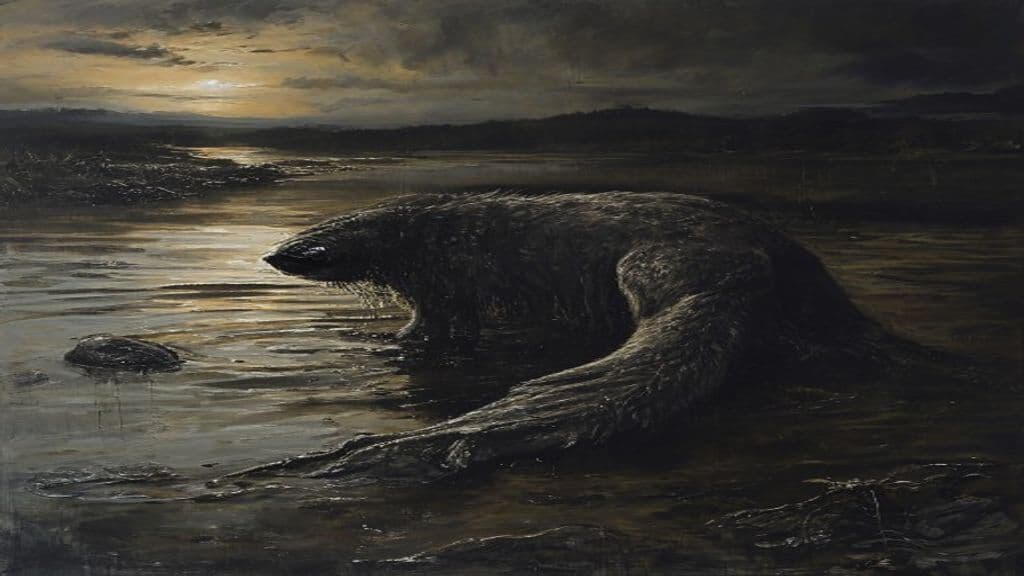
The Dobhar-chú ('water hound') appears in Irish tradition as a fearsome creature inhabiting lakes, particularly in County Leitrim and County Donegal. A famous gravestone in Connaught depicts a woman killed by the creature along with the scene of her husband and companion hunting and killing it — while a second creature pursued them. It was larger than any otter, semi-supernatural, and its skin was said to be a powerful protective charm.
Described as larger than an otter, with the general form of an otter or dog but of supernatural proportions. White with a dark cross on its back in some accounts. It moved with great speed both in water and on land.
Could move at extraordinary speed both in water and on land, making it nearly impossible to escape. Its skin was a powerful protective charm against drowning if made into a belt. It hunted in pairs — killing one brought the mate in immediate retaliation.
Weaknesses
- conditionMust be killed at a single stroke — hesitating allows the mate to be alerted
Wards
- substanceBelt made from its hide — protects against drowning
- ritualAvoidance of specific known lakes
Anu
Anu (also Ana, Anann, Anand) is a mother-figure in early Irish tradition associated with nourishment, territorial fertility and prosperity—especially in Munster—and is variably conflated with other maternal or war-related goddesses in later sources.
Cat Sídhe
A large black fairy cat of Irish and Scottish tradition with a white spot on its chest, who could steal a corpse's soul before burial if allowed to leap over it.
Cú Chulainn
A legendary Irish warrior-hero and demigod of the Ulster Cycle, Cú Chulainn is the central martial protagonist of the Táin Bó Cúailnge and a culture-constituting figure whose stories were preserved in multiple medieval manuscripts and continue to appear in modern memorial and institutional contexts.
Cú Sídhe
The supernatural fairy hound of Celtic tradition — enormous, dark green or white, who hunts in eerie silence and whose triple bark is a death omen.
Dullahan
The headless horseman of Irish legend who carries his own rotting head under one arm, stops at the door of those about to die, and cannot be kept out by any lock.
Ecne
Ecne is the personification of wisdom in Irish/Celtic mythic tradition, attested in modern summaries as a member of the Tuatha Dé Danann and glossed in Old Irish as 'wisdom' (ecna, ecne). Sources present Ecne genealogically as the offspring of three brothers and as connected to the goddess Anu/Ananna, with variant accounts assigning ambiguous gender and, in one later report, an association with poetry.
Fairy
A class of anthropomorphic supernatural beings found across multiple European folk traditions, fairies are magical, liminal entities variously described as spirits, an older race, or enchanted people; their depiction ranges from human-sized to diminutive and their attributes and moral alignment vary by region and period.
Selkie
A seal-being from northern Atlantic coastal folklore said to shift between seal and human forms by removing or donning a seal skin. Tales focus on intimate relations with humans, the selkie's longing for the sea, and the narrative motif of a hidden skin that prevents return to the ocean.
Sluagh
The host of the unforgiven dead in Irish and Scottish tradition — a restless swarm who travel from the west, steal souls, and attack the living, whom they carry off into their dark company.
Tuatha Dé Danann
The Tuatha Dé Danann (earlier name: Tuath Dé) are a named supernatural race in Irish mythology. In modern summaries they are widely treated as representing the deities of pre‑Christian Gaelic Ireland and function as a mythic otherworldly people within Gaelic mythic history.
Djinn
The class of supernatural beings created from smokeless fire in Islamic cosmology — a parallel civilization to humanity, capable of belief or unbelief, with their own prophets, society, and judgment before God.
Dobiel
Dobiel (also Dubbiel; Hebrew דּוּבִּיאֵל) is a tutelary angel in Jewish/Talmudic-derived angelology identified as the guardian or patron angel of Ancient Persia. In the Talmudic legend he served temporarily in Heaven as a proxy for Gabriel and is portrayed as an advocate for Persia who acted with national partiality and as one of the angels who accused Israel in the heavenly court.
Community Record
- [1]Knocknarea gravestone. Local tradition. Connaught, Ireland. Gravestone at Conwal cemetery, c. 1722.folk
- [2]Irish Water Monsters. O'Brien, Daragh. 2009. 'The Dobhar-chú'. Fortean Studies 7.academic