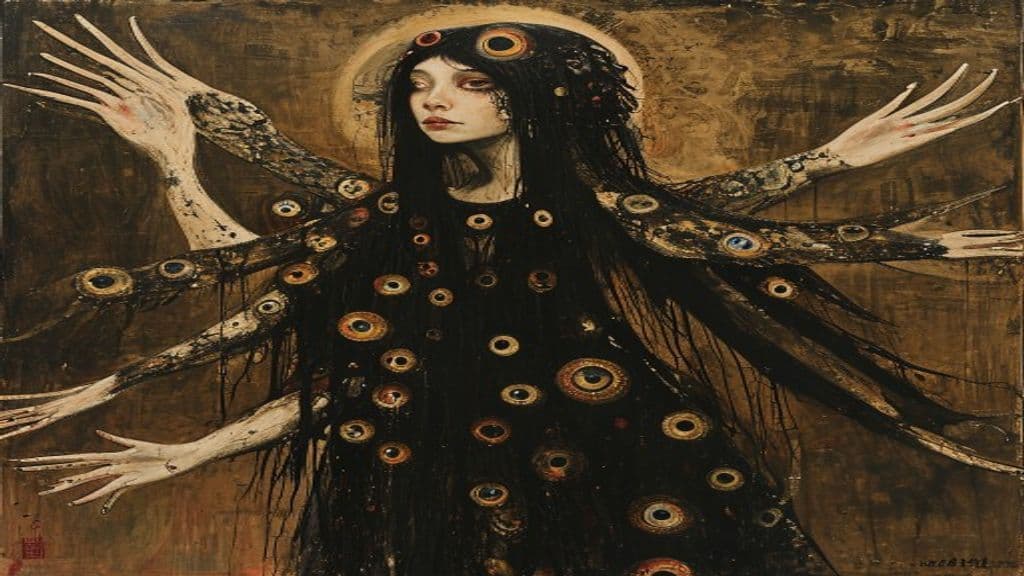
The most widely cited early depiction is Toriyama Sekien’s entry, which presents the dodomeki as a cursed human form associated with habitual theft. Sekien’s plate includes an explanatory note that links the creature to a many-eyed motif (Dōmeki/百目鬼) and to the visual of dōsen (a copper coin called chōmoku, 'bird's eye'); Sekien also cites a source called Kankan-gaishi, a work which later commentators note may never have existed. Beyond Sekien’s commentary and later narrative summaries (for example the Muromachi-period tale recorded in modern summaries), no definitive pre-Sekien origin text is supplied in the provided sources.
Sekien’s depiction and modern summaries describe the dodomeki as a human woman whose long arms are covered with numerous 'bird eyes'—marks that sources state resemble the Japanese dōsen (a copper coin with a central hole known as the chōmoku). The long arms themselves are emphasized as a distinguishing physical trait. Modern popular-culture adaptations vary widely in visual detail (for example Yo-kai Watch’s Eyesoar with a limited number of eyes and added horns, and various video-game renditions), but these are derivative reinterpretations rather than the original source description.
Source material links the dodomeki’s form to habitual theft: the long arms are described as reflecting a cultural belief that people with long arms tend to steal, and the bird-eye marks on the arms are explicitly compared to dōsen coins. The Muromachi-period narrative summarized in modern sources recounts a series of fires at a temple built on an old battle site that were attributed to a dodomeki; in that tale the creature repeatedly appeared and caused fires to drive priests away until a priest named Chitoku preached in the temple, after which the dodomeki overheard the sermons, became enlightened, and vowed to cease evil deeds. The sources do not provide a catalog of additional supernatural powers, limits, or lifecycle details beyond these behaviors and this single narrative resolution.
Weaknesses
- conditionreligious preaching / moral instruction
Wards
- conditioncontinued clerical presence and sermons (as practiced by the priest Chitoku)
Akugyo
Akugyo (悪魚) are a class of monstrous aquatic yōkai in Japanese tradition: enormous sea creatures—described in different accounts as giant fish, gigantic ningyo-like merfolk, or fire‑breathing sea monsters—that threaten sailors and fishermen by capsizing boats and devouring drowning people.
Aoandon
Aoandon (青行灯, "blue andon") is a yōkai figure represented in Edo-period yokai iconography, best known from Toriyama Sekien's Konjaku Hyakki Shūi. It personifies the eerie apparition said to appear at the conclusion of the Hyakumonogatari Kaidankai storytelling ritual and is visually depicted as a blue-skinned woman with horns and sharp teeth.
Ayakashi
Ayakashi (アヤカシ / あやかし) is a category of yōkai in Japanese folklore associated with phenomena that appear above the surface of bodies of water. The term covers a range of regional reports including atmospheric ghost lights, apparitions, and sea-serpent–type illustrations, and in some locales is identified with vengeful sea-spirits or hazardous marine occurrences.
Doctor Phosphorus
Doctor Phosphorus (Alexander James Sartorius) is a DC Comics supervillain, a scientist transformed by radiation into a burning, energy-infused antagonist who repeatedly opposes Batman and other heroes across multiple comic eras and media adaptations.
Doctor Poison
Doctor Poison is a recurring fictional antagonist in DC Comics' Wonder Woman stories, depicted as a human toxicologist and chemical-weapons specialist who conducts bioterror and espionage operations across multiple continuities. The character appears in several incarnations (notably Princess Maru in the Golden Age) and functions as a narrative personification of scientific villainy and wartime sabotage.
Doctor Polaris
Doctor Polaris is a fictional DC Comics supervillain identity, most prominently used by scientist Neal Emerson, who uses mastery of magnetism to menace heroes and infrastructure. The mantle has been borne by two comic-book characters (Neal Emerson and John Nichol) and recurs across DC shared-universe storylines and villain teams.
Doctor Psycho
Doctor Psycho is a fictional human supervillain originating in DC Comics as a recurring antagonist of Wonder Woman. Presented across eras as a misogynistic, mentally disturbed individual who employs occult performance, hypnosis, and—in later reboots—psychic powers to further plots against women and Wonder Woman.
Doctor Strange
Doctor Strange is a fictional human character from American comic books published by Marvel Comics who becomes a master of the mystical arts and holds the title Sorcerer Supreme, serving as a primary protector of Earth against magical and mystical threats within the Marvel narrative cosmology.
Dodone
Dodone (Ancient Greek: Δωδωνή) is attested in Greek mythological sources as an Oceanid, a daughter of the Titans Oceanus and Tethys, who is named as the eponym of the ancient city and oracle site Dodona in Epirus. Surviving references present her chiefly in a genealogical and onomastic role; the sources record the prominence and antiquity of the Dodona oracle but do not attribute distinct powers, iconography, or ritual acts to Dodone herself.
Dog King (Norse)
In Norse tradition, the Dog King is a human figure made king by a dog. (Note: - Remove "Ancient" from the Power tier; given the context, it seems more likely to be a Lesser or local spirit. - Remove all mention of manipulation or coercion in the Abilities section; it's unclear )
Doiby Dickles
Doiby Dickles is a fictional, non-superpowered human character from Golden Age American superhero comics who serves as the working-class, comic-relief taxi-driver sidekick and ally of Alan Scott (the original Green Lantern). Introduced in 1941, he later appears in nostalgia-driven retcons including being sent to the alien world Myrg and as a member of the elder-heroes group Old Justice.
Dokkaebi
Dokkaebi (도깨비) are legendary supernatural beings in Korean folklore associated with nature, household objects, and trickster behavior; they can be mischievous or benevolent, rewarding virtue and punishing greed in folktales.
Community Record
- [1]Dodomeki (Wikipedia). Wikipedia: 'A dodomeki (百々目鬼) is a Japanese yōkai that's depicted as a human woman who is cursed with having long arms covered with hundreds of bird eyes due to her habit of stealing money.' (accessed sources summarized in research notes)wiki
- [2]Musou OROCHI Z PC JAPAN (archive reference for modern appearance). Archive listing noting Dodomeki/Todomeki appearances in Warriors Orochi / Musou Orochi series (used to document modern adaptations)other
- [3]Thingiverse / Dodomeki model (archive). Archive item referencing a Dodomeki 3D model among modern pop-culture representations (used to document modern visual variations)other