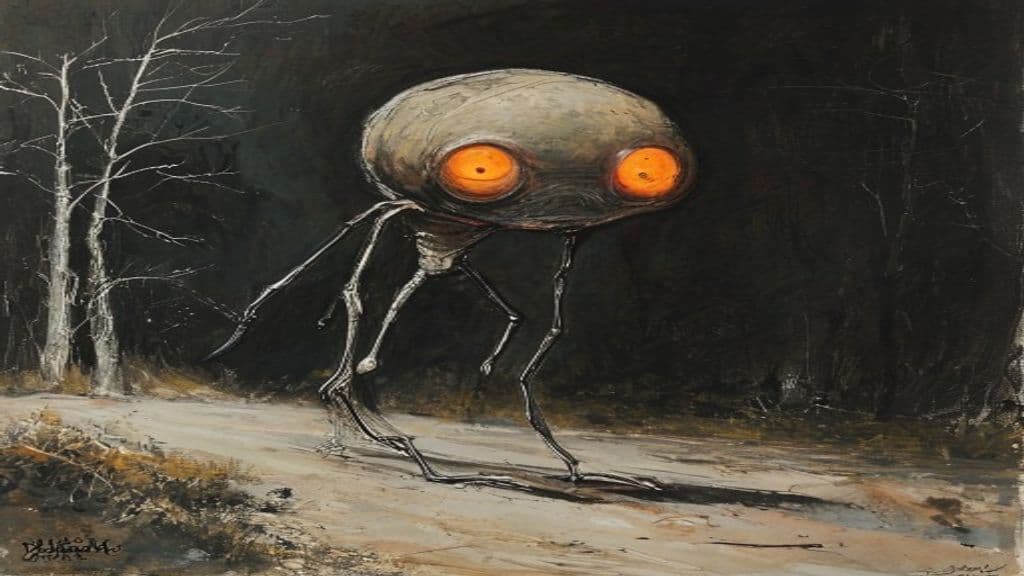
The Dover Demon originates from a cluster of eyewitness reports made on April 21–22, 1977 by three teenagers — William "Bill" Bartlett, John Baxter, and Abby Brabham — who independently reported seeing a small humanoid creature in different locations in Dover, Massachusetts (Farm Street, Miller Hill Road, and Springdale Avenue). The locations of the sightings, when plotted, lay roughly in a straight line over about two miles. The reports were publicized in May 1977 and have since been discussed by investigators of unexplained phenomena, skeptics offering naturalistic identifications, and by popular culture. The case entered the corpus of contemporary cryptid lore as an anomalous eyewitness encounter rather than as part of an older indigenous cosmology or religious tradition.
Eyewitness descriptions and hand-drawn sketches by the teenagers depict a small creature roughly 4 feet tall with an unusually large, rounded "watermelon-shaped" head, glowing orange eyes, and no visible nose or mouth. Sketches imply slender limbs and long finger-like appendages; Bartlett's sketch was accompanied by his written oath: "I, Bill Bartlett, swear on a stack of Bibles that I saw this creature." The sightings and sketches are confined to the dates April 21–22, 1977 in Dover, Massachusetts.
Primary sources and subsequent investigations do not attribute supernatural abilities to the Dover Demon; reported behavior is limited to brief sightings by teenagers while driving at night. Later commentators and fictional adaptations sometimes assign attributes or powers in creative contexts, but the eyewitness reports and skeptical investigations cited supply no evidence of speech, aggression, or world-altering capacities. Investigators have compared the report topologically and descriptively to other mid‑20th‑century anomalous humanoid encounters; skeptics have proposed misidentifications (for example, Joe Nickell's snowy owl hypothesis) or hoax.
Weaknesses
- othernone recorded in sources
Wards
- othernone recorded in sources
Dorus
In the supplied sources Dorus is identified as an eponymous ancestral figure in Greek mythology, described succinctly as the founder of the Dorians. The available material treats Dorus as a mythic name used to explain ethnic origin rather than as an actively described supernatural being.
Dorylas
Dorylas is attested in modern sources primarily as a Latinized taxonomic epithet for a butterfly species (Polyommatus (Plebicula) dorylas, the Turquoise Blue) and as a male given name borne by modern individuals (e.g., Bishop Dorylas Moreau). The name is not documented in the supplied sources as a traditional supernatural being or folkloric entity.
Dotia
Dotia (Ancient Greek: Δωτίας; variants Δωτίς/Δωτίδος) is an eponymous ancestress in Greek mythic-genealogical tradition, cited as the name-source for the Dotian plain and the city Dotion (Dotium) in Thessaly. Surviving references present her as an etiological figure — a mythic ancestor who explains a place-name — not as an independently acting deity, spirit, or cult figure.
Dotis
Dotis (Ancient Greek: Δωτίς or Δωτίδος) is a personal name attested in ancient Greek mythographic and lexicographic sources. The name is borne by multiple mythic individuals known from genealogical notices (one male, two female in the cited traditions) rather than a single, coherent supernatural being or class of entity.
Doto
Doto is one of the fifty Nereids in Greek mythology, a sea-nymph daughter of Nereus (the 'Old Man of the Sea') and the Oceanid Doris. She is named in classical lists of Nereids and appears collectively with other sea-nymphs as an attendant or escort in fragmentary references.
Douen
A childlike supernatural spirit from Trinidadian and Saint Lucian folklore, often depicted as faceless forest beings with backwards feet that mimic voices to lure living children. They are commonly described as mischievous and associated in some accounts with children who died before receiving baptism.
Doyen
The Bengali witch — closely related to the North Indian Dayan but with Bengali-specific characteristics including the ability to steal livers, which the witch must periodically consume to maintain her powers. Doyen accusations continue to drive violence against women in rural Bengal and tribal districts of Jharkhand.
Dracs
The string "Dracs" appears in multiple unrelated modern contexts; only a single provided literary source uses it to denote lethal, man-shaped scaled draconic creatures in an alternate-historical fantasy setting. Other occurrences are proper names (a Catalan literary collective, a sports team, track titles) or technical acronyms and do not document a unified folkloric entity.
Dracula
Count Dracula is the singular Transylvanian aristocratic vampire of Bram Stoker's 1897 novel who preys on the living by drinking blood and exerting mental influence, relocates to England via the ship Demeter with boxes of earth from his castle, and is ultimately tracked and destroyed by a group of hunters using a mix of scientific, clerical, and folkloric measures.
Dracule Mihawk
A fictional human character from Eiichiro Oda’s One Piece, widely described in sources as the "Greatest Swordsman in the World" and a high-ranking pirate-affiliated combatant who has served among the Shichibukai/Warlords in the series. He functions as a benchmark and occasional mentor to other swordsmen, notably Roronoa Zoro.
Draghignazzo
Draghignazzo is a modern fictional proper name applied across multiple entertainment media to distinct antagonistic figures: a named Malebranche-style demon in Dante-derived adaptations and games, a quasi-deity entry in a tabletop RPG bestiary, and a bio-organic weapon (B.O.W.) monster in the Resident Evil franchise. There is no attested historical folkloric origin for the name in the supplied sources; all attestations are modern fictional usages.
Dragon (Long)
Long (龍, "dragon") is a pervasive cultural and artistic motif that appears in Taoist sacred-geographical contexts, Chinese literature, and modern exhibitions; the provided sources treat it as part of the broader mythic imagery present around Taoist sites and ritual scenes rather than as a single, consistently described doctrinal entity.
Community Record
- [1]Dover Demon. Wikipedia contributors. "Dover Demon." Wikipedia, The Free Encyclopedia.wiki
- [2]Dover Demon (Wikidata). Wikidata entry Q1252960.other
- [3]Encyclopedia of Strange and Unexplained Physical Phenomena (index mention). Archive.org: encyclopedia index listing Dover Demon among unexplained physical phenomena.other
- [4]Podcast episode: 087 Unearthing The Dover Demon. Archive.org podcast episode recounting the Dover Demon case and discussing hypotheses.other
- [5]Podcast episode: Episode 60 - The Veil Between Worlds is Just a Glory Hole. Archive.org podcast episode referencing the Dover Demon in broader anomalistics discussion.other