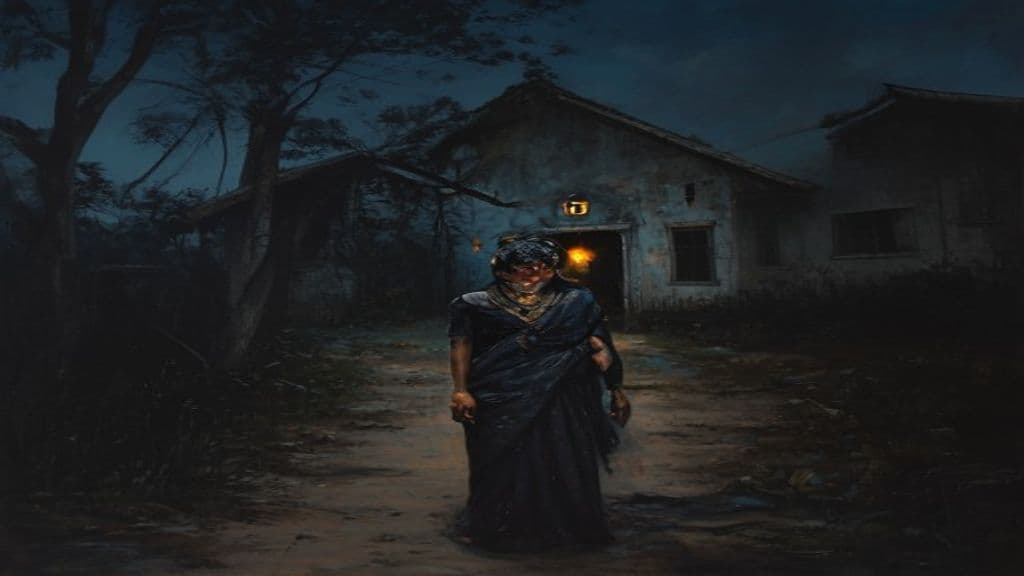
The Doyen is the Bengali form of the Dayan — a living woman who has acquired supernatural powers through a pact with dark forces. The Bengali tradition adds a specific and visceral detail: the Doyen must periodically steal and consume a person's liver to maintain her powers. The victim does not die immediately but wastes away over weeks as the stolen organ's energy depletes.
Doyen belief in Bengal is ancient, extensively documented, and continues to drive real-world violence. The Bengal-Jharkhand border region sees the highest concentration of witch-hunting incidents in India, most targeting widows and elderly women.
The Doyen looks like an ordinary woman. The supernatural signs are behavioural: she is seen at crossroads at night, her shadow does not match her movement, and she is observed speaking to her spirit-animal (typically an owl or cat).
In her operating form she is described as able to become invisible or to travel as a fireball, entering houses through the keyhole.
The Doyen's signature power in Bengali tradition is the liver theft: she enters a sleeping victim's room and extracts the liver without waking them, using supernatural means. The victim develops progressive weakness and pain in the upper abdomen, dying over weeks or months.
She can also cause wasting illness in children, poison stored food, and prevent medicines from working in people she has cursed.
Weaknesses
- ritualCounter-ritual by an Ojha (specialist exorcist)
Wards
- substanceNeem branches at the doorway
- symbolRed chili and lemon hung at the entrance
Aleya
Ghost lights of the Sundarbans delta — flickering flames over swamp water said to be the souls of dead fishermen, luring the living off safe paths into drowning waters.
Bhunni
The female guardian-spirit of agricultural fields in Bihar and eastern UP — her presence ensures fertile soil and good harvest, but she is territorial and punishes those who plough without permission, steal crops, or use chemical methods that poison the soil she inhabits.
Brahmadaitya
Bengal's most distinctive ghost: the spirit of a Brahmin who died celibate — before marriage, or having taken a vow of celibacy — whose accumulated learning and unfulfilled life persists. Unlike the North Indian Brahmpret, the Brahmadaitya is often passive or even helpful, but its presence makes any household it inhabits spiritually unsettled.
Dayan (Daayan, Ḍāin, Ḍāini)
A North and East Indian folkloric figure: a malevolent female revenant or vengeful spirit commonly associated with women who died in traumatic or unresolved circumstances. Dayans are described in popular sources as powerful life-draining entities with distinctive physical markers and as a label that also functions in social witch‑hunt practices.
Jokhini
A female supernatural predator of Assamese folklore — the Jokhini appears as a beautiful woman to lure men, but also as a hideous crone to devour them. She is associated with the dense forests of the Brahmaputra valley and is one of the most feared night entities in Assamese village belief.
Mahapreta
The 'great ghost' — in Bihar and UP folk classification, a Mahapreta is a preta of exceptional power, born from a death involving multiple injustices simultaneously: wrongful killing, incomplete rites, and unresolved family debt combined. It commands lesser spirits and can cause harm across an entire lineage.
Mamdo Bhoot
The ghost of a Muslim person in Bengali Hindu folk belief — 'Mamdo' deriving from 'Mahmood.' The Mamdo Bhoot occupies a unique place in Bengal's supernatural taxonomy: a cross-religious ghost in a deeply syncretic tradition, with its own distinctive characteristics and ward practices that follow the ghost's religious tradition rather than the observer's.
Mechho Bhoot
The fish-eating ghost of Bengal — the spirit of a fisherman or a person obsessively fond of fish in life, condemned to haunt river banks and fishing boats, stealing the catch and causing boats to capsize. Distinctly Bengali: a ghost shaped by the culture of a river civilization.
Nathiya
Ghost of a young bride who died before her first Diwali as a wife — still wearing her wedding nose ring (nath), she haunts the marital home she never truly inhabited, causing illness in subsequent brides and making the household unwelcoming to new marriages.
Nishi
Bengali spirit of the night that calls your name in a loved one's voice — answering three times seals your fate. Its call cannot be refused by those whose time has come.
Petni
The female equivalent of the Bengali bhoot — the ghost of a young woman who died unmarried or before fulfilling her expected life. The Petni is more volatile and less predictable than the Shakchunni (married woman's ghost), driven by the particular bitterness of a life foreclosed rather than interrupted.
Pichal Peri
Shared across North Indian and Pakistani folklore — a female spirit with reversed feet who lures lone travellers off roads at night. One of the most cross-cultural supernatural figures in the subcontinent, appearing in Hindu, Muslim, and Sikh communities alike.
Community Record
- [1]Witch-hunting in India: A Human Rights Perspective. Human Rights Watch. (2009). Witchcraft accusations and violence against women in India. New York: HRW.academic
- [2]Daini in Bengali folk tradition. Risley, H.H. (1891). The Tribes and Castes of Bengal, Vol. 1. Bengal Secretariat Press, Calcutta.academic