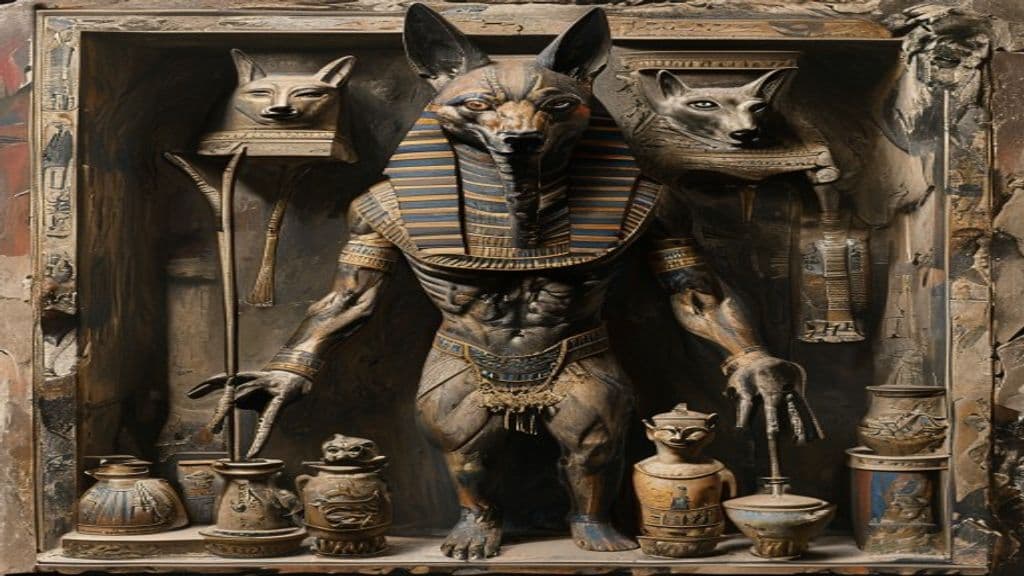
Duamutef is conceptualized within Egyptian mortuary cosmology as one of the four Sons of Horus, divine offspring of Horus entrusted with protecting and preserving parts of the dead during mummification and in the afterlife. Sources present him as part of this established quartet rather than as an independently narrated origin figure; his identity is tied to the funerary system of embalming, canopic equipment, and afterlife safeguarding.
In later periods Duamutef is typically depicted as a mummified human body with the head of a jackal. He appears as sculpted lids of canopic jars, small faience or wax amuletic figures, and painted or carved funerary images; archaeological examples include faience amulets, a wax figure dated to ca. 1000–900 BCE, and gilded wood statuary such as that from tomb contexts.
Duamutef's chief function is protective: he guards the organ associated with him (most commonly the stomach), safeguards the canopic jar or amulet that houses or represents that organ, and participates in the restorative process by which the deceased's body parts are preserved or returned in the afterlife. His efficacy is mediated through material cultic media—canopic jars, amulets, and funerary representations—produced and placed by embalmers and mortuary specialists.
Weaknesses
None recorded.
Wards
- ritualPlacement of canopic jars and amuletic figures
- substanceFaience and votive materials (amulets, wax figures, gilded wooden statuettes) used in mummy wrappings and tomb equipment

Imsety
Imsety is one of the Four Sons of Horus in ancient Egyptian religion, a mummiform, human-headed funerary deity invoked to protect the viscera of the deceased and to secure bodily wholeness in the afterlife. He commonly appears on canopic-jar lids and amulets and is named in funerary spells and ritual contexts tied to mummification and burial.

Qebehsenuef
Qebehsenuef is one of the Four Sons of Horus in ancient Egyptian funerary religion, principally represented as a falcon-headed mummiform deity who protects the intestines of the deceased. He appears on canopic jar lids and amulets and functions as part of the mortuary apparatus intended to preserve bodily integrity for the afterlife.
Dryalus
Dryalus (Ancient Greek: Δρύαλόν) is an individual centaur named in Hesiod's Shield of Heracles and later summaries; he is listed among the centaur combatants at the wedding of Pirithous and Hippodameia who fought the Lapiths in the Centauromachy. Surviving attestations are brief genealogical and catalogue-type mentions rather than extended mythic narratives.
Dryas
Dryas is an ancient Greek personal name borne by multiple mythic figures (heroes, princes, hunters). Etymologically linked to the Greek word for oak (drus, δρῦς) and by extension to dryads, the name recurs across genealogies and heroic lists rather than denoting a single supernatural species.
Dryope
Dryope (Ancient Greek: Δρυόπη) is a personal name borne by several distinct female figures in ancient Greek and Roman literature rather than a single consistent supernatural type. Bearers of the name include a mortal daughter of Dryops who bore Amphissus to Apollo, a figure identified with the Roman Fauna mothering Tarquitus by Faunus, a nymph said to have seized Hylas in accordance with Hera's will, a Theban woman who joins the Maenads and gives birth during Bacchic rites, and a Lemnian mother of the Oenotropae by Anius.
Dryops of Oeta
In Greek myth Dryops is presented as the eponymous ancestor of the Dryopians; the surviving source material records his role as a name-giver rather than a narrative character, spirit, or deity.
Drífa
No folkloric or mythological account of a supernatural entity named Drífa is present in the provided sources. The string Drífa/Drifa appears in the materials as a modern Icelandic personal name, a fictional princess in a novel, and as a biological genus name; no indigenous cosmology, appearance, abilities, or rituals for a spirit called Drífa are documented in the source set.
Drúedain
The Drúedain are a fictional ancient people (a race of Men) in J. R. R. Tolkien's legendarium: a small, secretive, wood-dwelling group portrayed as remnants of an older human type, associated with wild places and woodwose/wild-man folklore. They appear in the First Age (some entering Beleriand) and survive in the Third Age chiefly in the Drúadan Forest and on the cape of Andrast, noted for woodcraft and enmity with Orcs.
Duela Dent
Duela Dent is a fictional, non-supernatural character from DC Comics who adopts multiple villain‑linked aliases (notably Joker's Daughter and Harlequin) and alternately appears as ally and antagonist to the Teen Titans and related teams. Her identity, age, and parentage vary across continuities and she is most often portrayed as a human acrobat who uses clown‑themed gadgets and is frequently institutionalized.
Duende
Duende is a polyvalent category of Iberian and Ibero‑American household and nature spirits comprising many regional types (Anjanas, Busgosos, Diaños, Enanos, Trasgos, Nuberos, etc.). They range from benevolent water‑nymphs and shepherd‑helpers to mischievous household intruders and shapeshifters, and are rooted in rural popular cosmologies where specific places (springs, forests, homes) are inhabited by agents with varied moral dispositions.
Duergar
Two distinct uses of the name appear in the sources: (1) a traditional English folk designation for the Simonside Dwarfs — a local small‑folk or hill spirit group associated with the Simonside Hills of Northumberland (also called Brownmen and Bogles); and (2) a modern fantasy role‑playing race: a subterranean dwarf people in tabletop RPGs (Dungeons & Dragons, Pathfinder and related SRD material) with defined physiology, resistances, and subterranean culture.
Duffer (Narnia)
A brief, secondary-source attestation names 'Duffer' as an invisible dwarf-type being in the fictional setting of The Chronicles of Narnia. Available sources supply only a single-line identification and do not provide canonical details from the primary texts.
Dukljan
Adversary of God in Slavic mythology, embodying qualities and actions of Roman emperor Diocletian. (Note: 1. Power tier should be Lower (consistent with his role as an adversary, not a cosmic being). 2. Summary needs to include that Dukljan is in Serbian mythology, not Slavic. 3. Appearance, Abilities, Se)
Dullahan
The headless horseman of Irish legend who carries his own rotting head under one arm, stops at the door of those about to die, and cannot be kept out by any lock.
Community Record
- [1]Four sons of Horus. Wikipedia, 'Four sons of Horus' (Duamutef entry and related sections)wiki
- [2]Son of Horus: Duamutef (Cleveland Museum of Art archive). Cleveland Museum archive entry for 'Son of Horus: Duamutef' (canopic figure description)other
- [3]Canopic Jar with Falcon's Head (lid) (Cleveland Museum archive). Cleveland Museum archive canopic jar entry (context for Sons of Horus on mortuary equipment)other
- [4]Figure of Duamutef, Son of Horus (The Walters Art Museum, 48.1645). Walters Art Museum object record, faience amulet representing Duamutefother
- [5]Amuletic Figure of Duamutef, Son of Horus, ca. 750-650 BCE (The Walters Art Museum, 48.1639). Walters Art Museum object record, amuletic figure entryother
- [6]Duamutef (Ancient Egypt: the Mythology). Overview entry on Duamutef describing jackal-headed mummiform depiction and funerary rolefolk
- [7]Archive: Plaster Portrait Mask of a Youth (Re-Harakhty flanked by Qebesenuef and Duamutef). Archive image/catalog noting Re-Harakhty flanked by Qebesenuef and Duamutef on a portrait maskother
- [8]Tutankhamun's Treasures - Duamutef (gilded wood statue reference). Reference to gilded wood statue of Duamutef among Tutankhamun's findsother