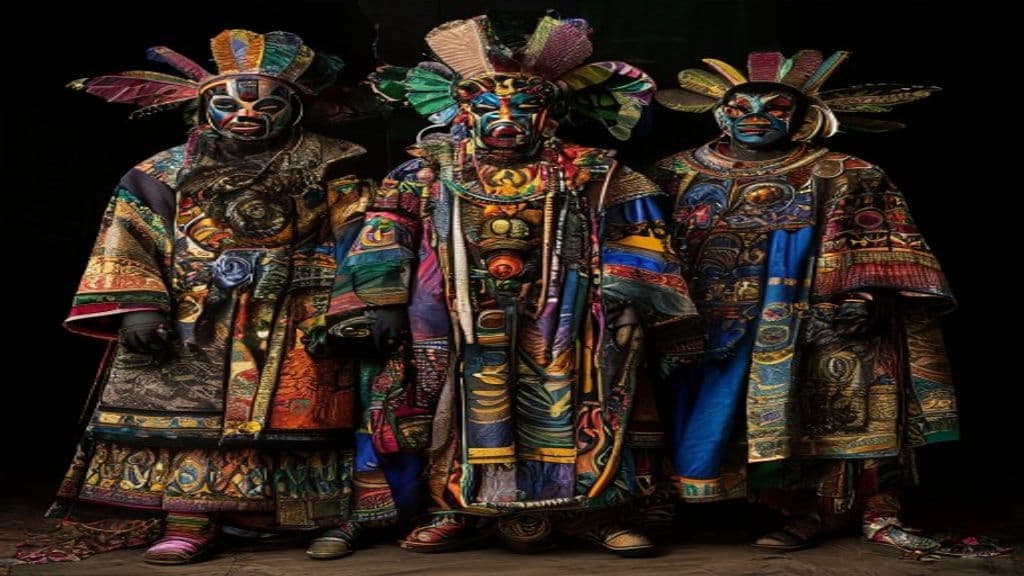
The sources do not provide a mythic founding narrative. Ethnographic and museum records frame egungun as an established ritual category in Yoruba praxis: a lexical item that names both masked, costumed figures and the ancestors collectively. Within ritual life egungun are enacted when a living performer dons a multilayered costume arranged according to Yoruba design sense (ojú-ọnà); the costume is conceived as creating a ‘dwelling place’ for ancestral spirits, allowing the ancestors to 'periodically revisit' the community during scheduled communal festivities to give remembrance and blessings.
Egungun are realized through large, enveloping layered costumes made from many fabric panels. Museum descriptions record the use of hundreds of African, Asian, and European fabrics (including imported damasks, velvets, faux furs, embroideries, and local indigo-dyed cottons) alongside materials such as cotton, velvet, flannel, leather, cowrie shells, metal, and wood elements. Costumes are voluminous—examples in collections measure on the order of ~152–168 cm in height with broad, layered widths—and often include a face covering of striped netting that allows the wearer to see while concealing identity. The layered panels are explicitly described as creating a dwelling place for ancestral spirits.
Sources describe egungun primarily in social-ritual terms rather than as a catalogue of supernatural powers. They are a visible manifestation of departed ancestors, appearing in masquerade to 'periodically revisit' the human community for remembrance, celebration, and blessings. In performance egungun function as an interface or bridge between the living community and the otherworld; the costume and embodied performance host or embody ancestor presence. Museum and archive texts emphasize communal blessing and mediated ancestral presence rather than discrete combative or magical abilities.
Ajogun
Ajogun are a class of malevolent spiritual forces in the Yoruba religious worldview that regularly interfere with human lives, responsible for death, disease, curses, loss, conflict and related misfortunes. They are described as the polar opposite of the benevolent Oriṣa, led by Iku (Death), and can be warded off or appeased through intercession by Eṣu and by observing Ifá divinatory counsel.
Gelede (Gẹlẹdẹ)
Gelede is a Yoruba public masquerade spectacle and the ritual institution that honors and manages the spiritual power of 'Mothers' (senior women, female ancestors and deities). As a multi-media performance of carved and painted headdresses, masks, dance and music, Gelede functions to celebrate fertility and motherhood, educate the community, and placate potentially dangerous female powers.
Obalufon Alayemore
Obalufon Alayemore (Ọbalùfọ̀n II, Alayemore) is a historical Ooni of Ile Ife who was deified after death and is venerated in the Yoruba religious-cultural corpus as an oríṣa and patron of art, weaving, and bronze/brass casting. He appears in royal succession lists as the third Ooni of Ife and is associated with material-culture representations such as brass heads and masks.
Obatala
Obatala is a high-ranking primordial orisha in the Yoruba religious framework, widely described as the sculptor of humankind who molds human bodies and is regarded as father of humanity and owner of all heads. He is associated with wisdom, coolness of thought, and senior or royal status among the orisha; some traditions connect him to the founding of Ife.
Odùduwà
Divine king and Oriṣa in the Yoruba religion, progenitor of the Ife Empire. (Note: - Power tier is uncertain; source material does not provide clear information on Odùduwà's abilities or power level. - Appearance should be included for completeness. - Abilities need to be rewritten,)
Orisha
Orisha (Òrìṣà) are named divine or supernatural figures in Yoruba religious thought and its Afro‑diasporic continuations (for example, Candomblé and Cuban Yoruba associations). They function as central agents of worship, ritual engagement, and divinatory communication in Yoruba communal and individual religious life.
Oriṣa (Orisha / Orixá)
Oriṣa (Yoruba: òrìṣà; Portuguese: orixá; Spanish variants: orisha, oricha, orichá) are the class of divine spirits or deities central to the Yoruba religion of West Africa and to Yoruba-derived religious systems in the Atlantic diaspora (notably Lucumí/Santería in Cuba and Candomblé in Brazil). They function as active sacred presences and intermediaries in communal and individual religious life; in diaspora settings they were often syncretized with Catholic saints as a strategy of continuity under colonial Christian rule.
Oshun
Oshun (Ọṣun, Ochún, Oxúm) is a major orisha and Irunmole in the Yoruba religious corpus and its diasporic traditions, associated with freshwater (rivers), love, fertility, femininity, divination, prosperity and beauty. She is honored at the Osun-Osogbo Sacred Grove and in festivals and ritual forms across Yorubaland and Afro‑Atlantic religions such as Candomblé and Regla de Ocha/Santería.
Sopona (Ṣọ̀pọ̀na, Shapona)
Sopona is the Yoruba orisha associated with smallpox and related illnesses; the deity is understood to be capable of causing outbreaks through divine displeasure and—in traditions that identify him with Ọbaluaye/Obaluaiye—exists within a wider power to both afflict and remove pestilence. Beliefs about Sopona traveled with Yoruba peoples to the Americas and were syncretized in Orisha-based religions (e.g., as Babalú-Ayé).
Yemọja
Yemọja is a major water deity (orisha) in the Yoruba religion, venerated as a maternal patron of rivers—particularly the Ogun River in Nigeria—and, in Afro-Cuban and Brazilian Orisha traditions, of the ocean. She is depicted as a protective mother figure associated with fertility, healing, wealth symbolism (cowrie shells), and both nurturing and potentially destructive aspects of water.
Èṣù
Èṣù is a central orìṣà in the Yoruba religious system associated with trickery, chance, crossroads, judgement, duality, and languages. Described as a primordial divinity who descended from Ìkọ̀lé Ọ̀run, he functions as an intermediary who enforces natural and divine laws and governs liminal spaces and communication.
Ògún
Ògún (also Ogum, Gu, Egu) is a major West African and diaspora deity (orisha/vodun) associated with iron, metalworking, hunting, war and the crafts that use iron. In Yoruba cosmology he is described in some traditions as an Irunmọlẹ (primordial orisha) who cleared a path for other orisha and functions as patron and protector for blacksmiths, hunters, warriors, drivers and related occupations.
Community Record
- [1]Egungun - Wikipedia. Wikipedia contributors, 'Egungun', Wikipedia, The Free Encyclopedia, https://en.wikipedia.org/wiki/Egungunwiki
- [2]Egúngún Masquerade Dance Costume (Cleveland Art 1976.188). Cleveland Museum of Art, 'Egúngún Masquerade Dance Costume', accession 1976.188, archive.org record https://archive.org/details/clevelandart-1976.188-costumeother
- [3]Egúngún Masquerade Dance Costume (Cleveland Art 1976.187). Cleveland Museum of Art, 'Egúngún Masquerade Dance Costume', accession 1976.187, archive.org record https://archive.org/details/clevelandart-1976.187-costumeother