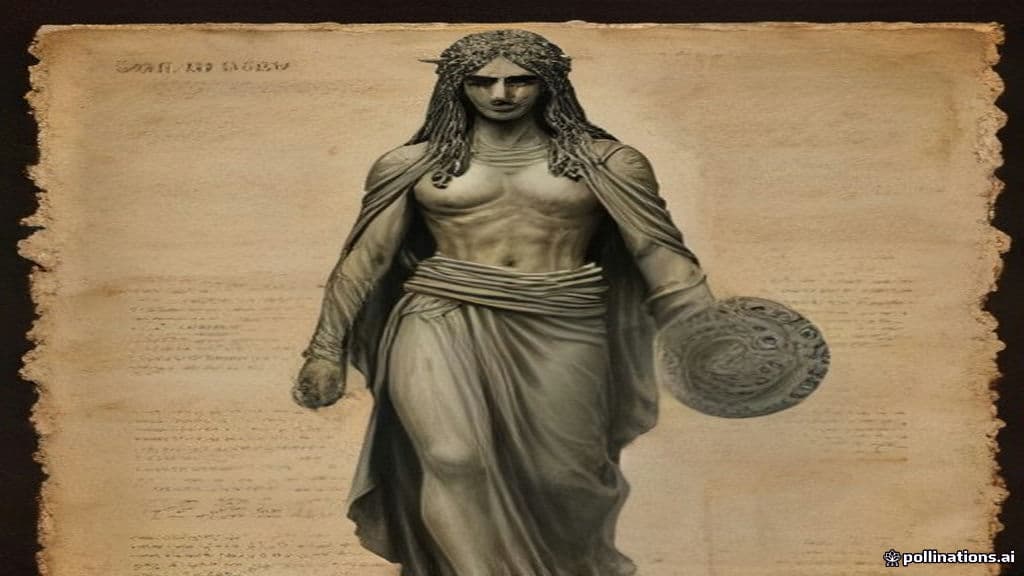
Ancient sources record multiple variant traditions for Eleius. In one account he is given as son of Poseidon and Eurycyda and succeeds to kingship of the Epeans after the exile of Aetolus; he then renames his people the Eleans and the land Elis after himself. A separate genealogical tradition lists Eleius within a royal sequence (Eleius → Augeas → Agasthenes → Polyxenus → Amphimachus → Eleius II), placing a later Eleius as a descendant and king during events associated with the Heracleidae. A further, less-certain variant names an Eleius as a son of Tantalus; this variant is noted in modern summaries but is not expanded in the supplied excerpts. These accounts are preserved in Pausanias' record of Elis (as summarized in the provided Archive excerpt) and in modern aggregations (e.g., Wikipedia) which compile the ancient variants.
The supplied ancient and modern summaries provide no physical description of Eleius. He is represented in the sources exclusively through genealogy and political title (king of Elis/eponymous ancestor), with no testimony about stature, dress, facial features, or other visible markers.
Sources attribute social and political functions to Eleius rather than supernatural powers. His recorded behaviors and roles include succession to kingship, renaming his people and land (ethnogenesis), and serving as a node in dynastic genealogies that legitimize ruling lines (including being attested as father of Augeas in one tradition). The texts do not ascribe magical, prophetic, cultic, or ritual powers to Eleius; no rituals, divine offices, or extraordinary abilities are recorded in the supplied material.
Community Record
- [1]Eleius. Wikipedia, entry 'Eleius' (summary of ancient variants)wiki
- [2]LP0052 The Kingdom of Elis (summary of Pausanias). Archive.org audio/text summarizing Pausanias' Description of Greece (sections on Elis, Pausanias 5.1.1–5.3.4) as translated by W. H. S. Jonesliterary
- [3]Wikidata: Eleius. Wikidata entry for Eleius (identifier and aggregated metadata)other