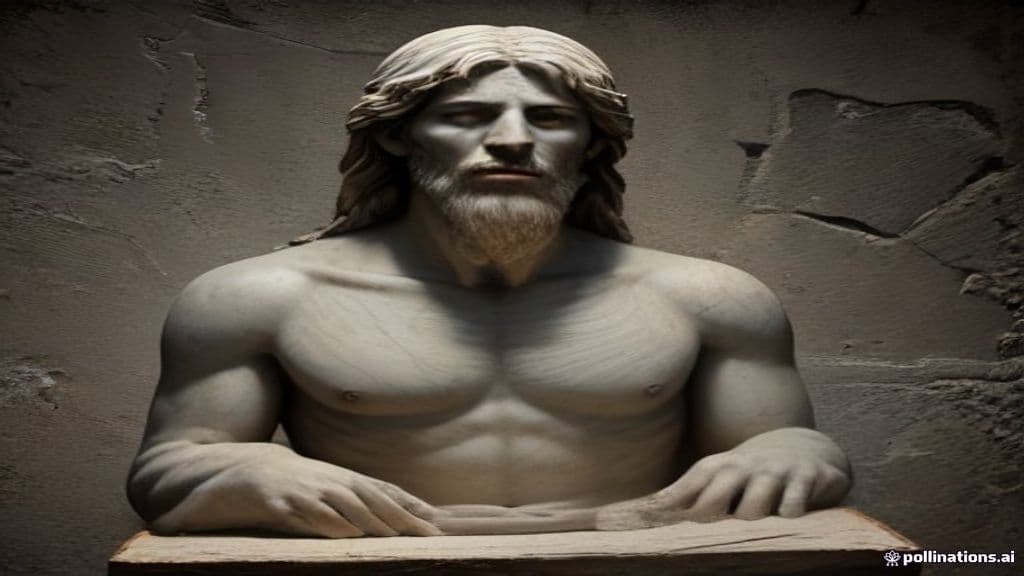
Elpenor is introduced in the Odyssey as one of Odysseus' crew. While on Circe's island he becomes intoxicated, sleeps on the palace roof, and in the morning falls and breaks his neck, dying accidentally. After Odysseus sails on and later conducts a descent to the dead, Elpenor appears among the shades in Hades and entreats Odysseus to return to Aeaea to give his body proper funerary treatment. Odysseus subsequently returns, cremates Elpenor's body, buries his ashes with armor, and marks the grave with an oar.
Homer provides no sustained physical portrait beyond noting Elpenor as the youngest of Odysseus' comrades and emphasizing the condition of his corpse as 'unburied' and cast upon the earth. In the Odyssey he appears as a shade in Hades capable of speech. Later poetic receptions commonly pick out and repeat two visual motifs associated with him in the tradition: the unburied corpse and the grave marked by an oar, but these are literary amplifications rather than new canonical anatomical detail.
In the Homeric account Elpenor's only demonstrated postmortem capacity is to exist as a shade in Hades and to recognize and speak with Odysseus, remembering the circumstances of his death and requesting burial. He exerts moral pressure on the living by pleading for the fulfillment of mortuary obligations; there is no portrayal of ongoing hostile agency, magical powers, or recurring appearances beyond the single katabasis episode.
Weaknesses
- conditionfulfillment of funerary obligation (cremation and burial)
Wards
- ritualcremation and burial with grave-marker (oar)
Community Record
- [1]Elpenor (Wikipedia summary referencing Homer’s Odyssey). Wikipedia: 'While on the island of Circe, he became drunk and decided to spend the night on the roof. In the morning he fell and broke his neck, dying quickly.' and summary of the Hades episode and Odysseus' subsequent cremation and burial.wiki
- [2]The Odyssey, Book XI (English translation / text). Homer, Odyssey, Book XI: narrative of Odysseus' descent to Hades and the encounter with Elpenor as a shade requesting burial.literary
- [3]Elpenor: its multiple poetic dimensions (reception and poetic uses). Discussion of later poetic receptions that emphasize the motifs of the unburied man and the oar-marked grave in modern poetry and translations.literary
- [4]Odyssey lines and poetic variants (excerpted translations emphasizing 'unburied' phrasing). Cited translations and poetic echoes render Elpenor as 'unburied, cast on the wide earth' and 'pitiful spirit', reinforcing the Homeric motif.wiki
- [5]Name-variant tradition: Dictys Cretensis (Alphenor reference noted in summaries). Reference in source materials noting that Dictys Cretensis records an 'Alphenor' in a different account; treated as a possible name-variant but not equated definitively in the supplied sources.other