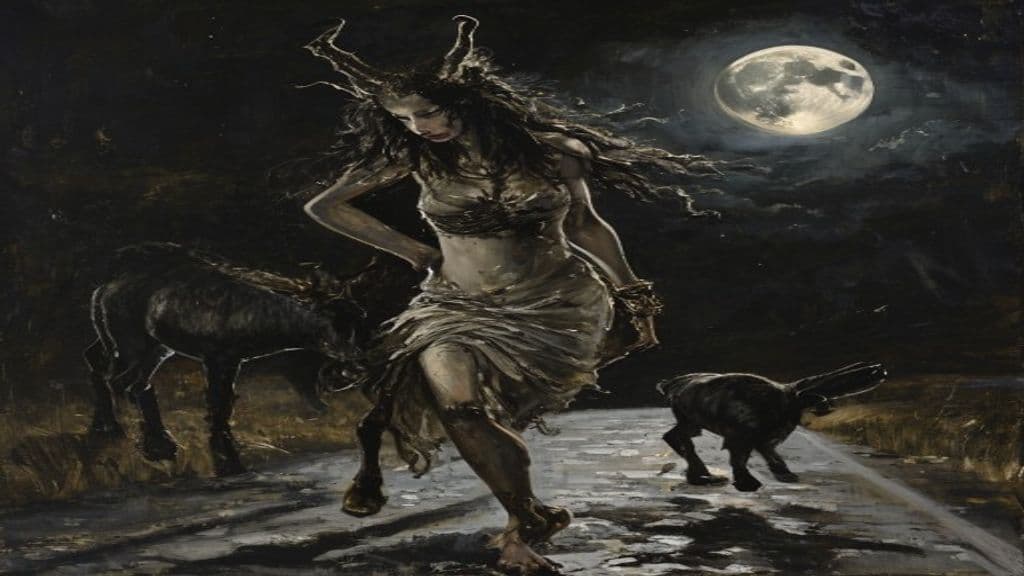
Empusa (plural Empousai) are servants of Hecate, goddess of witchcraft and crossroads. Aristophanes mocks her in The Frogs, where Dionysus is terrified to encounter one. Philostratus preserves the fullest account: Apollonius of Tyana exposed an Empusa posing as his student's bride, who confessed she was fattening him for consumption.
Her natural form is asymmetrical and unsettling — one leg is bronze, the other a donkey's leg (or sometimes a goat's). She has flaming hair and a hideous face. She transforms these features away when presenting as a beautiful woman.
Shape-shifts into a beautiful young woman to seduce and trap victims. Takes the forms of animals — especially dogs — for concealment. Feeds on blood and flesh. Flees only when her true name is spoken or when Hecate's mysteries are correctly invoked.
Weaknesses
- conditionFlees if insulted or if her donkey's leg is revealed
Wards
- ritualInvocation of Hecate with proper offerings at a crossroads
- symbolIron blade drawn against her
*Péh₂usōn (reconstructed)
Péh₂usōn is a hypothetical Proto‑Indo‑European pastoral guardian reconstructed by comparative scholars from parallels in Greek and Vedic traditions. Proposed as a Graeco‑Aryan ancestor‑figure, the reconstruction describes a protector of flocks, roads, and travellers rather than an attested historical cultic personality.
Aetnaeus
An epithet associated with gods and mythical beings connected to Mount Etna. (Note: - Power tier: Primordial (due to association with major gods like Zeus) - Weaknesses: Needs to be filled - Wards: Needs to be filled - Sensory cues: Needs to be filled - The summary should be revised )
Alexander the Great (legend)
A pan-cultural legendary hero-king whose historical career was transformed into a body of miraculous and etiological tales (the Alexander Romance). In these traditions he is alternately a divinely sanctioned conqueror, boundary-builder credited with the Gates of Alexander, and a questing culture-hero associated with oracles, votive dedications, and tests of loyalty.
Attis
Attis is a mythic consort and semi-divine cult figure associated with the Anatolian Mother Goddess (Cybele / Agdistis). He functions as a vegetation-associated beloved whose self-castration, death, and ritual rebirth form the core myth enacted by his priests and festivals, especially around the vernal equinox in Phrygia, Greece and later Rome.
Baton (Greek Mythology)
In Greek mythology, the origin, appearance, and abilities of Baton are unknown due to lack of information. (Note: 1. Add "incomplete" or "insufficient information" to the summary to reflect that there's no actual description of Baton, rather than it being unknown. 2. Power tier should be listed as "Unknown" since)
Callithyia
Callithyia (Ancient Greek: Καλλίθυια), also called Callithoe, Callithea, or Io, is an Argive princess in Greek mytho-historical tradition described as the first priestess of Hera at Argos. She functions as a foundational, legitimating figure for the local Hera-cult rather than as a supernatural being.
Cerberus
The three-headed hound of Hades, guardian of the underworld's gates — welcoming the dead in but allowing no shade to leave and no living mortal to enter uninvited.
Cybele
An Anatolian mother goddess (Phrygian Matar Kubileya) whose cult centers on mountains, city protection, fertility, and wild nature; adopted and reinterpreted by Greek and Roman religion where she became associated with ecstatic rites, a eunuch priesthood (the Galli), and the Roman Magna Mater cult.
Echidna
The 'Mother of Monsters' — half beautiful woman, half enormous serpent — who with Typhon gave birth to nearly every great monster of Greek mythology.
Erinyes
The three avenging Furies of Greek myth — Alecto, Megaera, and Tisiphone — who pursued and tormented those guilty of crimes against blood kin, especially murder of family members.
Gello
A child-strangling demoness of Greek and Byzantine tradition, the spirit of a young woman who died before marriage, now preying on pregnant women and newborns.
Goddess
A goddess is a female deity — a sacred female divine figure found across many polytheistic and religious traditions. The term functions as a classificatory label for diverse culturally specific female divinities and metaphysical female principles, ranging from local patronesses to supreme cosmic realities.
Community Record
- [1]Life of Apollonius of Tyana. Philostratus. c. 3rd century CE. Life of Apollonius of Tyana. Book IV.25.literary
- [2]The Frogs. Aristophanes. 405 BCE. The Frogs. Lines 289–295.literary