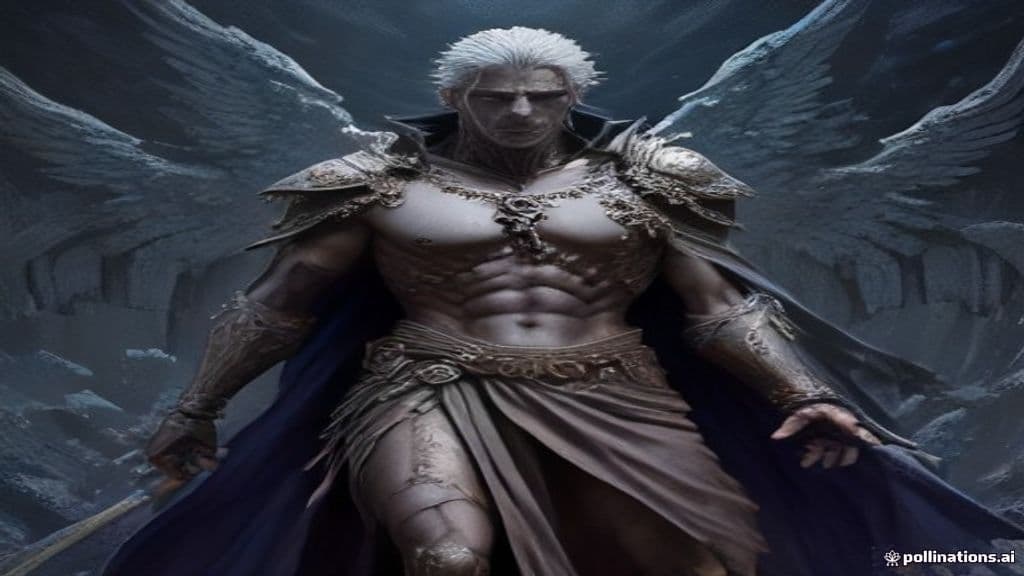
In Vergil's Aeneid (Evander's speech) Erulus is presented as a king of Praeneste whose mother, the goddess Feronia, at his birth 'gave three souls (animae)' and also 'tripled his ability to defend himself by giving him three sets of arms.' The only surviving literary attestation provided in the cited materials is this passage in Vergil; modern scholars note Erulus may be Vergil's invention or a remnant of an otherwise lost archaic tradition connected to Feronia's cult.
Vergil's account supplies a functional descriptor rather than a detailed portrait: Erulus is said to have been given three sets of arms. The cited sources do not provide further physical details such as height, facial features, or specific armor.
The sole extraordinary attributes recorded are that Erulus possessed three lives (animae) and three sets of arms, making him a warrior who 'had to be brought down three times.' He is remembered as a formidable martial opponent whom Evander claims to have slain by ending all three lives. No other supernatural powers or behaviors are attested in the provided materials.
Weaknesses
- conditionmust be killed three times (as reported in Vergil)
Wards
None recorded.
Community Record
- [1]Erulus — Wikipedia. Wikipedia, entry 'Erulus' (summarizing Vergil's Aeneid and modern commentary)wiki
- [2]Erulus — Wikidata. Wikidata item for Erulus (king of Praeneste in Vergil's Aeneid)other
- [3]Feronia (mythology) — Wikipedia. Wikipedia, entry 'Feronia' (notes Feronia as Erulus's mother in Vergil and summarizes scholarly views such as Dumézil's)wiki
- [4]Erulus (astronomical/modern name usages and summaries). Modern reference noting later uses of the name 'Erulus' (non-mythological reuse)other