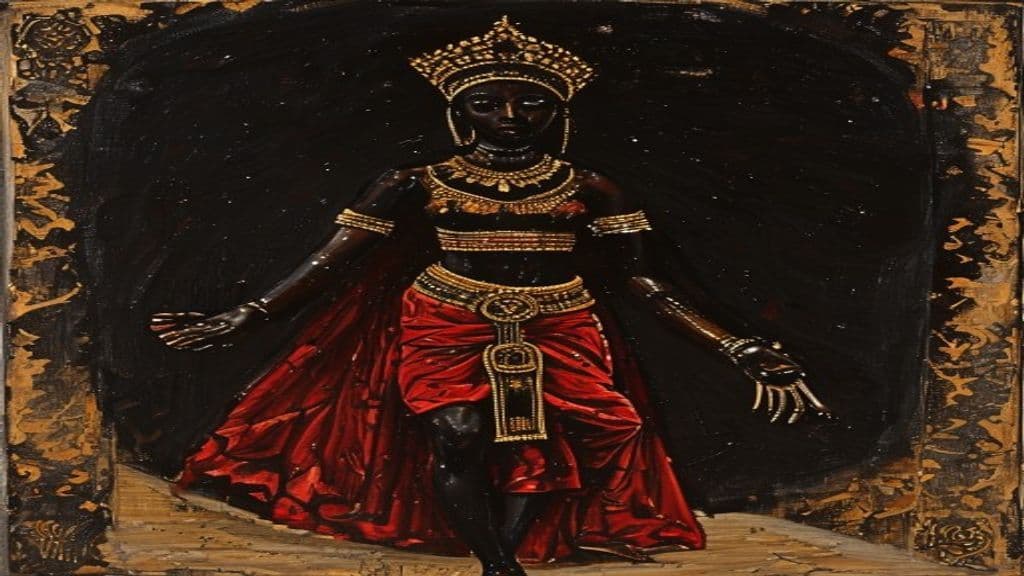
The provided source does not supply a cosmogonic origin or specific myth of birth for Esu. It situates Esu functionally within the Orisha pantheon of Yoruba religion and notes the deity's retention and adaptation in multiple Afro-diasporic religions. No origin myth or genealogical account is given in the excerpt.
The source excerpt contains no physical description or iconography for Esu. While regional orthographies and local spellings (Elegua, Elegguá, Exu) are cited, the provided material does not describe how Esu is depicted or any iconographic variants.
Within the limits of the excerpt, Esu is documented primarily as an Orisha associated with roads — a deity whose domain is paths and crossroads. The source does not enumerate additional powers, personality traits, or behaviors beyond this functional association.
Aganjú
Primordial Orisha associated with the sun, fire, and the untamed wilderness in Yoruba tradition. (Note: - Remove "untamed wilderness" from Power tier description as it's a trait associated with Lesser entities, not Primordial. - Add Appearance section based on source material (e.g., no specific descript)
Cowrie-Shell Divination
A set of practices using cowrie shells for divination and guidance in West African and Afro-American traditions. (Note: - Power tier: Minor Spirit is unlikely, given the widespread use of cowrie shells across various cultures for significant spiritual practices; consider Greater or Ancient. - Appearance: Add that cowri)
Elegua
Elegua (Ẹlẹ́gbára / Eleguá / Exu / Legba variants) is an Orisha and liminal mediator in Yoruba and Yoruba-derived religions. He is guardian of roads, doorways, and crossroads, the messenger who must be acknowledged before other rituals, and a trickster-enforcer who manages balance between opposites.
Orisha
Orisha (Òrìṣà) are named divine or supernatural figures in Yoruba religious thought and its Afro‑diasporic continuations (for example, Candomblé and Cuban Yoruba associations). They function as central agents of worship, ritual engagement, and divinatory communication in Yoruba communal and individual religious life.
Oriṣa (Orisha / Orixá)
Oriṣa (Yoruba: òrìṣà; Portuguese: orixá; Spanish variants: orisha, oricha, orichá) are the class of divine spirits or deities central to the Yoruba religion of West Africa and to Yoruba-derived religious systems in the Atlantic diaspora (notably Lucumí/Santería in Cuba and Candomblé in Brazil). They function as active sacred presences and intermediaries in communal and individual religious life; in diaspora settings they were often syncretized with Catholic saints as a strategy of continuity under colonial Christian rule.
Oshun
Oshun (Ọṣun, Ochún, Oxúm) is a major orisha and Irunmole in the Yoruba religious corpus and its diasporic traditions, associated with freshwater (rivers), love, fertility, femininity, divination, prosperity and beauty. She is honored at the Osun-Osogbo Sacred Grove and in festivals and ritual forms across Yorubaland and Afro‑Atlantic religions such as Candomblé and Regla de Ocha/Santería.
Pomba Gira
Pomba Gira is an Afro-Brazilian female spirit invoked in Umbanda and Quimbanda who personifies feminine sexuality, desire, and liminality; she functions as a consort to Exu, is petitioned for matters of the heart, and is treated with respect because of her reputed wrath and power in ritual possession.
Ṣàngó (Shango / Chango / Xangô)
Ṣàngó is a major orisha in the Yorùbá pantheon identified as a deified royal ancestor (the third Alaafin of Oyo) and as the spirit who governs thunder, lightning, fire, virility, drumming, dance, strength and justice. He is venerated across Yorubaland and in African-derived New World religions (e.g., Candomblé, Santería, Vodou) where his attributes, symbols and rituals have been adapted and occasionally syncretized with Catholic saints.
Esther
Esther is the eponymous human heroine of the Book of Esther in the Hebrew Bible (Megillat Ester). Presented as a Jewish woman who becomes queen in the Persian royal court, her strategic concealment of identity, intercession with King Ahasuerus, and the communal fast she requests are narrated as securing the survival of the Jewish people in that story and underpin the festival of Purim.
Estries
Supernatural being in Jewish folklore that preys on infants, associated with blood consumption. (Note: - Power tier should be revised to Ancient (deity-level) as Estries' focus on a specific community and their vampiric nature suggests a significant level of power. - The article should include the prov)
Etana
Etana is a legendary early king of Kish in Mesopotamian tradition who, according to epic texts and the Sumerian King List, aided an eagle and was conveyed to the heaven of the god Anu to seek a 'plant of birth' enabling him to sire an heir. He functions as a culture-hero whose narrative situates kingship, divine favor, and animal intermediaries within Mesopotamian cosmology.
Eteocles
Eteocles is a mytho-historical Theban king of the Greek tradition, son of Oedipus, who becomes central to the dynastic feud with his brother Polynices that culminates in the war of the Seven against Thebes and the mutual killing of the two brothers.
Community Record
- [1]Esu (Eshu, Elegbara) — Wikipedia. Wikipedia contributors. "Elegua". Wikipedia, The Free Encyclopedia.wiki