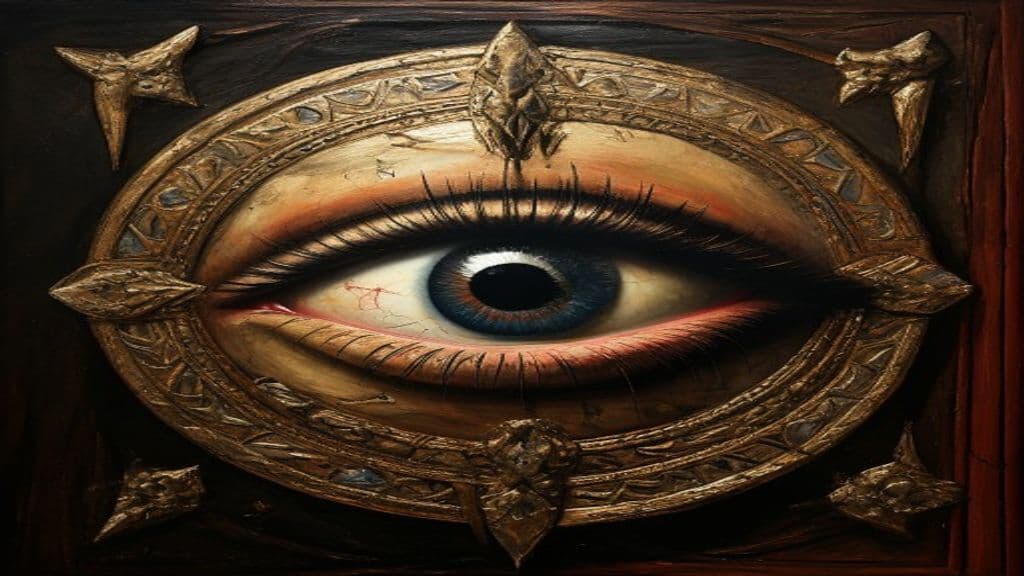
The evil-eye concept is ancient and widely attested rather than the product of a single origin myth. Archaeological evidence for apotropaic eye imagery dates back millennia (amulets associated with protection ca. 5,000 years ago), and textual attestations appear in sources from ancient Ugarit through Classical Greek and Roman authors. Classical writers such as Plutarch and Pliny the Elder discuss the phenomenon as a real and dangerous effect of looking, while later religious and folk practices developed a variety of protective responses.
The evil eye itself lacks a fixed anthropomorphic form in the sources; it is described as a glare, gaze, or visual emission. Classical authors used metaphors such as "deadly rays" or "poisoned darts" to describe the effect of a malignant look (as recorded for Plutarch and Pliny), but archaeological and folkloric material instead depicts apotropaic symbols—stylized eyes (nazar), hands (hamsa), phallic charms (fascinum, cornicello), and other motifs—as protective imagery rather than a literal portrait of the phenomenon.
Across cultures the evil eye is described as able to cause misfortune, injury, decline, or even death through sight; it is reported to affect humans and animals (for example, cattle in ancient Mediterranean sources). Classical writers described some people as able to "fascinate" or harm those upon whom they fixed their gaze (Pliny the Elder) and spoke of the eyes as sources of harmful emanations (Plutarch). In many traditions the effect is associated with envy or excessive attention and may be involuntary or intentional depending on context.
Weaknesses
- conditionavoidance of gaze or immediate use of apotropaic object
Wards
- symbolnazar (eye-shaped amulet)
- symbolhamsa (hand-shaped amulet)
- symbolfascinum / phallic charms (Roman fascinum, cornicello, cimaruta)
- mantraMasha'Allah (ما شاء الله) — formula spoken when giving compliments (Arab cultural practice)
- substancerue (plant used as protective charm in some regions such as Palestine and Iran)
- ritualspitting into clothing folds (ancient Greek and Roman apotropaic gesture)
Agrat bat Mahlat
Agrat bat Mahlat is a female night‑spirit attested in rabbinic, midrashic, and Kabbalistic literature, portrayed as “daughter of Mahlat” and counted among principal female powers associated with Samael. She leads or is accompanied by a retinue of destructive nocturnal spirits and appears in teachings warning against going out alone at certain nights.
Djinn
The class of supernatural beings created from smokeless fire in Islamic cosmology — a parallel civilization to humanity, capable of belief or unbelief, with their own prophets, society, and judgment before God.
Ghoul
A ghoul is a demon-like or monstrous humanoid originating in pre-Islamic Arabian religion, traditionally associated with graveyards and the consumption of human flesh. The concept later entered broader folklore and has been widely reused and transformed in modern fiction and popular culture.
Ifrit
One of the most powerful classes of jinn in Islamic and pre-Islamic Arab tradition — a fire-born being of immense strength and cunning, capable of great works of engineering and terrible violence.
Jann
The weakest class of djinn in Islamic tradition, associated with desert winds and taking the form of snakes or whirlwinds, dwelling in empty wilderness and posing little threat to those who know the proper invocations.
Marid
The most powerful class of jinn in Islamic tradition — beings of the sea, associated with the deep ocean, storms, and the granting of wishes at terrible cost. The classic genie of the Arabian Nights.
Nasnas
A half-human djinn creature of Arab folklore — possessing only half a face, one arm, one leg, and half a torso — descended from the union of a shaitan and a human, moving by leaping and highly dangerous to encounter.
Shaitan
A class of corrupted djinn who follow Iblis and dedicate themselves to leading humans astray — distinct from Iblis himself, the Shayatin are a species of evil djinn who whisper doubts and temptations into the minds of the living.
Sila (Si'la, Si'lat)
A jinn-like, chiefly female shapeshifting spirit from Arabian folklore, the Sila (Si'la/Si'lat) is associated with desolate desert places where it misleads travellers, seduces men, and may intermarry with humans. Early sources equated it with the ghoul; later traditions treat it as the female counterpart of ghoul-type beings.
Evil Star
Evil Star is a fictional supervillain identity from DC Comics. The name has been used for two distinct characters: Guy Pompton, a costumed crime lord from Earth, and an alien scientist from the planet Aoran who gains cosmic power through a device called the Starband/Starbrand.
Evil clown
A modern pop‑culture archetype and horror trope that inverts the traditional comic clown into a disturbing, threatening, or malevolent figure. It functions across literature, film, comics, media scares, and occasional real‑world associations rather than as a traditional supernatural being.
Evippus (Εὔιππος)
Evippus (Ancient Greek Εὔιππος, 'having good horses') is a recurring personal name in Greek myth borne by several mortal figures — princes, warriors, and local heroes — attested in varied narrative episodes (Calydonian cycle, the Trojan War, local Megarian and Arcadian tales). The name signals aristocratic/horsemanship status rather than a distinct supernatural class.
Community Record
- [1]Evil eye. Wikipedia: Evil eyewiki
- [2]Evil eye (Wikidata). Wikidata entry for evil eyeother