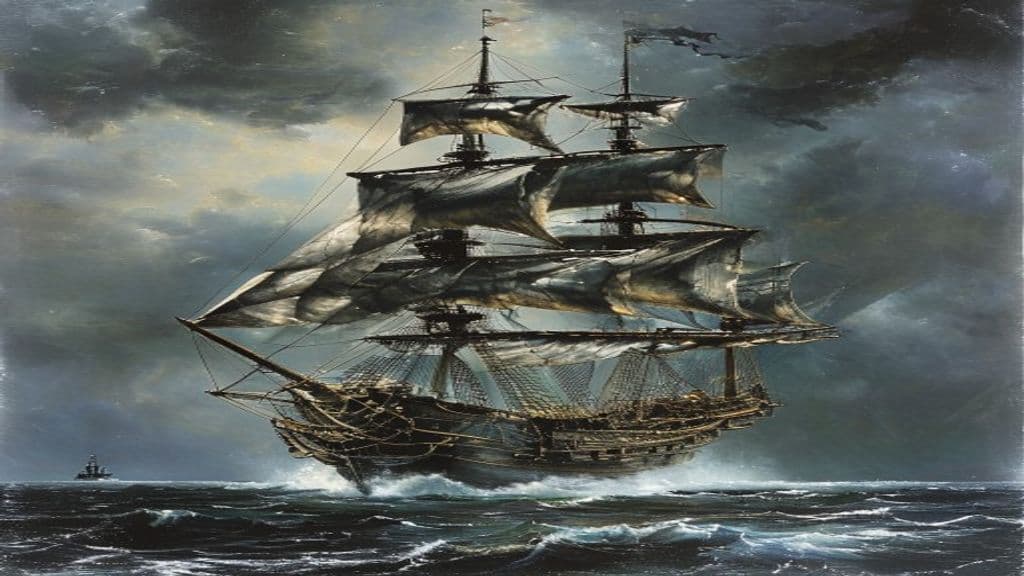
Late-18th- and early-19th-century literary and popular print sources tie the legend to a Dutch vessel from the age of sail (often conceptually linked to 17th-century Dutch maritime power). Early printed references shaping the tale appear in John MacDonald (cited 1790), Daines Barrington (1795), and John Leyden (1803), with an influential expansion in an 1821 Blackwood's Magazine account that names a damned captain and an oath (commonly cited as Van der Decken). Variants attribute the ship's condition to a dreadful crime, piracy, pestilence, or an oath that condemns the vessel and crew to perpetual voyaging as penance; these origin motifs circulate in literary and print traditions rather than being fixed ethnographic traditions.
Described as a full-rigged, 17th-century–type vessel (frequently identified in summaries as resembling a fluyt), witnesses report a ship with sails set though wind is calm, sometimes glowing with a ghostly light and elsewhere portrayed as dark or gloomy. Accounts emphasize impossibility—sails full without breeze, a vessel visible in storms or at night, and occasional luminous or uncanny atmospheric effects surrounding the hull or rigging.
The Flying Dutchman is not depicted as a mundane wreck but as a recurring supernatural phenomenon: condemned to traverse the sea forever and unable to make port. It appears to living mariners as an apparition and functions as a portent of doom. Narrative motifs include the ghost ship attempting to communicate—offering letters or messages addressed to the dead for delivery to living vessels—which, in the tradition, may bring misfortune if accepted. Some accounts place the ship in stormy conditions and describe it looming near or seeming to bear down on passing ships, though sources present this behavior as part of the omen/appearance rather than a documented ability to actively assault other vessels.
Weaknesses
None recorded.
Wards
- conditionRefuse offered messages or letters
Ghost Ship (Phantom Ship)
A ghost ship (or phantom ship) denotes either a physical vessel found adrift with no living crew or a spectral vessel apparition reported in maritime folklore. The motif functions across maritime cultures as omen, memory of catastrophe, and a narrative way to confront unexplained loss at sea.
Flauros
Flauros (also attested as Haures / Hauras in variant spellings) is a named high-ranking spirit in Western grimoires, notably the Ars Goetia (Lesser Key of Solomon). Described as a 'Great Duke' who initially appears as a leopard and later assumes a human form with flaming eyes, he is invoked for truthful revelation about past, present, and future and for destructive aid against enemies, but must be constrained by ritual to prevent deception.
Flidais
Flidais (also Flidas; modern Fliodhas/Fliodhais) is a named female figure in medieval Irish narrative tradition associated with a prodigious herd and exceptional milking; she appears in Ulster-Cycle and related cattle-raid tales as a woman of high status whose favored cow and herd can provision large numbers of people.
Flogdrake
A Scandinavian firedrake or "fly‑dragon" associated with evening streaks of light in the sky and with tunnelling mountain lairs that hide ore and treasure. Primarily attested in Swedish folklore, it participates in a pan‑European motif of fiery serpents and is sometimes linked with household or earth spirits in nearby traditions.
Flora
Flora is the Roman divine personification associated with flowers, spring, and vegetative fertility. She functioned as a named cultic figure within Roman religion, attested in sources that link her to a priestly office and to temple dedication(s), and her name later supplied the Latin root for the modern term 'flora' denoting plant-life.
Floronic Man (Jason Woodrue)
A singular DC Comics character, Jason Woodrue is a botanist who becomes a plant–human hybrid called the Floronic Man. Across continuities he functions variously as a villain, occasional antihero, and a contested agent of the Green/Parliament of Trees, employing botanical science and plant-based powers in conflicts with heroes such as the Atom, Batman, and Swamp Thing.
Flying Crustacean
A cryptozoological report of a transparent, shrimp- or crayfish-shaped crustacean observed to leave the water and travel briefly through the air off Palawan, Philippines, in early 20th-century field notes by Dean C. Worcester. The phenomenon is also cataloged as a narrative motif in motif-indexing resources.
Flying Spaghetti Monster
The Flying Spaghetti Monster (FSM) is the satirical creator-deity of the Church of the Flying Spaghetti Monster (Pastafarianism), originated by Bobby Henderson in 2005 to parody and critique the introduction of intelligent design into public-school science. It functions as both a mock-religious deity in movement literature and a cultural/internet symbol used in public and media debates over religion and science education.
Focalor
Focalor is a named spirit from the Ars Goetia corpus, described in modern goetic compilations as a ducal-ranked spirit with authority over winds and seas who can drown men and sink ships; like other Goetic spirits he is represented as commandable by a conjurer.
Fodbgen
Fodbgen (also Odbgen; modern Irish Foidhbhgen) is a legendary High King of Ireland from the Fir Bolg branch of the Dela. Medieval regnal lists record that he overthrew his cousin Rinnal, ruled for four years, and fell at Magh Muirthemne to Eochaid mac Erc; brief notices associate his reign with an etiological note about knots in trees and an unusual climatic formula.
Folklore, legends and myths in Dombey and Son
Literary influences from Greek folklore and mythology on the novel 'Dombey and Son' by Charles Dickens. (Note: 1. Summary: "Literary influences" is too vague; rephrase to specifically mention "Greek folklore and mythology". 2. Power tier: This entity doesn't exist in the source material; there's no indication )
Fomorians
A distinct supernatural race in early Irish myth who function as recurring antagonists to successive settler and divine groups in Ireland. They are frequently associated with hostile, chaotic forces of nature (sea, darkness, blight) and appear in origin‑war narratives as opponents of the Tuatha Dé Danann and earlier settler groups.
Community Record
- [1]Flying Dutchman. Wikipedia entry 'Flying Dutchman' (summarized motifs, appearances, and history)wiki
- [2]Wikidata: Flying Dutchman. Wikidata item for Flying Dutchman (identifier and linked data)other
- [3]Blackwood's Magazine (1821) account (as summarized). Summarized 1821 Blackwood's account naming a damned captain and an oath (as cited in the Wikipedia summary)literary
- [4]John Leyden, Scenes of Infancy (c.1803) (as summarized). Summary of Leyden's version linking the ship to penance for a dreadful crime and pestilence (cited in Wikipedia)literary
- [5]Daines Barrington / MacDonald early references (summaries). Summaries of early printed references (MacDonald c.1790; Barrington 1795) reporting sightings near the Cape and storm-time appearances (as cited in Wikipedia)literary
- [6]Thomas Moore, 'Written on passing Dead-man's Island ...' (poem lines). Quoted lines describing a 'gloomy bark' with sails full though the wind is still (as cited in Wikipedia)literary