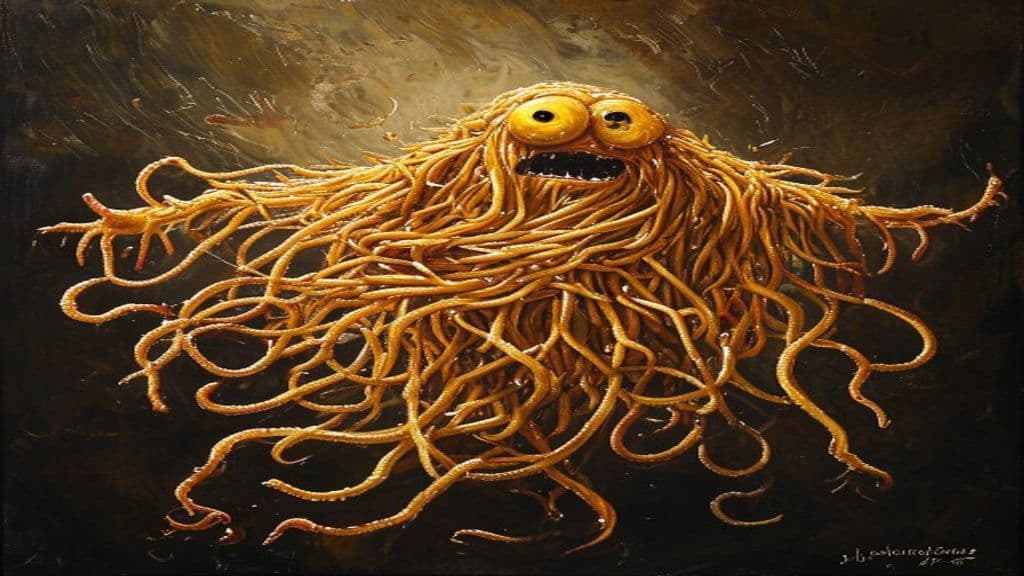
According to the movement's origin account created by Bobby Henderson in an open letter (January–May 2005), an invisible and undetectable Flying Spaghetti Monster created the universe after drinking heavily. Henderson formulated the FSM as a rhetorical mirror to intelligent-design claims; the letter and subsequent texts (The Gospel of the Flying Spaghetti Monster, The Loose Canon) anchor the FSM as the movement's creator figure and founding narrative.
Movement materials and community imagery depict the FSM as a being resembling spaghetti and meatballs that flies; simultaneously, Henderson's origin claim describes the FSM as "invisible and undetectable," a rhetorical posture that blends a noodle-and-meatball visual trope used in fan imagery with asserted invisibility in the creation myth.
Within Pastafarian origin accounts the FSM is credited as the creator of the universe and is rhetorically said to intervene in measurements (for example, "changing the results with His Noodly Appendage" when scientists carbon-date an object). Beyond cosmogenesis, the FSM functions behaviorally as a rhetorical and communal figure: it is invoked in satire, media appearances, online "sightings," crafts, and public advocacy opposing the teaching of intelligent design as science.
Flidais
Flidais (also Flidas; modern Fliodhas/Fliodhais) is a named female figure in medieval Irish narrative tradition associated with a prodigious herd and exceptional milking; she appears in Ulster-Cycle and related cattle-raid tales as a woman of high status whose favored cow and herd can provision large numbers of people.
Flogdrake
A Scandinavian firedrake or "fly‑dragon" associated with evening streaks of light in the sky and with tunnelling mountain lairs that hide ore and treasure. Primarily attested in Swedish folklore, it participates in a pan‑European motif of fiery serpents and is sometimes linked with household or earth spirits in nearby traditions.
Flora
Flora is the Roman divine personification associated with flowers, spring, and vegetative fertility. She functioned as a named cultic figure within Roman religion, attested in sources that link her to a priestly office and to temple dedication(s), and her name later supplied the Latin root for the modern term 'flora' denoting plant-life.
Floronic Man (Jason Woodrue)
A singular DC Comics character, Jason Woodrue is a botanist who becomes a plant–human hybrid called the Floronic Man. Across continuities he functions variously as a villain, occasional antihero, and a contested agent of the Green/Parliament of Trees, employing botanical science and plant-based powers in conflicts with heroes such as the Atom, Batman, and Swamp Thing.
Flying Crustacean
A cryptozoological report of a transparent, shrimp- or crayfish-shaped crustacean observed to leave the water and travel briefly through the air off Palawan, Philippines, in early 20th-century field notes by Dean C. Worcester. The phenomenon is also cataloged as a narrative motif in motif-indexing resources.
Flying Dutchman
A legendary phantom vessel in maritime folklore, said to be unable to make port and condemned to sail the oceans forever. Appearing to sailors as a full-rigged ship—sometimes ghostly-luminous, sometimes dark—its sighting functions as an omen of doom and is tied in many versions to a past crime or penance.
Focalor
Focalor is a named spirit from the Ars Goetia corpus, described in modern goetic compilations as a ducal-ranked spirit with authority over winds and seas who can drown men and sink ships; like other Goetic spirits he is represented as commandable by a conjurer.
Fodbgen
Fodbgen (also Odbgen; modern Irish Foidhbhgen) is a legendary High King of Ireland from the Fir Bolg branch of the Dela. Medieval regnal lists record that he overthrew his cousin Rinnal, ruled for four years, and fell at Magh Muirthemne to Eochaid mac Erc; brief notices associate his reign with an etiological note about knots in trees and an unusual climatic formula.
Folklore, legends and myths in Dombey and Son
Literary influences from Greek folklore and mythology on the novel 'Dombey and Son' by Charles Dickens. (Note: 1. Summary: "Literary influences" is too vague; rephrase to specifically mention "Greek folklore and mythology". 2. Power tier: This entity doesn't exist in the source material; there's no indication )
Fomorians
A distinct supernatural race in early Irish myth who function as recurring antagonists to successive settler and divine groups in Ireland. They are frequently associated with hostile, chaotic forces of nature (sea, darkness, blight) and appear in origin‑war narratives as opponents of the Tuatha Dé Danann and earlier settler groups.
Fontus (Fons)
Fontus (Latin Fons, pl. Fontes) is a deity in ancient Roman religion associated with wells, springs, and fountains. He is honored in the calendar festival Fontinalia (October 13), appears in ritual inscriptions (including Mithraic dedications as Fons Perennis), and is named in Roman religious records such as an Arval Brothers expiatory sacrifice.
Foras
Foras (also Forrasis, Forcas) is a named non‑human intelligible being listed in early modern Latin grimoires. Described as a 'Mighty President' who rules twenty‑nine legions, he is presented as a teacher of logic and ethics, a revealer of the virtues of herbs and precious stones, a disposer of treasure‑finding and recovery of lost things, and a grantor of talents such as eloquence, wit, invisibility, and longevity.
Community Record
- [1]Flying Spaghetti Monster - Wikipedia. Wikipedia, entry "Flying Spaghetti Monster"wiki
- [2]Flying Spaghetti Monster - Wikidata. Wikidata entry Q12044other
- [3]G4TV Archive: After a report on "intelligent design" Kevin interviews the Pastafarian deity Flying Spaghetti Monster. Archived media item describing a media sketch involving the FSMother