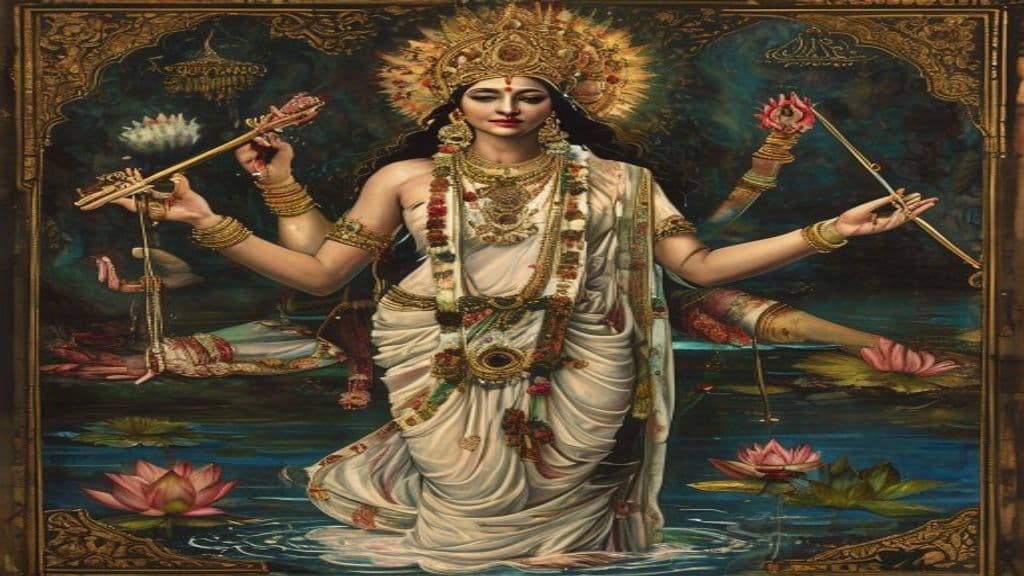
Multiple, sometimes competing origin accounts exist in the tradition. In the Rigvedic and later Vedic milieu Ganga appears as a named sacred river (personified in hymnic contexts). In epic genealogy (e.g., Ramayana tradition) she is presented as a daughter of Himavat and sister of Parvati. In the Bhagavata Purana she is cosmologically derived: Vishnu pierces the covering of the causal ocean so that the pure water enters the universe as the Ganges; in later Purāṇic narratives her descent to earth is facilitated by King Bhagiratha and mediated by Shiva, who retains her waters in his matted hair before releasing them to flow on earth. The sources therefore report a plurality of origin motifs rather than a single canonical narrative. (Sources: Rigvedic references; Ramayana genealogy; Bhagavata Purana; Purāṇic accounts.)
Iconographic traditions portray Ganga primarily as a fair-complexioned woman often wearing a white crown. Variants show her holding a water-lily and flute, or in four-armed forms carrying a water-pot (kalasha), lotus, rosary and displaying abhaya (protection) and varada (boon-giving) gestures. She is frequently associated with a makara (a composite aquatic mount with crocodile/dolphin-like features) — depicted as her vehicle or seat; some iconographic variants show her enthroned with crocodilian motifs or the kalasha releasing holy water. The literary tradition also imagines her as divine waters descending from higher realms (Brahmaloka) into the world. (Sources: Ganga goddess entry; iconographic descriptions; Bhagavata Purana imagery.)
Traditionally attributed capacities are principally purificatory and salvific: her waters are believed by pilgrims and ritual practitioners to cleanse sins, forgive, and bring the ashes of the dead 'closer to moksha' (liberation). Mythic narratives ascribe to her the ability to move between divine realms and earth — e.g., entering the universe as the Ganges from the causal ocean (Bhagavata Purana) and descending to earth at Bhagiratha's petition with Shiva's mediation. Descriptive epithets in the tradition also frame her as life-giving and nourishing (metaphorically compared to a milk-giving cow and bountiful body full of fish). The supplied sources report these religious beliefs and mythic acts; they do not provide technical descriptions of metaphysical mechanics beyond the literary accounts. (Sources: Ganga goddess entry; Bhagavata Purana; Puranic descriptions.)
Weaknesses
- otherNo traditional weaknesses recorded; sources do not present Ganga as a harmful being requiring specific vulnerabilities or means to subdue her. (Source: surveyed summaries — absence noted.)
Wards
- otherNo wards against Ganga are recorded in the provided materials; tradition emphasizes access to her waters for benefit rather than protections against her. (Source: surveyed summaries — absence noted.)
Community Record
- [1]Ganga (goddess) — Wikipedia. Wikipedia contributors. "Ganga (goddess)." Wikipedia, The Free Encyclopedia.wiki
- [2]Statue of Shiva in the lotus position at Murudeshwar (archive item referencing iconography). Archive.org item used as supporting iconographic reference for Shiva entwined with the Ganga motif.other
- [3]Mahabharata (archive item). Archive.org recording (Mahabharata) referenced for epic context; used as supporting material for epic embedding of river-deities.other
- [4]Sri Varaha Nrsimha At Simhachalam (archive). Archive.org item cited for Purāṇic and temple-context imagery; used as supporting iconographic/contextual material.other