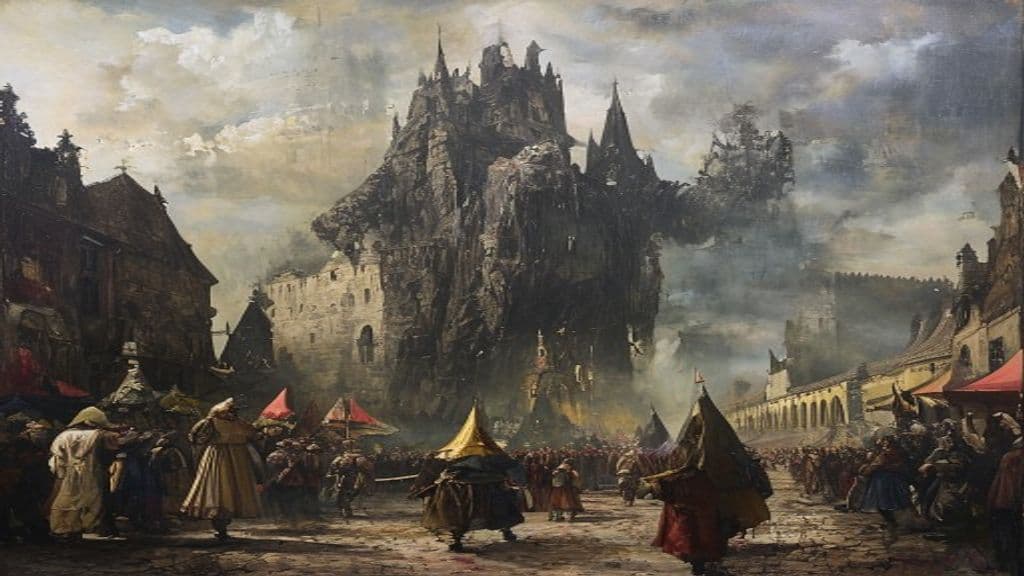
The gegants belong to Catalonia’s long-standing tradition of public festival pageantry in which large animated figures represent community identity and local history. The provided sources situate such figures within the region’s festival calendar—examples include Saint George’s Day (a major Catalan celebration) and local patronal events and fairs such as the Santa Úrsula Fair in nearby towns—indicating that the Montblanc gegants originate as civic parade figures used in communal celebrations rather than as mythological or supernatural beings.
The sources identify the Montblanc figures by the Catalan term 'gegants' (literally 'giants') and as large festival figures used in parades. No detailed physical description of the Montblanc gegants (materials, costume details, exact height, or individual attributes) is supplied in the available material; what is documented is their status as large parade effigies typical of Catalan civic festivities.
Sources do not attribute supernatural powers to the gegants. Their behaviors are performative and civic: they are carried and animated by people during public festivities and processions as part of communal celebration. They are components of festival ritual and spectacle rather than independent agents with volition or paranormal abilities.
La Guita Xica
La Guita Xica is a Catalan mule–dragon figure tied to the Patum de Berga Corpus Christi festivities. Historically described as threatening or demonic, twentieth-century traditions reframe it as a protective festival spirit embodied by large effigies that parade and theatrically spit fireworks.
Gegants del Casc Antic
Gegants del Casc Antic are the neighborhood 'gegants' (festival giants) paraded during the festa major of Barcelona's Casc Antic (Ciutat Vella). They are civic, performative figures used in street celebrations that embody local identity for the barrios of Sant Pere, Santa Caterina and La Ribera (El Born).
Gegants del Pi
The corpus supplied does not document a supernatural being named 'Gegants del Pi.' The materials instead refer to two cultural referents: the Pi de les tres branques, a named dead pine tree near Berga with political-cultural significance, and the Catalan festival tradition of gegants (large processional figures). No source in the set ties these into a single mythic entity.
Gegants del Raval
Processional giants associated with El Raval neighbourhood in Barcelona; civic festival effigies paraded during the Festa Major del Raval and other Barcelona street festivals. Sources treat them as part of popular festa-major culture rather than as supernatural beings.
Gegants del tricentenari
The Gegants del tricentenari are processional giants used in public celebrations in Barcelona. They are large anthropomorphic parade figures associated with a tricentenary commemoration and function as civic ceremonial effigies rather than autonomous supernatural beings.
Gegants from Balsareny
Processional giants belonging to the Catalan tradition of gegants, presented and carried in civic and religious festivals in the town of Balsareny. They function as communal, performative icons within local procession ensembles rather than as supernatural beings.
Gegants from Cardona
No reliable information about 'Gegants from Cardona' was present in the supplied source. The single provided reference (a Wikipedia article about Sant Just Desvern) does not mention these figures; therefore no factual claims about their nature, appearance, or practices can be supported from the given material.
Gegants from Ripoll
Gegants from Ripoll refers to the local manifestation of the Catalan gegants (giants) tradition associated with the town/area of Ripoll in Catalonia. The provided sources are travel and regional descriptions that mention the regional context but do not supply detailed folkloric texts about the Ripoll gegants themselves.
Gegants from Tarragona
No information on the gegants of Tarragona is present in the provided source. The supplied material concerns the city of Terrassa and does not describe gegants, their appearance, history, rituals, or cultural role in Tarragona.
Gegants i Nans de l'Arboç
Gegants i Nans de l'Arboç are processional giants and dwarfs — large, human-form effigies used in public parades and festivals in the town of l'Arboç. They are civic, ceremonial objects created and carried by people for communal celebration rather than autonomous supernatural beings.
Gegants vells de Cervera
The Gegants vells de Cervera are processional giants — large anthropomorphic parade figures from the town of Cervera in Catalonia, Spain. They belong to the Catalan tradition of gegants used in civic and ceremonial processions and are presented in sources as cultural artifacts rather than animate supernatural beings.
Geira
In Slavic tradition, Geira was a Wendish princess attested by Old Norse sagas who ruled over territory near the border of Germania and married a young Óláfr Tryggvasonr. (Note: * Power tier: Not provided in source material, but can be inferred as Primordial given the lack of detailed information and Geira's significance in Old Norse sagas. * Summary: Inaccurate; correct summ)
Community Record
- [1]Saint George's Day in Catalonia (mentions Catalan festivals). "Saint George's Day, also known as the Day of Books and Roses, is celebrated annually in Catalonia (Spain) on 23 April... it is one of Catalonia’s national holidays due to its overwhelming popularity and cultural significance."wiki
- [2]Wikidata: Q11923919 (giants from Montblanc). Wikidata entry label — "giants from Montblanc."wiki
- [3]Catalunya Travel Guide | What to do in Catalunya | Rough Guides. "Barcelona may make the biggest splash with visitors, but it’s the rest of Catalunya that defines the region’s distinct – and proud – identity."other
- [4]Valls is the destination: experience the Santa Úrsula Fair with BusPlana. "Valls... is once again preparing for its Santa Úrsula Fair, which is much more than just a fair; it is one of the essential events on the Catalan cultural calendar, held in October."other
- [5]15 Best Things to Do in Tarragona (Spain) - The Crazy Tourist. Regional festival coverage situates local civic celebrations and attractions within Tarragona and neighbouring Catalan towns.other